
Pulp Fiction, 1926 · page 17 of 212
Adventure Magazine Cover — page 17: what you’re looking at
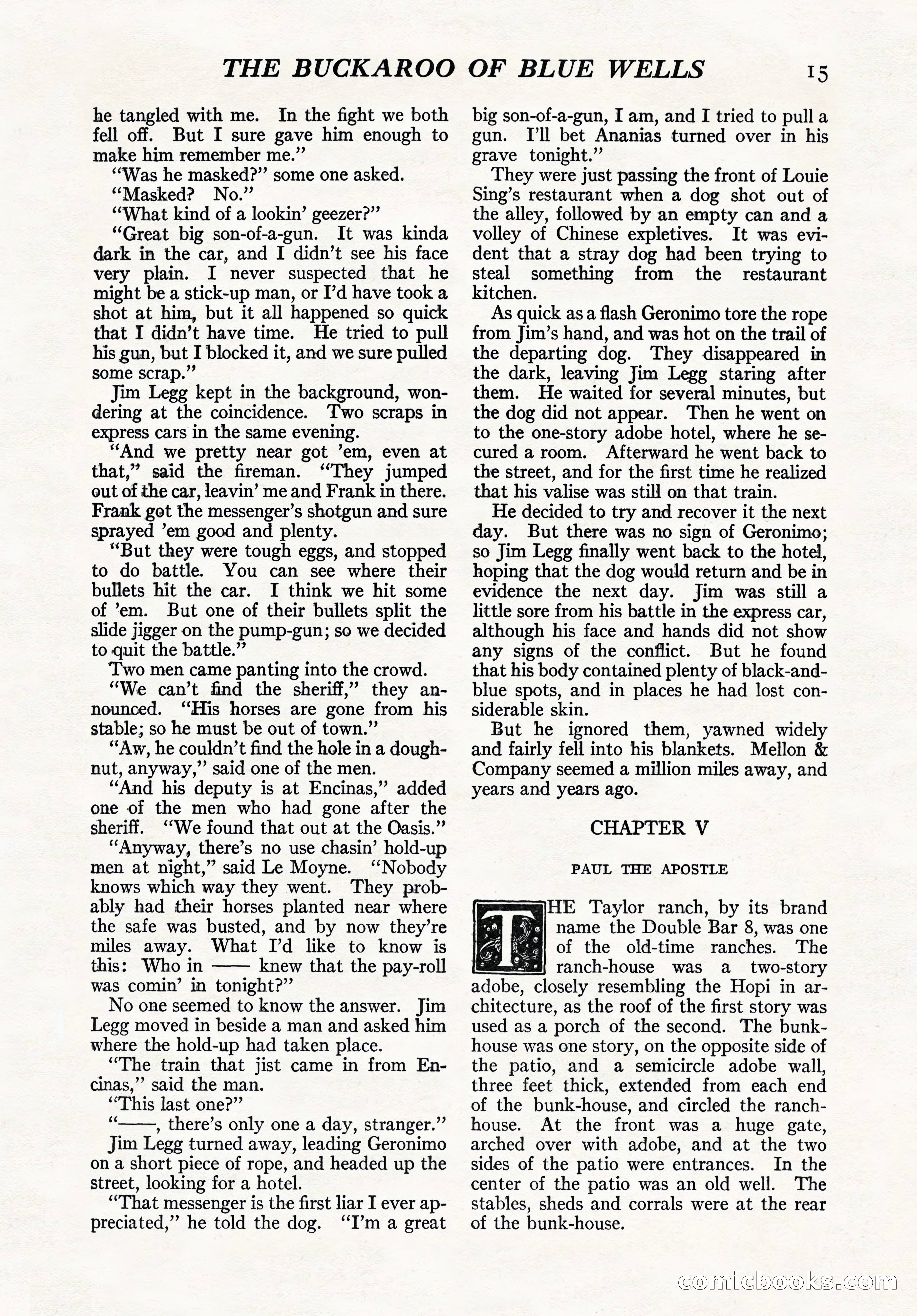
A restored page from Pulp Fiction, 1926. Page through the whole issue in the reader above.
📄 Transcribed text from this page (OCR, searchable)
Machine-transcribed from the original scan — historical spelling and the odd misread are preserved.
THE BUCKAROO OF BLUE WELLS 15 he tangled with me. In the fight we both fell off. But I sure gave him enough to make him remember me.” ‘‘Was he masked?” some one asked. “Masked? No.” ‘What kind of a lookin’ geezer?” “Great big son-of-a-gun. It was kinda dark in the car, and I didn’t see his face very plain. I never suspected that he might be a stick-up man, or I’d have took a shot at him, but it all happened so quick that I didn’t have time. He tried to pull his gun, but I blocked it, and we sure pulled some scrap.” Jim Legg kept in the background, won- dering at the coincidence. Two scraps in express cars in the same evening. “And we pretty near got ’em, even at that,” said the fireman. “They jumped out of the car, leavin’ me and Frank in there. Frank got the messenger’s shotgun and sure sprayed ’em good and plenty. “But they were tough eggs, and stopped to do battle. You can see where their bullets hit the car. I think we hit some of ’em. But one of their bullets split the slide jigger on the pump-gun; so we decided to quit the battle.” ‘Two men came panting into the crowd. “We can’t find the sheriff,” they an- nounced. “His horses are gone from his stable; so he must be out of town.” “Aw, he couldn’t find the hole in a dough- nut, anyway,” said one of the men. “And his deputy is at Encinas,’ added one of the men who had gone after the sheriff. ‘“We found that out at the Oasis.” ‘Anyway, there’s no use chasin’ hold-up men at night,” said Le Moyne. “Nobody knows which way they went. They prob- ably had their horses planted near where the safe was busted, and by now they’re miles away. What I’d like to know is this: Who in knew that the pay-roll was comin’ in tonight?” No one seemed to know the answer. Jim Legg moved in beside a man and asked him where the hold-up had taken place. “The train that jist came in from En- cinas,”’ said the man. ‘This last one?”’ Zs , there’s only one a day, stranger.” Jim Legg turned away, leading Geronimo on a short piece of rope, and headed up the street, looking for a hotel. ‘‘That messenger is the first liar I ever ap- preciated,”’ he told the dog. “I’m a great big son-of-a-gun, I am, and I tried to pull a gun. I'll bet Ananias turned over in his grave tonight.” They were just passing the front of Louie Sing’s restaurant when a dog shot out of the alley, followed by an empty can and a volley of Chinese expletives. It was evi- dent that a stray dog had been trying to steal something from the restaurant kitchen. As quick asa flash Geronimo tore the rope from Jim’s hand, and was hot on the trail of the departing dog. They disappeared in the dark, leaving Jim Legg staring after them. He waited for several minutes, but the dog did not appear. Then he went on to the one-story adobe hotel, where he se- cured a room. Afterward he went back to the street, and for the first time he realized that his valise was still on that train. He decided to try and recover it the next day. But there was no sign of Geronimo; so Jim Legg finally went back to the hotel, hoping that the dog would return and be in evidence the next day. Jim was still a little sore from his battle in the express car, although his face and hands did not show any signs of the conflict. But he found that his body contained plenty of black-and- blue spots, and in places he had lost con- siderable skin. But he ignored them, yawned widely and fairly fell into his blankets. Mellon & Company seemed a million miles away, and years and years ago. CHAPTER V PAUL THE APOSTLE aHE Taylor ranch, by its brand we name the Double Bar 8, was one Gl of the old-time ranches. The maa} ranch-house was a_ two-story adobe, closely resembling the Hopi in ar- chitecture, as the roof of the first story was used as a porch of the second. The bunk- house was one story, on the opposite side of the patio, and a semicircle adobe wall, three feet thick, extended from each end of the bunk-house, and circled the ranch- house. At the front was a huge gate, arched over with adobe, and at the two sides of the patio were entrances. In the center of the patio was an old well. The stables, sheds and corrals were at the rear of the bunk-house. DOOLK (C@