
Pulp Fiction, 1926 · page 166 of 212
Adventure Magazine Cover — page 166: what you’re looking at
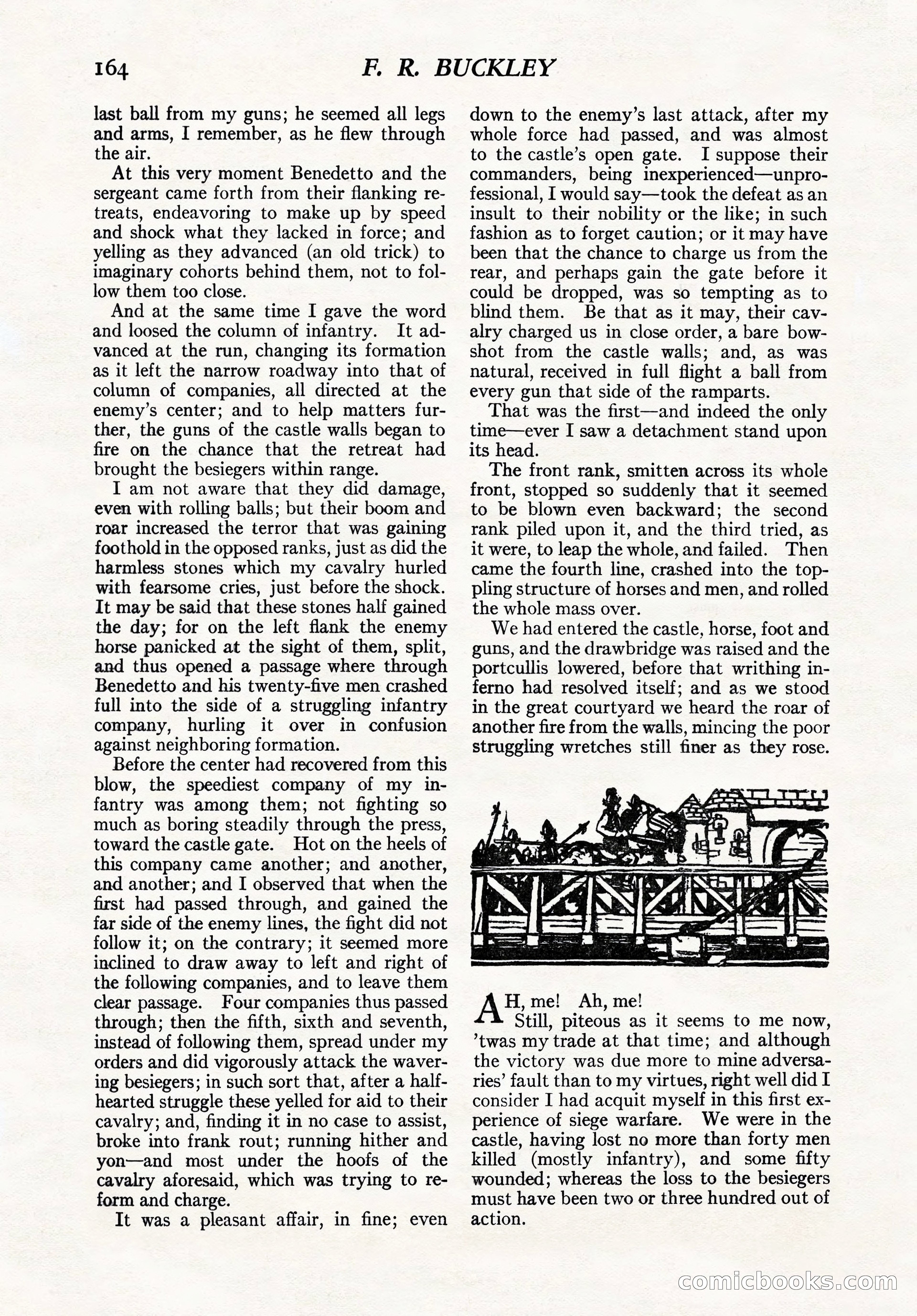
A restored page from Pulp Fiction, 1926. Page through the whole issue in the reader above.
📄 Transcribed text from this page (OCR, searchable)
Machine-transcribed from the original scan — historical spelling and the odd misread are preserved.
164 last ball from my guns; he seemed all legs and arms, I remember, as he flew through the air. At this very moment Benedetto and the sergeant came forth from their flanking re- treats, endeavoring to make up by speed and shock what they lacked in force; and yelling as they advanced (an old trick) to imaginary cohorts behind them, not to fol- low them too close. And at the same time I gave the word and loosed the column of infantry. It ad- vanced at the run, changing its formation as it left the narrow roadway into that of column of companies, all directed at the enemy’s center; and to help matters fur- ther, the guns of the castle walls began to fire on the chance that the retreat had brought the besiegers within range. I am not aware that they did damage, even with rolling balls; but their boom and roar increased the terror that was gaining foothold in the opposed ranks, just as did the harmless stones which my cavalry hurled with fearsome cries, just before the shock. It may be said that these stones half gained the day; for on the left flank the enemy horse panicked at the sight of them, split, and thus opened a passage where through Benedetto and his twenty-five men crashed full into the side of a struggling infantry company, hurling it over in confusion against neighboring formation. Before the center had recovered from this blow, the speediest company of my in- fantry was among them; not fighting so much as boring steadily through the press, toward the castle gate. Hot on the heels of this company came another; and another, and another; and I observed that when the first had passed through, and gained the far side of the enemy lines, the fight did not follow it; on the contrary; it seemed more inclined to draw away to left and right of the following companies, and to leave them clear passage. Four companies thus passed through; then the fifth, sixth and seventh, instead of following them, spread under my orders and did vigorously attack the waver- ing besiegers; in such sort that, after a half- hearted struggle these yelled for aid to their cavalry; and, finding it in no case to assist, broke into frank rout; running hither and yon—and most under the hoofs of the cavalry aforesaid, which was trying to re- form and charge. It was a pleasant affair, in fine; even F, R. BUCKLEY down to the enemy’s last attack, after my whole force had passed, and was almost to the castle’s open gate. I suppose their commanders, being inexperienced—unpro- fessional, I would say—took the defeat as an insult to their nobility or the like; in such fashion as to forget caution; or it may have been that the chance to charge us from the rear, and perhaps gain the gate before it could be dropped, was so tempting as to blind them. Be that as it may, their cav- alry charged us in close order, a bare bow- shot from the castle walls; and, as was natural, received in full flight a ball from every gun that side of the ramparts. That was the first—and indeed the only time—ever I saw a detachment stand upon its head. The front rank, smitten across its whole front, stopped so suddenly that it seemed to be blown even backward; the second rank piled upon it, and the third tried, as it were, to leap the whole, and failed. Then came the fourth line, crashed into the top- pling structure of horses and men, and rolled the whole mass over. We had entered the castle, horse, foot and guns, and the drawbridge was raised and the portcullis lowered, before that writhing in- ferno had resolved itself; and as we stood in the great courtyard we heard the roar of another fire from the walls, mincing the poor struggling wretches still finer as they rose. H, me! Ah, me! Still, piteous as it seems to me now, ’twas my trade at that time; and although the victory was due more to mine adversa- ries’ fault than to my virtues, right well did I consider I had acquit myself in this first ex- perience of siege warfare. We were in the castle, having lost no more than forty men killed (mostly infantry), and some fifty wounded; whereas the loss to the besiegers must have been two or three hundred out of action. MICLOOOK C@