
Pulp Fiction, 1926 · page 161 of 212
Adventure Magazine Cover — page 161: what you’re looking at
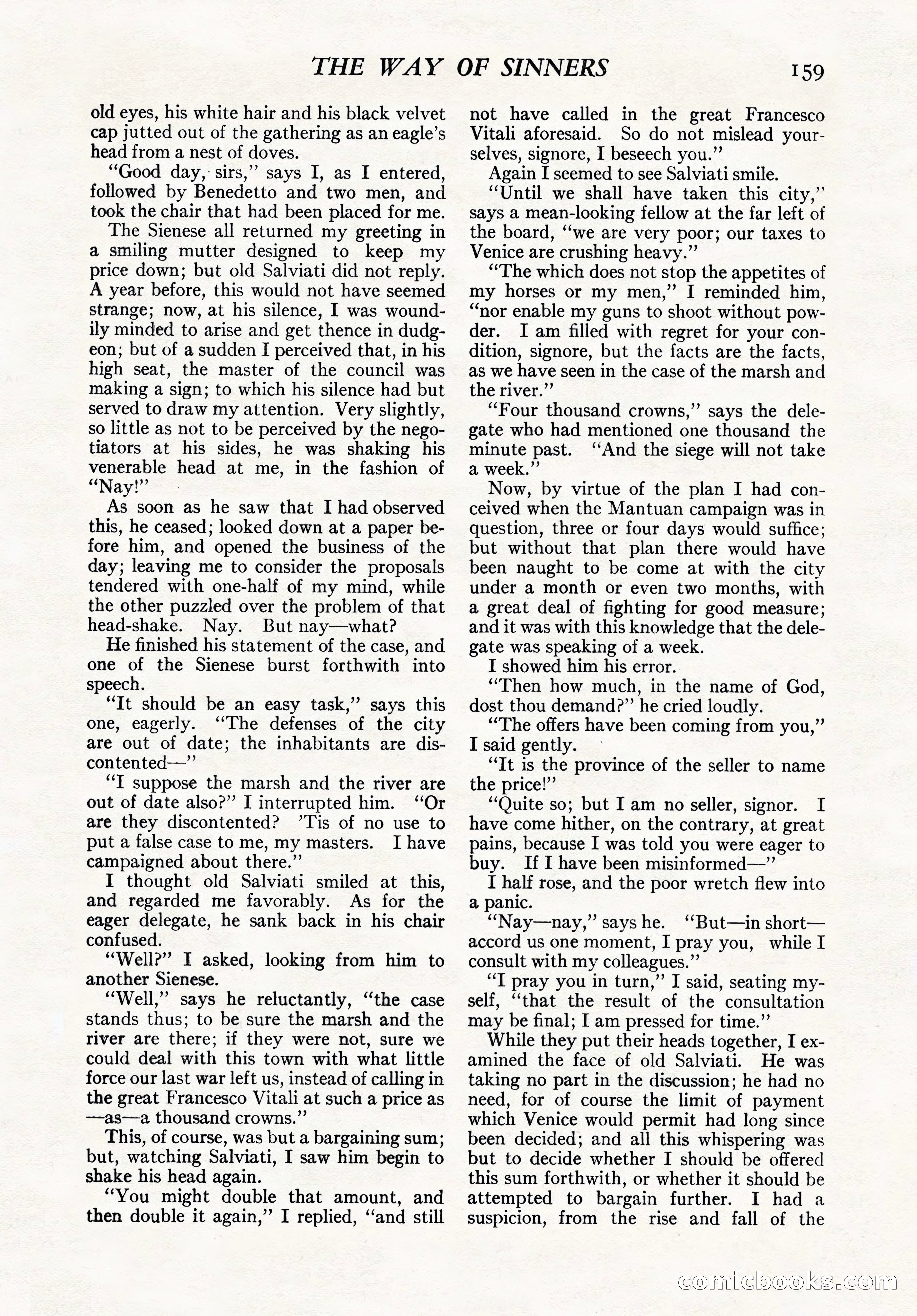
A restored page from Pulp Fiction, 1926. Page through the whole issue in the reader above.
📄 Transcribed text from this page (OCR, searchable)
Machine-transcribed from the original scan — historical spelling and the odd misread are preserved.
THE WAY OF SINNERS old eyes, his white hair and his black velvet cap jutted out of the gathering as an eagle’s head from a nest of doves. “Good day, sirs,”’ says I, as I entered, followed by Benedetto and two men, and took the chair that had been placed for me. The Sienese all returned my greeting in a smiling mutter designed to keep my price down; but old Salviati did not reply. A year before, this would not have seemed strange; now, at his silence, I was wound- ily minded to arise and get thence in dudg- eon; but of a sudden I perceived that, in his high seat, the master of the council was making a sign; to which his silence had but served to draw my attention. Very slightly, so little as not to be perceived by the nego- tiators at his sides, he was shaking his venerable head at me, in the fashion of “Nay!” As soon as he saw that I had observed this, he ceased; looked down at a paper be- fore him, and opened the business of the day; leaving me to consider the proposals tendered with one-half of my mind, while the other puzzled over the problem of that head-shake. Nay. But nay—what? He finished his statement of the case, and one of the Sienese burst forthwith into speech. “It should be an easy task,” says this one, eagerly. ‘“The defenses of the city are out of date; the inhabitants are dis- contented—”’ “T suppose the marsh and the river are out of date also?” I interrupted him. “Or are they discontented? ’Tis of no use to put a false case to me, my masters. I have campaigned about there.” I thought old Salviati smiled at this, and regarded me favorably. As for the eager delegate, he sank back in his chair confused. “Well?” I asked, looking from him to another Sienese. “Well,” says he reluctantly, “the case stands thus; to be sure the marsh and the river are there; if they were not, sure we could deal with this town with what little force our last war left us, instead of calling in the great Francesco Vitali at such a price as —as—a thousand crowns.”’ This, of course, was but a bargaining sum; but, watching Salviati, I saw him begin to shake his head again. “You might double that amount, and then double it again,” I replied, ‘and still 159 not have called in the great Francesco Vitali aforesaid. So do not mislead your- selves, signore, I beseech you.”’ Again I seemed to see Salviati smile. “Until we shall have taken this city,”’ says a mean-looking fellow at the far left of the board, ‘‘we are very poor; our taxes to Venice are crushing heavy.” ‘The which does not stop the appetites of my horses or my men,” I reminded him, “nor enable my guns to shoot without pow- der. I am filled with regret for your con- dition, signore, but the facts are the facts, as we have seen in the case of the marsh and the river.”’ “Four thousand crowns,” says the dele- gate who had mentioned one thousand the minute past. ‘And the siege will not take a week.”’ Now, by virtue of the plan I had con- ceived when the Mantuan campaign was in question, three or four days would suffice; but without that plan there would have been naught to be come at with the city under a month or even two months, with a great deal of fighting for good measure; and it was with this knowledge that the dele- gate was speaking of a week. I showed him his error.. “Then how much, in the name of God, dost thou demand?”’ he cried loudly. ‘The offers have been coming from you,” I said gently. “It is the province of the seller to name the price!’ “Quite so; but I am no seller, signor. I have come hither, on the contrary, at great pains, because I was told you were eager to buy. If I have been misinformed—”’ I half rose, and the poor wretch flew into a panic. “Nay—nay,”’ sayshe. ‘‘But—in short— accord us one moment, I pray you, while I consult with my colleagues.’’ “T pray you in turn,” I said, seating my- self, “that the result of the consultation may be final; I am pressed for time.” While they put their heads together, I ex- amined the face of old Salviati. He was taking no part in the discussion; he had no need, for of course the limit of payment which Venice would permit had long since been decided; and all this whispering was but to decide whether I should be offered this sum forthwith, or whether it should be attempted to bargain further. I had a suspicion, from the rise and fall of the GCOMIGIOO S (C@