
Pulp Fiction, 1926 · page 157 of 212
Adventure Magazine Cover — page 157: what you’re looking at
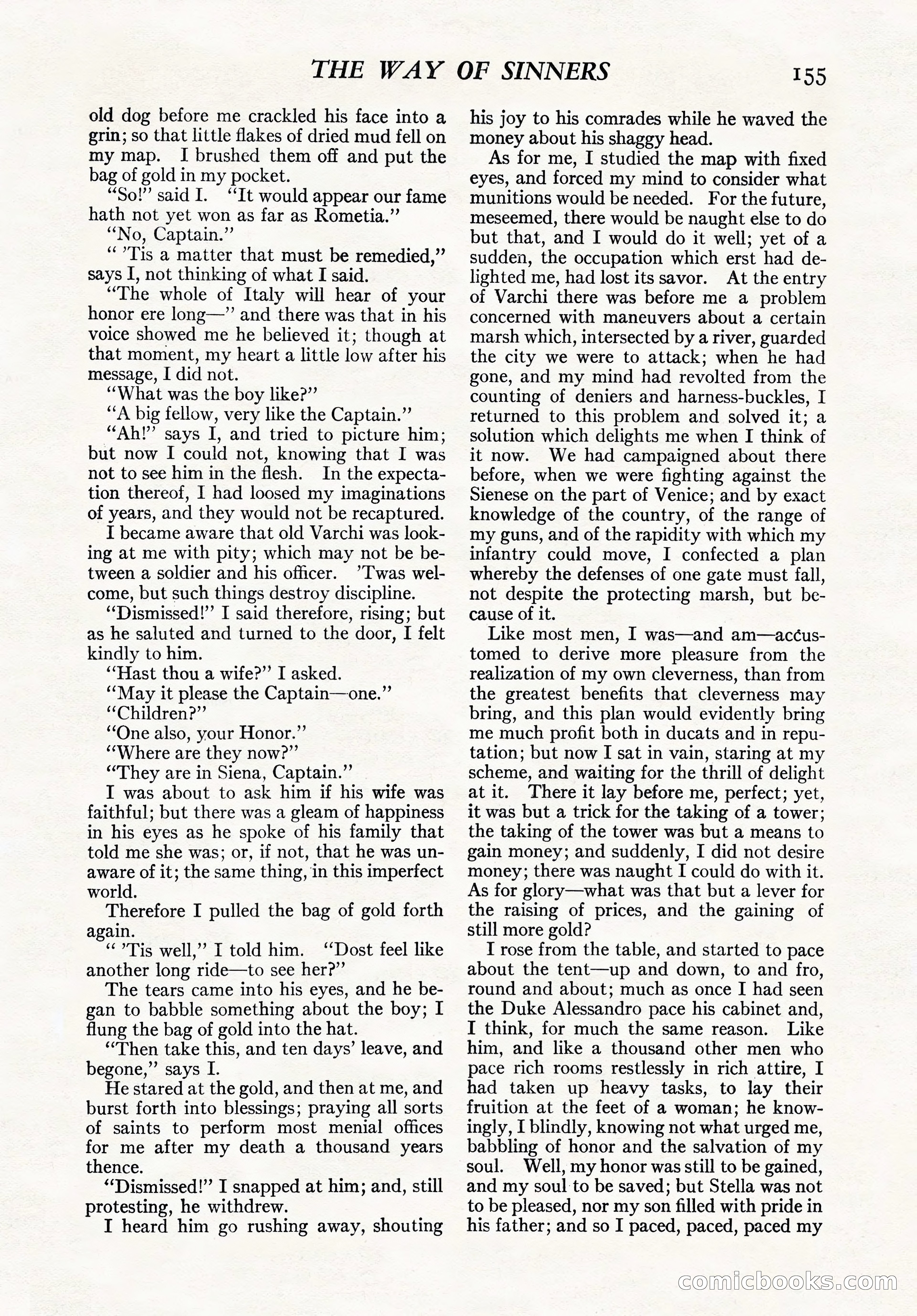
A restored page from Pulp Fiction, 1926. Page through the whole issue in the reader above.
📄 Transcribed text from this page (OCR, searchable)
Machine-transcribed from the original scan — historical spelling and the odd misread are preserved.
THE WAY OF SINNERS old dog before me crackled his face into a grin; so that little flakes of dried mud fell on my map. I brushed them off and put the bag of gold in my pocket. “Sol” said I. ‘It would appear our fame hath not yet won as far as Rometia.”’ “No, Captain.” “Tis a matter that must be remedied,” says I, not thinking of what I said. “The whole of Italy will hear of your honor ere long—”’ and there was that in his voice showed me he believed it; though at that moment, my heart a little low after his message, I did not. “What was the boy like?”’ ‘A big fellow, very like the Captain.” “Ah! says I, and tried to picture him; but now I could not, knowing that I was not to see him in the flesh. In the expecta- tion thereof, I had loosed my imaginations of years, and they would not be recaptured. I became aware that old Varchi was look- ing at me with pity; which may not be be- tween a soldier and his officer. ~I'was wel- come, but such things destroy discipline. ‘“Dismissed!’’ I said therefore, rising; but as he saluted and turned to the door, I felt kindly to him. “Hast thou a wife?’’ I asked. “May it please the Captain—one.” “Children?” “One also, your Honor.” ‘Where are they now?” “They are in Siena, Captain.” I was about to ask him if his wife was faithful; but there was a gleam of happiness in his eyes as he spoke of his family that told me she was; or, if not, that he was un- aware of it; the same thing, in this imperfect world. Therefore I pulled the bag of gold forth again. “°Tis well,’ I told him. ‘Dost feel like another long ride—to see her?” The tears came into his eyes, and he be- gan to babble something about the boy; I flung the bag of gold into the hat. “Then take this, and ten days’ leave, and begone,” says I. He stared at the gold, and then at me, and burst forth into blessings; praying all sorts of saints to perform most menial offices for me after my death a thousand years thence. “Dismissed!’’ I snapped at him; and, still protesting, he withdrew. I heard him go rushing away, shouting 155 his joy to his comrades while he waved the money about his shaggy head. As for me, I studied the map with fixed eyes, and forced my mind to consider what munitions would be needed. For the future, meseemed, there would be naught else to do but that, and I would do it well; yet of a sudden, the occupation which erst had de- lighted me, had lost its savor. At the entry of Varchi there was before me a problem concerned with maneuvers about a certain marsh which, intersected by a river, guarded the city we were to attack; when he had gone, and my mind had revolted from the counting of deniers and harness-buckles, I returned to this problem and solved it; a solution which delights me when I think of it now. We had campaigned about there before, when we were fighting against the Sienese on the part of Venice; and by exact knowledge of the country, of the range of my guns, and of the rapidity with which my infantry could move, I confected a plan whereby the defenses of one gate must fall, not despite the protecting marsh, but be- cause of it. Like most men, I was—and am—accus- tomed to derive more pleasure from the realization of my own cleverness, than from the greatest benefits that cleverness may bring, and this plan would evidently bring me much profit both in ducats and in repu- tation; but now I sat in vain, staring at my scheme, and waiting for the thrill of delight at it. There it lay before me, perfect; yet, it was but a trick for the taking of a tower; the taking of the tower was but a means to gain money; and suddenly, I did not desire money; there was naught I could do with it. As for glory—what was that but a lever for the raising of prices, and the gaining of still more gold? I rose from the table, and started to pace about the tent—up and down, to and fro, round and about; much as once I had seen the Duke Alessandro pace his cabinet and, I think, for much the same reason. Like him, and like a thousand other men who pace rich rooms restlessly in rich attire, I had taken up heavy tasks, to lay their fruition at the feet of a woman; he know- ingly, I blindly, knowing not what urged me, babbling of honor and the salvation of my soul. Well, my honor was still to be gained, and my soul to be saved; but Stella was not to be pleased, nor my son filled with pride in his father; and so I paced, paced, paced my GOMIGIOO S (C@