
Pulp Fiction, 1926 · page 149 of 212
Adventure Magazine Cover — page 149: what you’re looking at
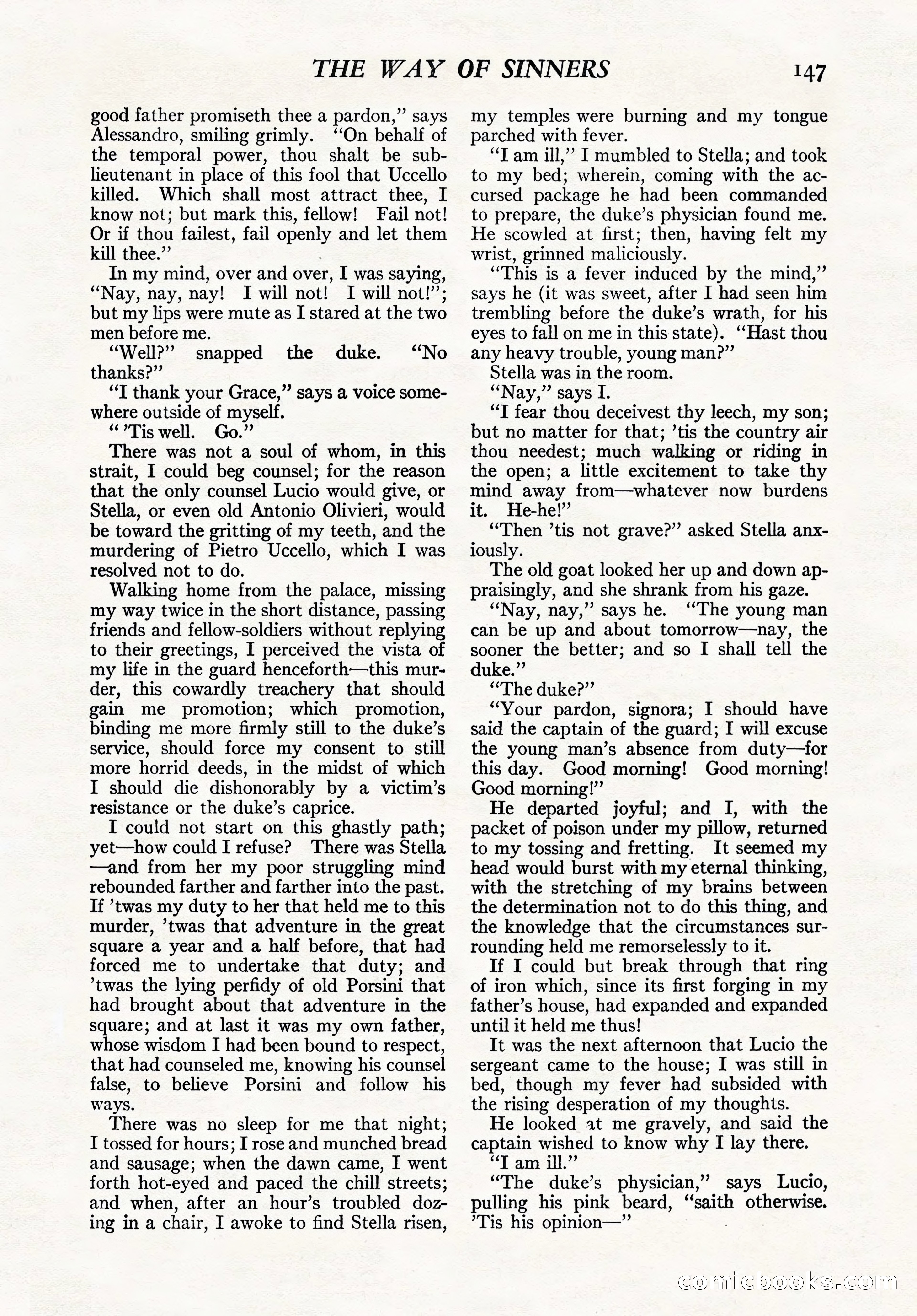
A restored page from Pulp Fiction, 1926. Page through the whole issue in the reader above.
📄 Transcribed text from this page (OCR, searchable)
Machine-transcribed from the original scan — historical spelling and the odd misread are preserved.
THE WAY OF SINNERS good father promiseth thee a pardon,” says Alessandro, smiling grimly. “On behalf of the temporal power, thou shalt be sub- lieutenant in place of this fool that Uccello killed. Which shall most attract thee, I know not; but mark this, fellow! Fail not! Or if thou failest, fail oP and let them kill thee.” In my mind, over and over, I was saying, “Nay, nay, nay! I will not! I will not!’; but my lips were mute as I stared at the two men before me. “Well?” snapped the duke. thanks?” “T thank your Grace,” says a voice some- where outside of myself. “Tis well. Go.” There was not a soul of whom, in this strait, I could beg counsel; for the reason that the only counsel Lucio would give, or Stella, or even old Antonio Olivieri, would be toward the gritting of my teeth, and the murdering of Pietro Uccello, which I was resolved not to do. Walking home from the palace, missing my way twice in the short distance, passing friends and fellow-soldiers without replying to their greetings, I perceived the vista of my life in the guard henceforth—this mur- der, this cowardly treachery that should gain me promotion; which promotion, binding me more firmly still to the duke’s service, should force my consent to still more horrid deeds, in the midst of which I should die dishonorably by a victim’s resistance or the duke’s caprice. I could not start on this ghastly path; yet—how could I refuse? There was Stella —and from her my poor struggling mind rebounded farther and farther into the past. If ’twas my duty to her that held me to this murder, ’twas that adventure in the great square a year and a half before, that had forced me to undertake that duty; and twas the lying perfidy of old Porsini that had brought about that adventure in the square; and at last it was my own father, whose wisdom I had been bound to respect, that had counseled me, knowing his counsel false, to believe Porsini and follow his ways. There was no sleep for me that night; I tossed for hours; I rose and munched bread and sausage; when the dawn came, I went forth hot-eyed and paced the chill streets; and when, after an hour’s troubled doz- ing in a chair, I awoke to find Stella risen, “No 147 my temples were burning and my tongue parched with fever. “T am ill,” I mumbled to Stella; and took to my bed; wherein, coming with the ac- cursed package he had been commanded to prepare, the duke’s physician found me. He scowled at first; then, having felt my wrist, grinned maliciously. “This is a fever induced by the mind,” says he (it was sweet, after I had seen him trembling before the duke’s wrath, for his eyes to fall on me in this state). ‘“Hast thou any heavy trouble, young man?” Stella was in the room. “Nay,” says I. “T fear thou deceivest thy leech, my son; but no matter for that; ’tis the country air thou needest; much walking or riding in the open; a little excitement to take thy mind away from—whatever now burdens it. He-he!’’ “Then ’tis not grave?” asked Stella anx- iously. The old goat looked her up and down ap- praisingly, and she shrank from his gaze. “Nay, nay,” says he. “The young man can be up and about tomorrow—nay, the sooner the better; and so I shall tell the duke.”’ “The duke?” “Your pardon, signora; I should have said the captain of the guard; I will excuse the young man’s absence from duty—for this day. Good morning! Good morning! Good morning!” He departed joyful; and I, with the packet of poison under my pillow, returned to my tossing and fretting. It seemed my head would burst with my eternal thinking, with the stretching of my brains between the determination not to do this thing, and the knowledge that the circumstances sur- rounding held me remorselessly to it. If I could but break through that ring of iron which, since its first forging in my father’s house, had expanded and expanded until it held me thus! It was the next afternoon that Lucio the sergeant came to the house; I was still in bed, though my fever had subsided with the rising desperation of my thoughts. He looked at me gravely, and said the captain wished to know why I lay there. “T am ill.” “The duke’s physician,’ says Lucio, pulling his pink beard, “saith otherwise. ’Tis his opinion—” DOOK (C@