
Pulp Fiction, 1926 · page 147 of 212
Adventure Magazine Cover — page 147: what you’re looking at
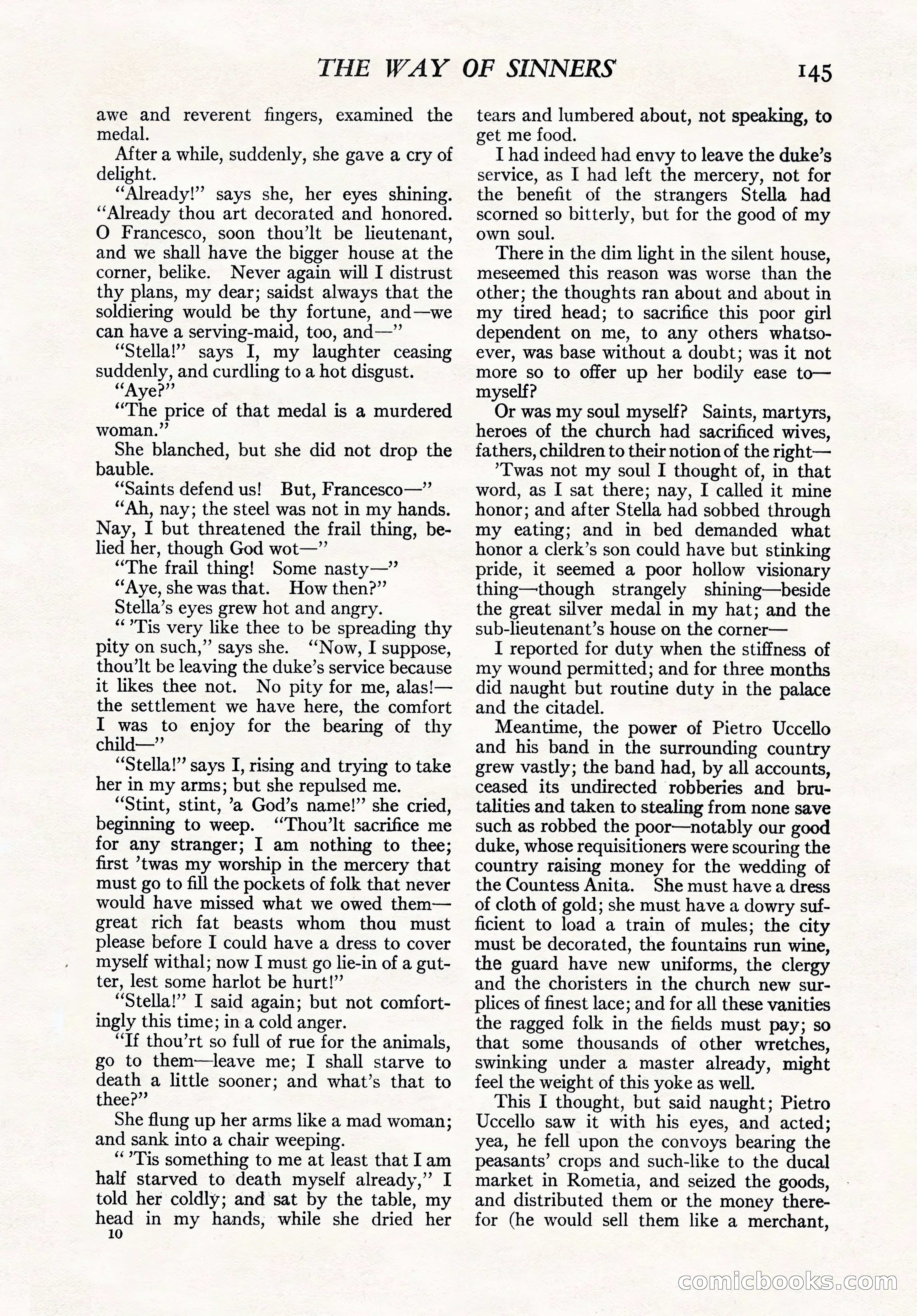
A restored page from Pulp Fiction, 1926. Page through the whole issue in the reader above.
📄 Transcribed text from this page (OCR, searchable)
Machine-transcribed from the original scan — historical spelling and the odd misread are preserved.
THE WAY OF SINNERS awe and reverent fingers, examined the medal. After a while, suddenly, she gave a cry of delight. “Already!” says she, her eyes shining. “Already thou art decorated and honored. O Francesco, soon thou’lt be lieutenant, and we shall have the bigger house at the corner, belike. Never again will I distrust thy plans, my dear; saidst always that the soldiering would be thy fortune, and—we can have a serving-maid, too, and—”’ “Stella!” says I, my laughter ceasing suddenly, and curdling to a hot disgust. cc Aye?”’ “The price of that medal is a murdered woman.” She blanched, but she did not drop the bauble. “Saints defend us! But, Francesco—”’ “Ah, nay; the steel was not in my hands. Nay, I but threatened the frail thing, be- lied her, though God wot—”’ “The frail thing! Some nasty—” “Aye, she was that. How then?” Stella’s eyes grew hot and angry. ‘Tis very like thee to be spreading thy pity on such,” says she. ‘Now, I suppose, thou’lt be leaving the duke’s service because it likes thee not. No pity for me, alas!— the settlement we have here, the comfort I was to enjoy for the bearing of thy child—’” “Stella!” says I, rising and trying to take her in my arms; but she repulsed me. “Stint, stint, ’a God’s name!” she cried, beginning to weep. ‘“Thou’lt sacrifice me for any stranger; I am nothing to thee; first ’twas my worship in the mercery that must go to fill the pockets of folk that never would have missed what we owed them— great rich fat beasts whom thou must please before I could have a dress to cover myself withal; now I must go lie-in of a gut- ter, lest some harlot be hurt!” “Stella!” I said again; but not comfort- ingly this time; in a cold anger. “Tf thou’rt so full of rue for the animals, go to them—leave me; I shall starve to death a little sooner; and what’s that to thee?” She flung up her arms like a mad woman; and sank into a chair weeping. ‘“°Tis something to me at least that Iam half starved to death myself already,’ I told her coldly; and sat by the table, my head in my hands, while she dried her 10 145 tears and lumbered about, not speaking, to get me food. I had indeed had envy to leave the duke’s service, as I had left the mercery, not for the benefit of the strangers Stella had scorned so bitterly, but for the good of my own soul. There in the dim light in the silent house, meseemed this reason was worse than the other; the thoughts ran about and about in my tired head; to sacrifice this poor girl dependent on me, to any others whatso- ever, was base without a doubt; was it not more so to offer up her bodily ease to— myself? Or was my soul myself? Saints, martyrs, heroes of the church had sacrificed wives, fathers, children to their notion of the right— *Twas not my soul I thought of, in that word, as I sat there; nay, I called it mine honor; and after Stella had sobbed through my eating; and in bed demanded what honor a clerk’s son could have but stinking pride, it seemed a poor hollow visionary thing—though strangely shining—beside the great silver medal in my hat; and the sub-lieutenant’s house on the corner— I reported for duty when the stiffness of my wound permitted; and for three months did naught but routine duty in the palace and the citadel. Meantime, the power of Pietro Uccello and his band in the surrounding country grew vastly; the band had, by all accounts, ceased its undirected robberies and bru- talities and taken to stealing from none save such as robbed the poor—notably our good duke, whose requisitioners were scouring the country raising money for the wedding of the Countess Anita. She must havea dress of cloth of gold; she must have a dowry suf- ficient to load a train of mules; the city must be decorated, the fountains run wine, the guard have new uniforms, the clergy and the choristers in the church new sur- plices of finest lace; and for all these vanities the ragged folk in the fields must pay; so that some thousands of other wretches, swinking under a master already, might feel the weight of this yoke as well. This I thought, but said naught; Pietro Uccello saw it with his eyes, and acted; yea, he fell upon the convoys bearing the peasants’ crops and such-like to the ducal market in Rometia, and seized the goods, and distributed them or the money there- for (he would sell them like a merchant, COnniclboooks Cc C@