
Pulp Fiction, 1926 · page 141 of 212
Adventure Magazine Cover — page 141: what you’re looking at
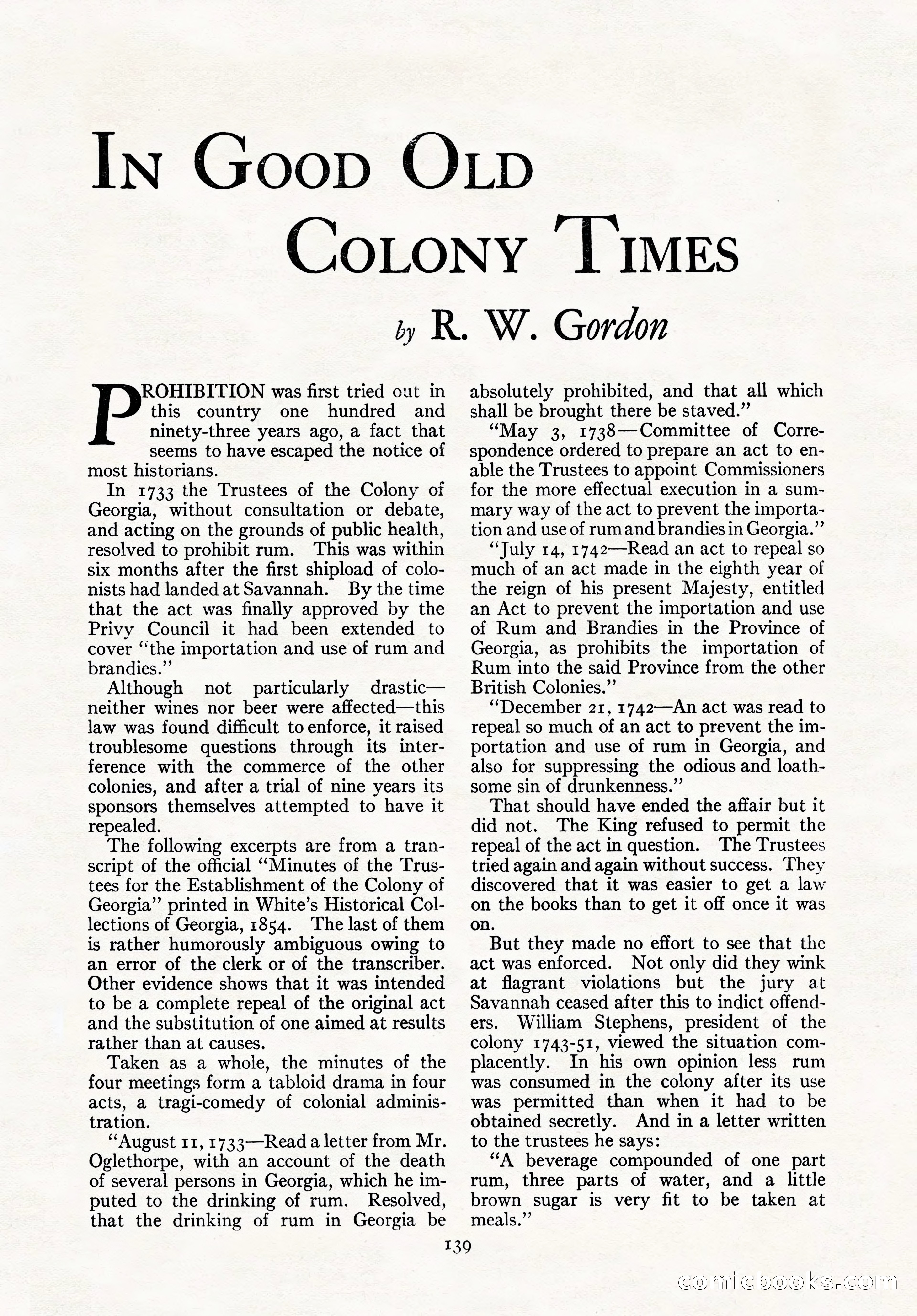
A restored page from Pulp Fiction, 1926. Page through the whole issue in the reader above.
📄 Transcribed text from this page (OCR, searchable)
Machine-transcribed from the original scan — historical spelling and the odd misread are preserved.
IN Goop OLD CoLony IL IMeEs by R. W. Gordon ROHIBITION was first tried out in this country one hundred and ninety-three years ago, a fact that seems to have escaped the notice of most historians. In 1733 the Trustees of the Colony of Georgia, without consultation or debate, and acting on the grounds of public health, resolved to prohibit rum. This was within six months after the first shipload of colo- nists had landed at Savannah. By the time that the act was finally approved by the Privy Council it had been extended to cover ‘‘the importation and use of rum and brandies.”’ Although not particularly drastic— neither wines nor beer were affected—this law was found difficult to enforce, it raised troublesome questions through its inter- ference with the commerce of the other colonies, and after a trial of nine years its sponsors themselves attempted to have it repealed. The following excerpts are from a tran- script of the official ‘‘Minutes of the Trus- tees for the Establishment of the Colony of Georgia” printed in White’s Historical Col- lections of Georgia, 1854. The last of them is rather humorously ambiguous owing to an error of the clerk or of the transcriber. Other evidence shows that it was intended to be a complete repeal of the original act and the substitution of one aimed at results rather than at causes. Taken as a whole, the minutes of the four meetings form a tabloid drama in four acts, a tragi-comedy of colonial adminis- tration. ‘August 11, 1733—Read a letter from Mr. Oglethorpe, with an account of the death of several persons in Georgia, which he im- puted to the drinking of rum. Resolved, that the drinking of rum in Georgia be absolutely prohibited, and that all which shall be brought there be staved.”’ “May 3, 1738—Committee of Corre- spondence ordered to prepare an act to en- able the Trustees to appoint Commissioners for the more effectual execution in a sum- mary way of the act to prevent the importa- tion and use of rumand brandies in Georgia.” “July 14, 1742—-Read an act to repeal so much of an act made in the eighth year of the reign of his present Majesty, entitled an Act to prevent the importation and use of Rum and Brandies in the Province of Georgia, as prohibits the importation of Rum into the said Province from the other British Colonies.”’ ‘““December 21, 1742—An act was read to repeal so much of an act to prevent the im- portation and use of rum in Georgia, and also for suppressing the odious and loath- some sin of drunkenness.” That should have ended the affair but it did not. The King refused to permit the repeal of the act in question. The Trustees tried again and again without success. They discovered that it was easier to get a law on the books than to get it off once it was on. But they made no effort to see that the act was enforced. Not only did they wink at flagrant violations but the jury at Savannah ceased after this to indict offend- ers. William Stephens, president of the colony 1743-51, viewed the situation com- placently. In his own opinion less rum was consumed in the colony after its use was permitted than when it had to be obtained secretly. And in a letter written to the trustees he says: ‘“‘A beverage compounded of one part rum, three parts of water, and a little brown sugar is very fit to be taken at meals.”’ 139 MICLOOOK (C@ in