
Pulp Fiction, 1926 · page 13 of 212
Adventure Magazine Cover — page 13: what you’re looking at
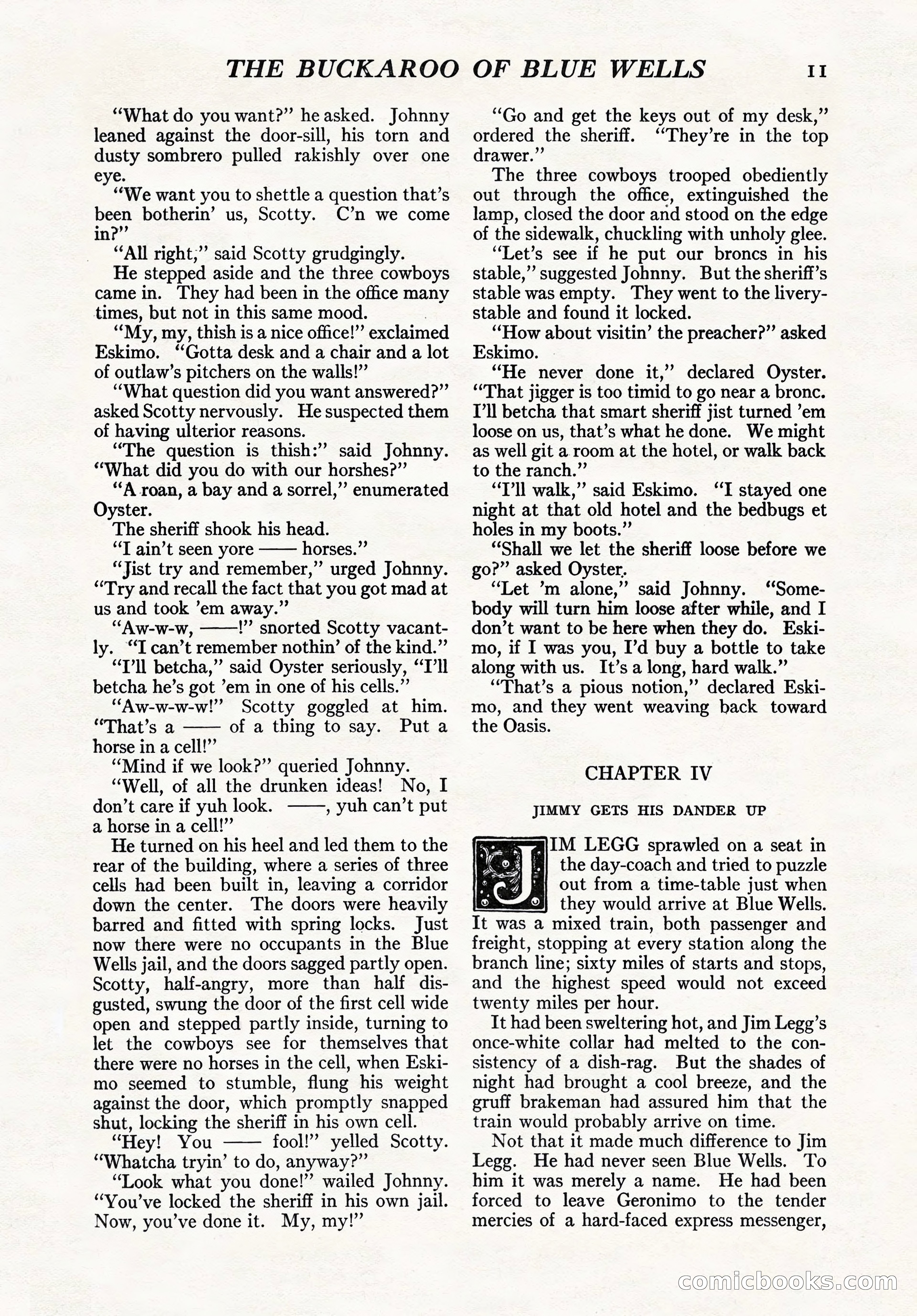
A restored page from Pulp Fiction, 1926. Page through the whole issue in the reader above.
📄 Transcribed text from this page (OCR, searchable)
Machine-transcribed from the original scan — historical spelling and the odd misread are preserved.
THE BUCKAROO OF BLUE WELLS “What do you want?” heasked. Johnny leaned against the door-sill, his torn and dusty sombrero pulled rakishly over one eye. “‘We want you to shettle a question that’s been botherin’ us, Scotty. C’n we come in?” “All right,” said Scotty grudgingly. He stepped aside and the three cowboys came in. They had been in the office many times, but not in this same mood. “My, my, thish is a nice office!” exclaimed Eskimo. ‘Gotta desk and a chair and a lot of outlaw’s pitchers on the walls!” ‘“‘What question did you want answered?” asked Scotty nervously. He suspected them of having ulterior reasons. “The question is thish:” said Johnny. “What did you do with our horshes?”’ *“‘A roan, a bay and a sorrel,’”’ enumerated Oyster. The sheriff shook his head. “T ain’t seen yore horses.” “Jist try and remember,” urged Johnny. “Try and recall the fact that you got mad at us and took ’em away.” “Aw-w-w, ——!” snorted Scotty vacant- ly. “I can’t remember nothin’ of the kind.” “T’ll betcha,” said Oyster seriously, ‘“T’ll betcha he’s got ’em in one of his cells.” ‘“Aw-w-w-w!” Scotty goggled at him. “That’s a of a thing to say. Put a horse in a cell!” “Mind if we look?” queried Johnny. “Well, of all the drunken ideas! No, I don’t care if yuh look. ——, yuh can’t put a horse in a cell!” He turned on his heel and led them to the rear of the building, where a series of three cells had been built in, leaving a corridor down the center. The doors were heavily barred and fitted with spring locks. Just now there were no occupants in the Blue Wells jail, and the doors sagged partly open. Scotty, half-angry, more than half dis- gusted, swung the door of the first cell wide open and stepped partly inside, turning to let the cowboys see for themselves that there were no horses in the cell, when Eski- mo seemed to stumble, flung his weight against the door, which promptly snapped shut, locking the sheriff in his own cell. “Hey! You fool!’ yelled Scotty. “Whatcha tryin’ to do, anyway?” “Look what you done!” wailed Johnny. “‘Vou’ve locked the sheriff in his own jail. Now, you’ve done it. My, my!” II “Go and get the keys out of my desk,” ordered the sheriff. ‘“They’re in the top drawer.” The three cowboys trooped obediently out through the office, extinguished the lamp, closed the door and stood on the edge of the sidewalk, chuckling with unholy glee. ‘Let’s see if he put our broncs in his stable,” suggested Johnny. But the sheriff’s stable was empty. They went to the livery- stable and found it locked. “How about visitin’ the preacher?” asked Eskimo. “He never done it,’ declared Oyster. ‘That jigger is too timid to go near a bronc. Tl betcha that smart sheriff jist turned ’em loose on us, that’s what he done. We might as well git a room at the hotel, or walk back to the ranch.” “T’ll walk,” said Eskimo. “TI stayed one night at that old hotel and the bedbugs et holes in my boots.” “Shall we let the sheriff loose before we go?” asked Oyster. “Let ’m alone,” said Johnny. “Some- body will turn him loose after while, and I don’t want to be here when they do. Eski- mo, if I was you, I’d buy a bottle to take along with us. It’s a long, hard walk.” “‘That’s a pious notion,”’ declared Eski- mo, and they went weaving back toward the Oasis. CHAPTER IV JIMMY GETS HIS DANDER UP m—a\IM LEGG sprawled on a seat in 1 l@| the day-coach and tried to puzzle m| out from a time-table just when ~ai3} they would arrive at Blue Wells. It was a mixed train, both passenger and freight, stopping at every station along the branch line; sixty miles of starts and stops, and the highest speed would not exceed twenty miles per hour. It had been sweltering hot, and Jim Legg’s once-white collar had melted to the con- sistency of a dish-rag. But the shades of night had brought a cool breeze, and the gruff brakeman had assured him that the train would probably arrive on time. Not that it made much difference to Jim Legg. He had never seen Blue Wells. To him it was merely a name. He had been forced to leave Geronimo to the tender mercies of a hard-faced express messenger, GCOMIGIOO SS (©