
Pulp Fiction, 1926 · page 128 of 212
Adventure Magazine Cover — page 128: what you’re looking at
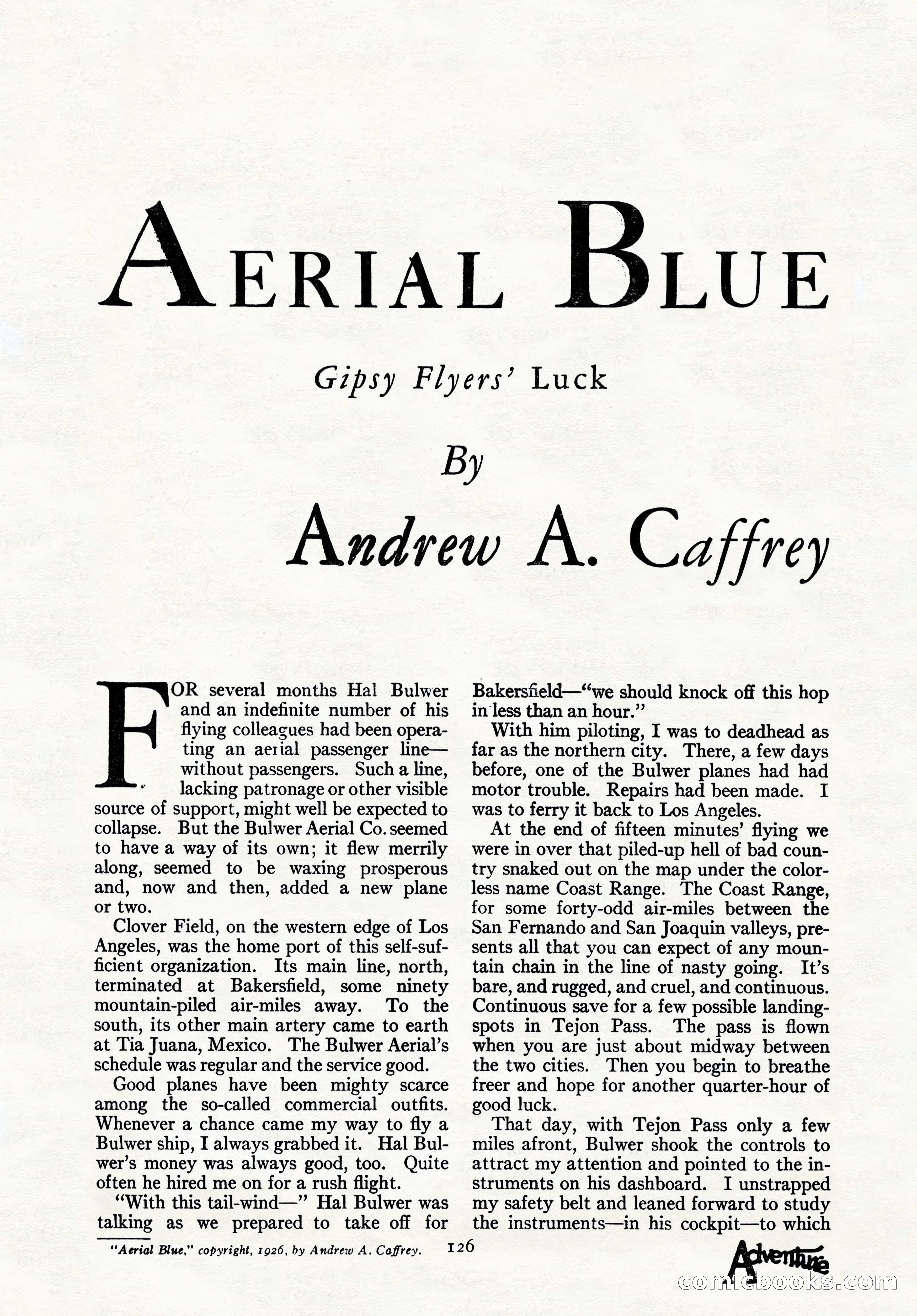
A restored page from Pulp Fiction, 1926. Page through the whole issue in the reader above.
📄 Transcribed text from this page (OCR, searchable)
Machine-transcribed from the original scan — historical spelling and the odd misread are preserved.
AERIAL LUE Gipsy Flyers’ Luck By Andrew A. Caffrey OR several months Hal Bulwer and an indefinite number of his flying colleagues had been opera- ting an aerial passenger line— without passengers. Such a line, lacking patronage or other visible source of support, might well be expected to collapse. But the Bulwer Aerial Co. seemed to have a way of its own; it flew merrily along, seemed to be waxing prosperous and, now and then, added a new plane or two. Clover Field, on the western edge of Los Angeles, was the home port of this self-suf- ficient organization. Its main line, north, terminated at Bakersfield, some ninety mountain-piled air-miles away. To the south, its other main artery came to earth at Tia Juana, Mexico. The Bulwer Aerial’s schedule was regular and the service good. Good planes have been mighty scarce among the so-called commercial outfits. Whenever a chance came my way to fly a Bulwer ship, I always grabbed it. Hal Bul- wer’s money was always good, too. Quite often he hired me on for a rush flight. “With this tail-wind—” Hal Bulwer was talking as we prepared to take off for “Aerial Blue," copyright, 1926, by Andrew A. Caffrey. Bakersfield—“we should knock off this hop in less than an hour.” With him piloting, I was to deadhead as far as the northern city. There, a few days before, one of the Bulwer planes had had motor trouble. Repairs had been made. I was to ferry it back to Los Angeles. At the end of fifteen minutes’ flying we were in over that piled-up hell of bad coun- try snaked out on the map under the color- less name Coast Range. The Coast Range, for some forty-odd air-miles between the San Fernando and San Joaquin valleys, pre- sents all that you can expect of any moun- tain chain in the line of nasty going. It’s bare, and rugged, and cruel, and continuous. Continuous save for a few possible landing- spots in Tejon Pass. The pass is flown when you are just about midway between the two cities. Then you begin to breathe freer and hope for another quarter-hour of good luck. That day, with Tejon Pass only a few miles afront, Bulwer shook the controls to attract my attention and pointed to the in- struments on his dashboard. I unstrapped my safety belt and leaned forward to study the instruments—in his cockpit—to which 126 Go DOO) aie KS (C@