
Pulp Fiction, 1926 · page 123 of 212
Adventure Magazine Cover — page 123: what you’re looking at
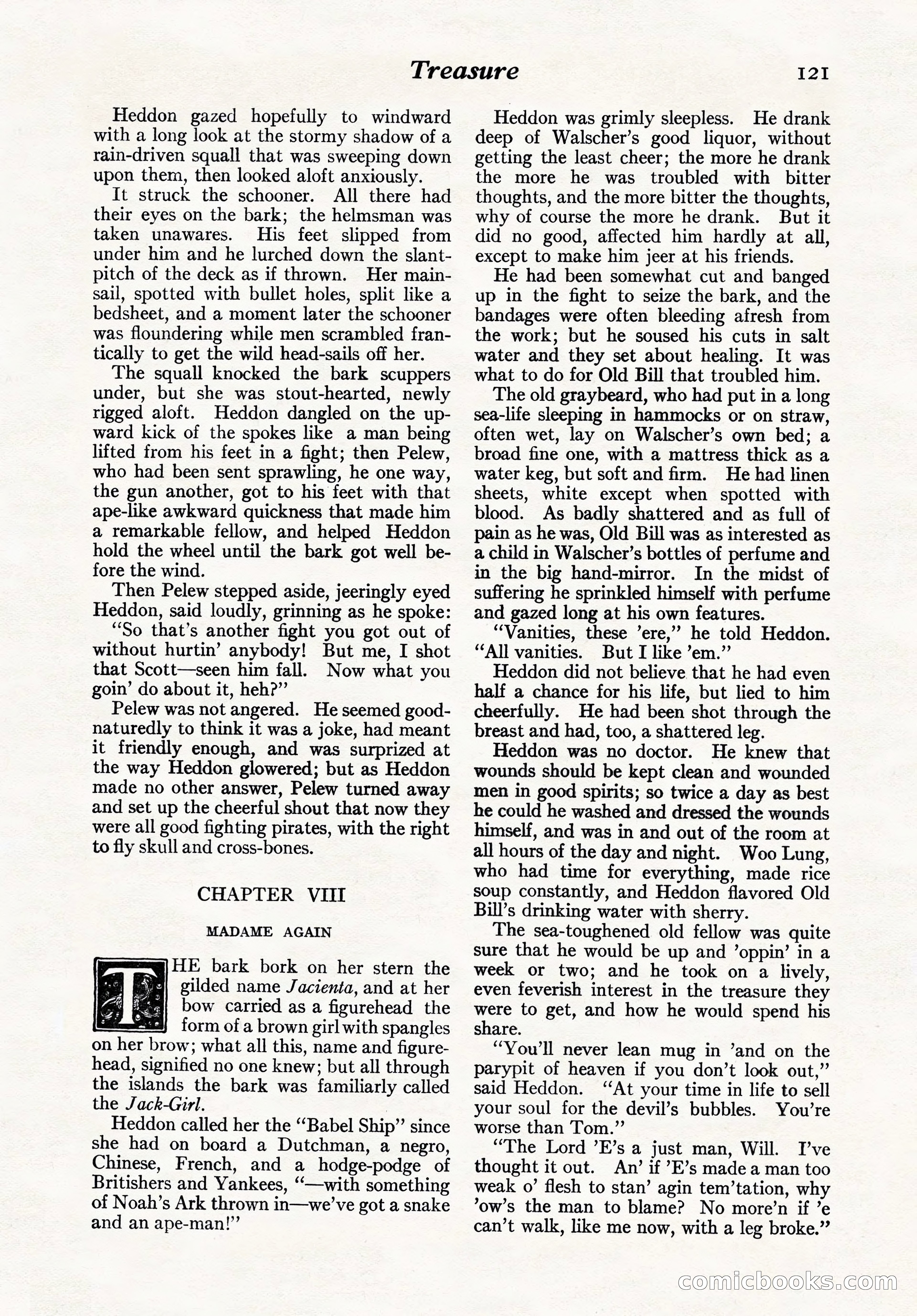
A restored page from Pulp Fiction, 1926. Page through the whole issue in the reader above.
📄 Transcribed text from this page (OCR, searchable)
Machine-transcribed from the original scan — historical spelling and the odd misread are preserved.
Treasure Heddon gazed hopefully to windward with a long look at the stormy shadow of a rain-driven squall that was sweeping down upon them, then looked aloft anxiously. It struck the schooner. All there had their eyes on the bark; the helmsman was taken unawares. His feet slipped from under him and he lurched down the slant- pitch of the deck as if thrown. Her main- sail, spotted with bullet holes, split like a bedsheet, and a moment later the schooner was floundering while men scrambled fran- tically to get the wild head-sails off her. The squall knocked the bark scuppers under, but she was stout-hearted, newly rigged aloft. Heddon dangled on the up- ward kick of the spokes like a man being lifted from his feet in a fight; then Pelew, who had been sent sprawling, he one way, the gun another, got to his feet with that ape-like awkward quickness that made him a remarkable fellow, and helped Heddon hold the wheel until the bark got well be- fore the wind. Then Pelew stepped aside, jeeringly eyed Heddon, said loudly, grinning as he spoke: “So that’s another fight you got out of without hurtin’ anybody! But me, I shot that Scott—seen him fall. Now what you goin’ do about it, heh?” Pelew was not angered. He seemed good- naturedly to think it was a joke, had meant it friendly enough, and was surprized at the way Heddon glowered; but as Heddon made no other answer, Pelew turned away and set up the cheerful shout that now they were all good fighting pirates, with the right to fly skull and cross-bones. CHAPTER VIII MADAME AGAIN HE bark bork on her stern the gilded name Jacienta, and at her bow carried as a figurehead the 3} form of a brown girl with spangles on her brow; what all this, name and figure- head, signified no one knew; but all through the islands the bark was familiarly called the Jack-Girl. : Heddon called her the “Babel Ship” since she had on board a Dutchman, a negro, Chinese, French, and a hodge-podge of Britishers and Yankees, “—with something of Noah’s Ark thrown in—we’ve got a snake and an ape-man!”’ I2I Heddon was grimly sleepless. He drank deep of Walscher’s good liquor, without getting the least cheer; the more he drank the more he was troubled with bitter thoughts, and the more bitter the thoughts, why of course the more he drank. But it did no good, affected him hardly at all, except to make him jeer at his friends. He had been somewhat cut and banged up in the fight to seize the bark, and the bandages were often bleeding afresh from the work; but he soused his cuts in salt water and they set about healing. It was what to do for Old Bill that troubled him. The old graybeard, who had put in a long sea-life sleeping in hammocks or on straw, often wet, lay on Walscher’s own bed; a broad fine one, with a mattress thick as a water keg, but soft and firm. He had linen sheets, white except when spotted with blood. As badly shattered and as full of pain as he was, Old Bill was as interested as a child in Walscher’s bottles of perfume and in the big hand-mirror. In the midst of suffering he sprinkled himself with perfume and gazed long at his own features. ‘Vanities, these ere,” he told Heddon. “All vanities. But I like ’em.” Heddon did not believe that he had even half a chance for his life, but lied to him cheerfully. He had been shot through the breast and had, too, a shattered leg. Heddon was no doctor. He knew that wounds should be kept clean and wounded men in good spirits; so twice a day as best he could he washed and dressed the wounds himself, and was in and out of the room at all hours of the day and night. Woo Lung, who had time for everything, made rice soup constantly, and Heddon flavored Old Bill’s drinking water with sherry. The sea-toughened old fellow was quite sure that he would be up and ’oppin’ in a week or two; and he took on a lively, even feverish interest in the treasure they were to get, and how he would spend his share. “You'll never lean mug in ’and on the parypit of heaven if you don’t look out,” said Heddon. “At your time in life to sell your soul for the devil’s bubbles. You’re worse than Tom.” “The Lord ’E’s a just man, Will. Ive thought it out. An’ if ’E’s made a man too weak o’ flesh to stan’ agin tem’tation, why ’ow’s the man to blame? No more’n if ’e can’t walk, like me now, with a leg broke.” COnnicloooks Cc (C@