
Pulp Fiction, 1926 · page 117 of 212
Adventure Magazine Cover — page 117: what you’re looking at
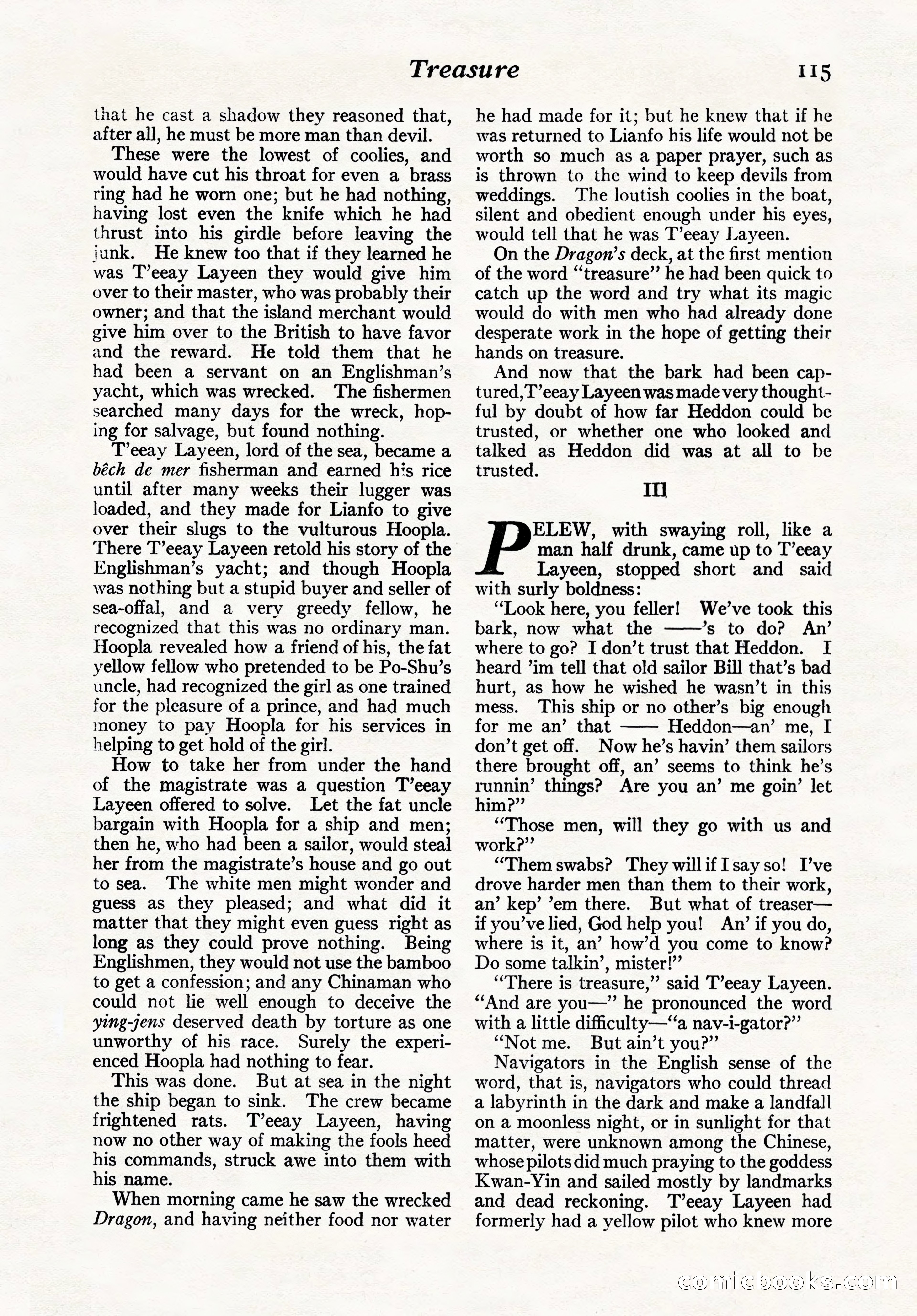
A restored page from Pulp Fiction, 1926. Page through the whole issue in the reader above.
📄 Transcribed text from this page (OCR, searchable)
Machine-transcribed from the original scan — historical spelling and the odd misread are preserved.
Treasure that he cast a shadow they reasoned that, after all, he must be more man than devil. These were the lowest of coolies, and would have cut his throat for even a brass ring had he worn one; but he had nothing, having lost even the knife which he had thrust into his girdle before leaving the junk. He knew too that if they learned he was T’eeay Layeen they would give him over to their master, who was probably their owner; and that the island merchant would give him over to the British to have favor and the reward. He told them that he had been a servant on an Englishman’s yacht, which was wrecked. The fishermen searched many days for the wreck, hop- ing for salvage, but found nothing. T’eeay Layeen, lord of the sea, became a béch de mer fisherman and earned his rice until after many weeks their lugger was loaded, and they made for Lianfo to give over their slugs to the vulturous Hoopla. There T’eeay Layeen retold his story of the Englishman’s yacht; and though Hoopla was nothing but a stupid buyer and seller of sea-offal, and a very greedy fellow, he recognized that this was no ordinary man. Hoopla revealed how a friend of his, the fat yellow fellow who pretended to be Po-Shu’s uncle, had recognized the girl as one trained for the pleasure of a prince, and had much money to pay Hoopla for his services in helping to get hold of the girl. How to take her from under the hand of the magistrate was a question T’eeay Layeen offered to solve. Let the fat uncle bargain with Hoopla for a ship and men; then he, who had been a sailor, would steal her from the magistrate’s house and go out to sea. The white men might wonder and guess as they pleased; and what did it matter that they might even guess right as long as they could prove nothing. Being Englishmen, they would not use the bamboo to get a confession; and any Chinaman who could not lie well enough to deceive the ying-jens deserved death by torture as one unworthy of his race. Surely the experi- enced Hoopla had nothing to fear. This was done. But at sea in the night the ship began to sink. The crew became frightened rats. T’eeay Layeen, having now no other way of making the fools heed his commands, struck awe into them with his name. When morning came he saw the wrecked Dragon, and having neither food nor water 115 he had made for it; but he knew that if he was returned to Lianfo his life would not be worth so much as a paper prayer, such as is thrown to the wind to keep devils from weddings. The loutish coolies in the boat, silent and obedient enough under his eyes, would tell that he was T’eeay Layeen. On the Dragon’s deck, at the first mention of the word “treasure’’ he had been quick to catch up the word and try what its magic would do with men who had already done desperate work in the hope of getting their hands on treasure. And now that the bark had been cap- tured, T’eeay Layeen was made very thought- ful by doubt of how far Heddon could be trusted, or whether one who looked and talked as Heddon did was at all to be trusted. IT] Poe with swaying roll, like a man half drunk, came up to T’eeay Layeen, stopped short and _ said with surly boldness: “Look here, you feller! We’ve took this bark, now what the ——’s to do? An’ where to go? I don’t trust that Heddon. I heard ’im tell that old sailor Bill that’s bad hurt, as how he wished he wasn’t in this mess. This ship or no other’s big enough for me an’ that Heddon—an’ me, I don’t get off. Now he’s havin’ them sailors there brought off, an’ seems to think he’s runnin’ things? Are you an’ me goin’ let him?” “‘Those men, will they go with us and work?” “Them swabs? They willifIsayso! I’ve drove harder men than them to their work, an’ kep’ ’em there. But what of treaser— if you’ve lied, God help you! An’ if you do, where is it, an’ how’d you come to know? Do some talkin’, mister!” ‘“‘There is treasure,” said T’eeay Layeen. ‘And are you—”’ he pronounced the word with a little difficulty—“a nav-i-gator?”’ “Not me. But ain’t you?” Navigators in the English sense of the word, that is, navigators who could thread a labyrinth in the dark and make a landfall on a moonless night, or in sunlight for that matter, were unknown among the Chinese, whose pilots did much praying to the goddess Kwan-Yin and sailed mostly by landmarks and dead reckoning. T’eeay Layeen had formerly had a yellow pilot who knew more COnnicloooks Cc (C@