
Pulp Fiction, 1925 · page 89 of 212
Adventure Magazine Cover, June 20, 1925 — page 89: what you’re looking at
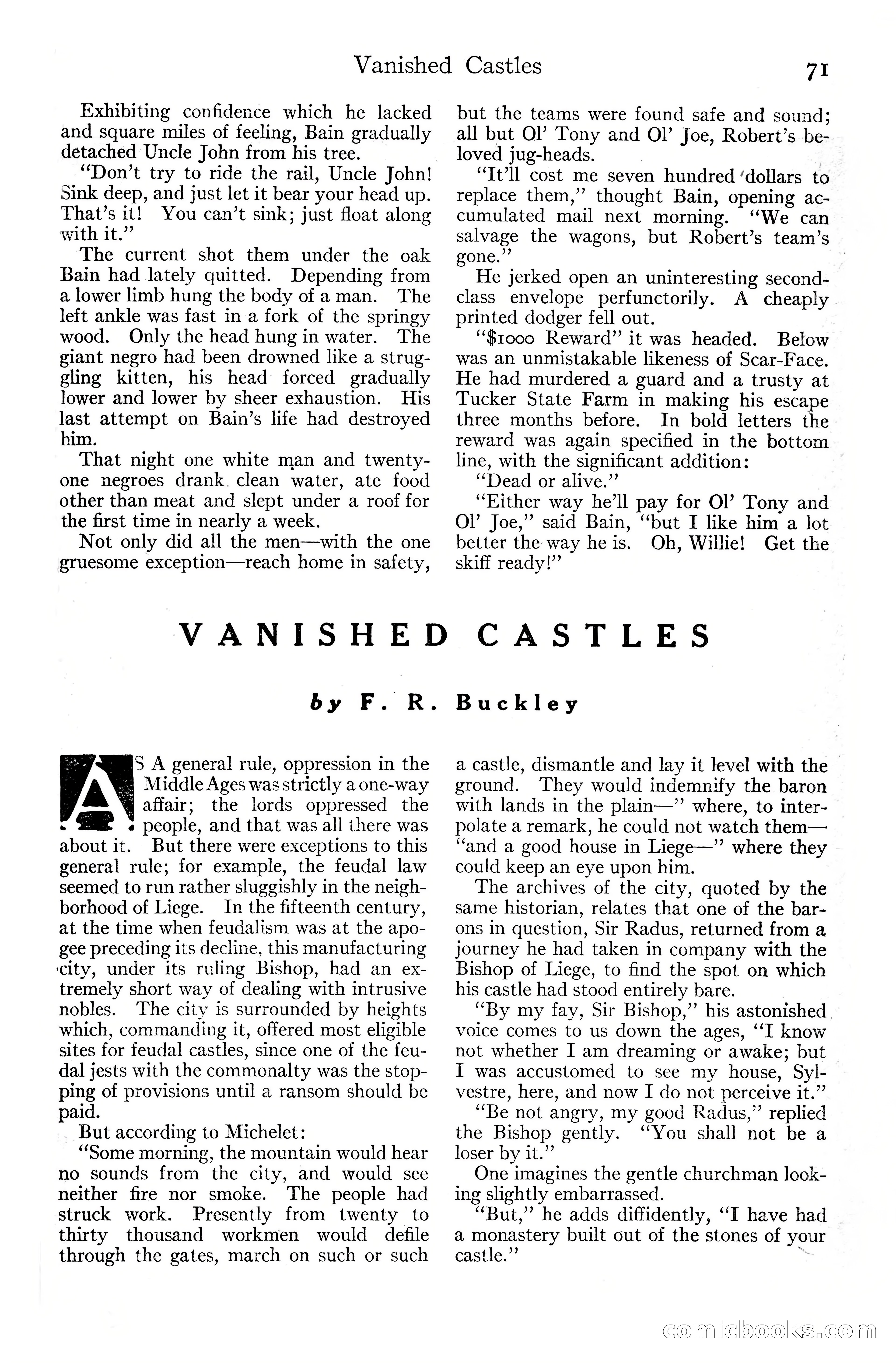
A restored page from Pulp Fiction, 1925. Page through the whole issue in the reader above.
📄 Transcribed text from this page (OCR, searchable)
Machine-transcribed from the original scan — historical spelling and the odd misread are preserved.
Vanished Castles 71 Exhibiting confidence which he lacked and square miles of feeling, Bain gradually detached Uncle John from his tree. “Don’t try to ride the rail, Uncle John! Sink deep, and just let it bear your head up. That’s it! You can’t sink; just float along with it.” The current shot them under the oak Bain had lately quitted. Depending from a lower limb hung the body of aman. The left ankle was fast in a fork of the springy wood. Only the head hung in water. The giant negro had been drowned like a strug- gling kitten, his head forced gradually lower and lower by sheer exhaustion. His last attempt on Bain’s hfe had destroyed him. That night one white man and twenty- one negroes drank. clean water, ate food other than meat and slept under a roof for the first time in nearly a week. Not only did all the men—with the one gruesome exception—reach home in safety, but the teams were found safe and sound; all but Ol’ Tony and OI’ Joe, Robert’s be- loved jug-heads. “Tt’ll cost me seven hundred ‘dollars to replace them,” thought Bain, opening ac- cumulated mail next morning. ‘We can salvage the wagons, but Robert’s team’s gone.”’ , He jerked open an uninteresting second- class envelope perfunctorily. A cheaply printed dodger fell out. “$1000 Reward” it was headed. Below was an unmistakable likeness of Scar-Face. He had murdered a guard and a trusty at Tucker State Farm in making his escape three months before. In bold letters the reward was again specified in the bottom line, with the significant addition: “Dead or alive.” “Either way he’ll pay for Ol Tony and Ol’ Joe,” said Bain, “but I like him a lot better the way he is. Oh, Willie! Get the skiff ready!” VANISHED CASTLES by F.R. maS A general rule, oppression in the me Middle Ages wasstrictly a one-way “@ affair; the lords oppressed the people, and that was all there was about it. But there were exceptions to this general rule; for example, the feudal law seemed to run rather sluggishly in the neigh- borhood of Liege. In the fifteenth century, at the time when feudalism was at the apo- gee preceding its decline, this manufacturing ‘city, under its ruling Bishop, had an ex- tremely short way of dealing with intrusive nobles. The city is surrounded by heights which, commanding it, offered most eligible sites for feudal castles, since one of the feu- dal jests with the commonalty was the stop- ping of provisions until a ransom should be paid. But according to Michelet: “‘Some morning, the mountain would hear no sounds from the city, and would see neither fire nor smoke. The people had struck work. Presently from twenty to thirty thousand workmen would defile through the gates, march on such or such Buckley a castle, dismantle and lay it level with the ground. ‘They would indemnify the baron with lands in the plain—”’ where, to inter- polate a remark, he could not watch them— ‘and a good house in Liege—”’ where they could keep an eye upon him. The archives of the city, quoted by the same historian, relates that one of the bar- ons in question, Sir Radus, returned from a journey he had taken in company with the Bishop of Liege, to find the spot on which his castle had stood entirely bare. | “By my fay, Sir Bishop,” his astonished. voice comes to us down the ages, “I know not whether I am dreaming or awake; but I was accustomed to see my house, Syl- vestre, here, and now I do not perceive it.” “Be not angry, my good Radus,”’ replied the Bishop gently. ‘You shall not be a loser by it.” One imagines the gentle churchman look- ing slightly embarrassed. “But,” he adds diffidently, ‘I have had a monastery built out of the stones of your castle.” : COMmiclboookks.CO