
Pulp Fiction, 1925 · page 84 of 212
Adventure Magazine Cover, June 20, 1925 — page 84: what you’re looking at
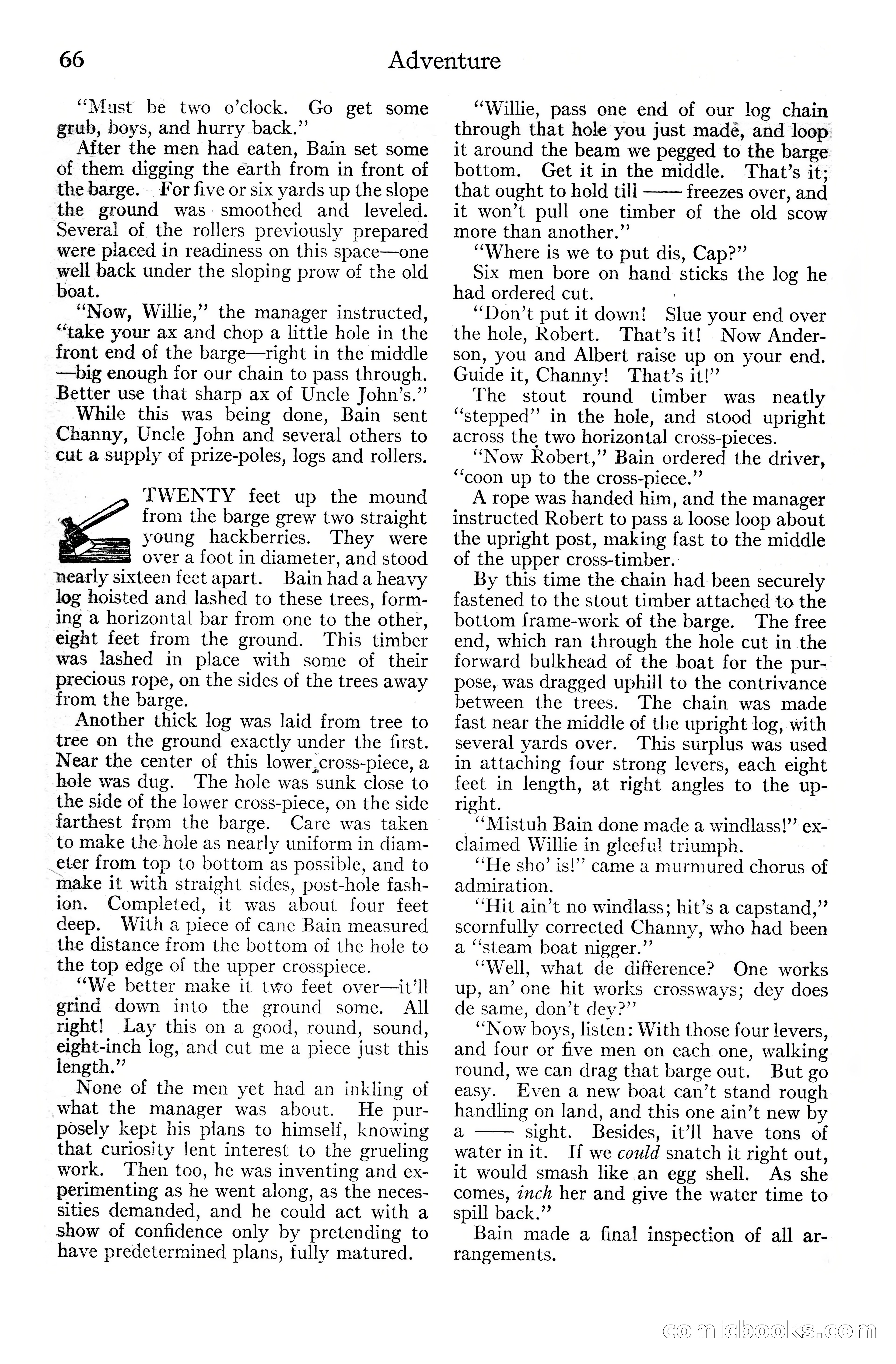
A restored page from Pulp Fiction, 1925. Page through the whole issue in the reader above.
📄 Transcribed text from this page (OCR, searchable)
Machine-transcribed from the original scan — historical spelling and the odd misread are preserved.
66 “Must be two o’clock. Go get some grub, boys, and hurry back.” Aiter the men had eaten, Bain set some of them digging the earth from in front of the barge. For five or six yards up the slope the ground was: smoothed and _ leveled. several of the rollers previously prepared were placed in readiness on this space—one well back under the sloping prow of the old boat. “Now, Willie,” the manager instructed, “take your ax and chop a little hole in the front end of the barge—right in the middle —big enough for our chain to pass through. Better use that sharp ax of Uncle John’s.” While this was being done, Bain sent Channy, Uncle John and several others to cut a supply of prize-poles, logs and rollers. TWENTY feet up the mound from the barge grew two straight \ == young hackberries. They were passes over a foot in diameter, and stood nearly sixteen feet apart. Bain hada heavy log hoisted and lashed to these trees, form- ing a horizontal bar from one to the other, eight feet from the ground. This timber was lashed in place with some of their precious rope, on the sides of the trees away from the barge. Another thick log was laid from tree to tree on the ground exactly under the first. Near the center of this lower,cross-piece, a hole was dug. The hole was sunk close to the side of the lower cross-piece, on the side farthest from the barge. Care was taken to make the hole as nearly uniform in diam- eter irom top to bottom as possible, and to make it with straight sides, post-hole fash- ion. Completed, it was about four feet deep. With a piece of cane Bain measured the distance from the bottom of the hole to the top edge of the upper crosspiece. “We better make it two feet over—it’ll grind down into the ground some. All right! Lay this on a good, round, sound, eight-inch log, and cut me a piece just this length.” _None of the men yet had an inkling of what the manager was about. He pur- posely kept his plans to himself, knowing that curiosity lent interest to the grueling work. Then too, he was inventing and ex- perimenting as he went along, as the neces- sities demanded, and he could act with a show of confidence only by pretending to have predetermined plans, fully matured. the hole, Robert. Adventure “Willie, pass one end of our log chain through that hole you just made, and loop it around the beam we pegged to the barge bottom. Get it in the middle. That’s it; that ought to hold till freezes over, and it won’t pull one timber of the old scow more than another.” ‘Where is we to put dis, Cap?” Six men bore on hand sticks the log he had ordered cut. “Don’t put it down! Slue your end over That’s it! Now Ander- son, you and Albert raise up on your end. Guide it, Channy! That’s it!” The stout round timber was neatly “stepped” in the hole, and stood upright across the two horizontal cross-pieces. ‘“‘Now Robert,” Bain ordered the driver, ‘‘coon up to the cross-piece.”’ , A rope was handed him, and the manager instructed Robert to pass a loose loop about the upright post, making fast to the middle of the upper cross-timber.. | . By this time the chain had been securely fastened to the stout timber attached to the bottom frame-work of the barge. The free end, which ran through the hole cut in the forward bulkhead of the boat for the pur- pose, was dragged uphill to the contrivance between the trees. The chain was made fast near the middle of the upright log, with several yards over. This surplus was used in attaching four strong levers, each eight feet in length, at right angles to the up- right. : ‘““Mistuh Bain done made a windlass!” ex- claimed Willie in gleeful triumph. ‘He sho’ is!”’ came a murmured chorus of admiration. ‘Hit ain’t no windlass; hit’s a capstand,” scornfully corrected Channy, who had been a “steam boat nigger.” ‘Well, what de difference? One works up, an’ one hit works crossways; dey does de same, don’t dey?”’ ‘‘Now boys, listen: With those four levers, and four or five men on each one, walking round, we can drag that barge out. But go easy. Even a new boat can’t stand rough handling on land, and this one ain’t new by a sight. Besides, it’ll have tons of water init. If we could snatch it right out, it would smash like an egg shell. As she comes, 77ch her and give the water time to spill back.” Bain made a final inspection of all ar- rangements. COMIGDIOOKSEEO