
Pulp Fiction, 1925 · page 77 of 212
Adventure Magazine Cover, June 20, 1925 — page 77: what you’re looking at
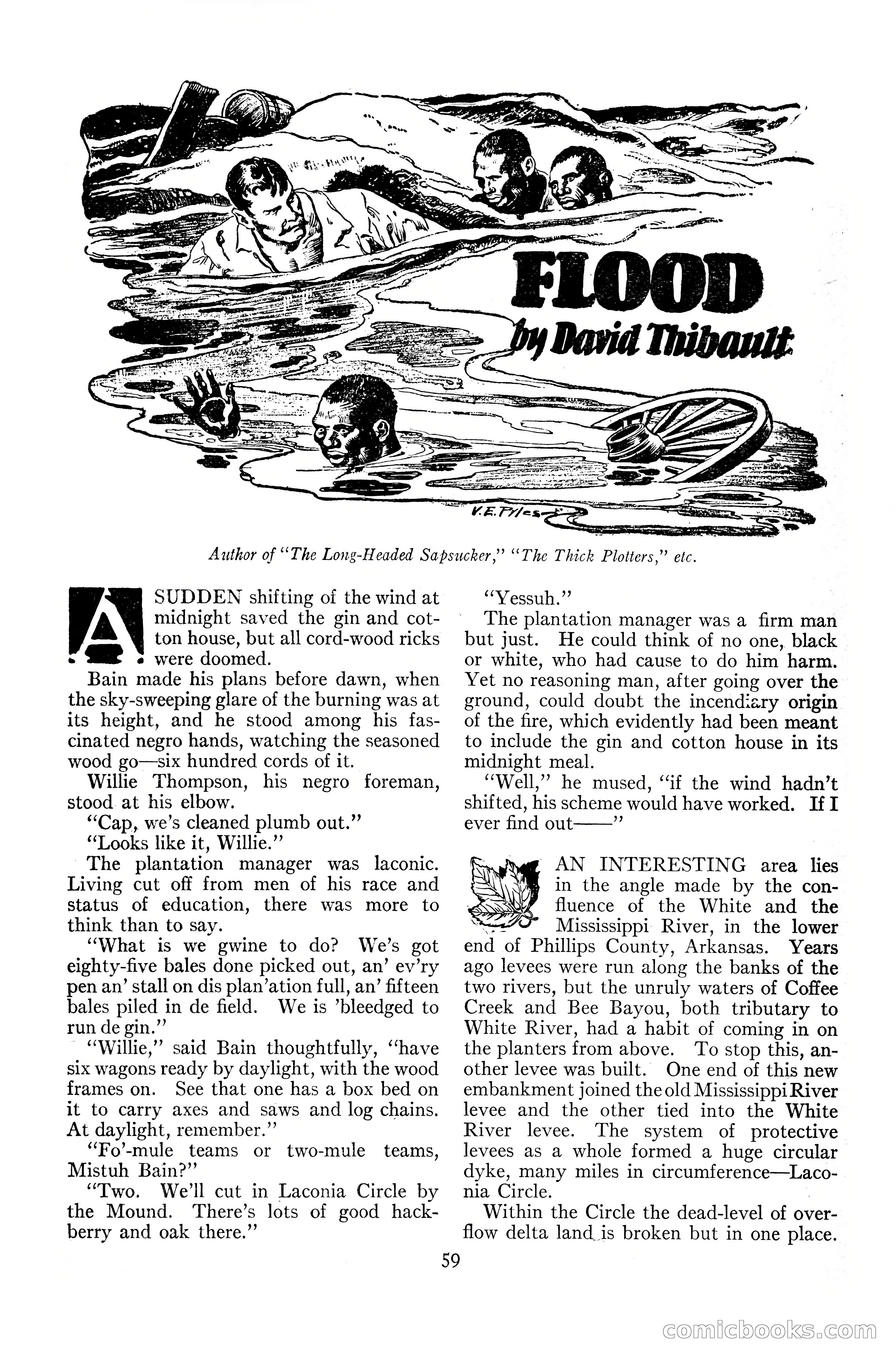
A restored page from Pulp Fiction, 1925. Page through the whole issue in the reader above.
📄 Transcribed text from this page (OCR, searchable)
Machine-transcribed from the original scan — historical spelling and the odd misread are preserved.
Author of “The Long-Headed Sapsucker,” “The Thick Plotters,” SUDDEN shifting of the wind at A midnight saved the gin and cot- ton house, but all cord-wood ricks © SP = were doomed. Bain made his plans before dawn, when the sky-sweeping glare of the burning was at its height, and he stood among his fas- cinated negro hands, watching the seasoned wood go—six hundred cords of it. Willie Thompson, his negro foreman, stood at his elbow. “Cap, we’s cleaned plumb out.” “Looks like it, Willie.” The plantation manager was laconic. Living cut off from men of his race and Status of education, there was more to think than to say. “What is we gwine to do? We’s got eighty-five bales done picked out, an’ ev’ry pen an’ stall on dis plan’ation full, an’ fifteen bales piled in de field. We is ’bleedged to run de gin.” _ “Willie,” said Bain thoughtfully, “have six wagons ready by daylight, with the wood frames on. See that one has a box bed on it to carry axes and saws and log chains. At daylight, remember.” “Fo’-mule teams or two-mule teams, Mistuh Bain?” “Two. We’ll cut in Laconia Circle by the Mound. There’s lots of good hack- berry and oak there.”’ 59 etc. ““Yessuh.”’ The plantation manager was a firm man but just. He could think of no one, black or white, who had cause to do him harm. Yet no reasoning man, after going over the ground, could doubt the incendiary origin of the fire, which evidently had been meant to include the gin and cotton house in its midnight meal. “Well,” he mused, “if the wind hadn’t shifted, his scheme would have worked. If I ever find out——”’ AN INTERESTING area lies in the angle made by the con- fluence of the White and the ) * Mississippi River, in the lower ond ‘of Phillipe County, Arkansas. Years ago levees were run along the banks of the two rivers, but the unruly waters of Coffee Creek and Bee Bayou, both tributary to White River, had a habit of coming in on the planters from above. To stop this, an- other levee was built. One end of this new embankment joined the old Mississippi River levee and the other tied into the White River levee. The system of protective levees as a whole formed a huge circular dyke, many miles in circumference—Laco- nia Circle. Within the Circle the dead-level of over- flow delta land_is broken but in one place. LOOOLK 1e@)