
Pulp Fiction, 1925 · page 58 of 212
Adventure Magazine Cover, June 20, 1925 — page 58: what you’re looking at
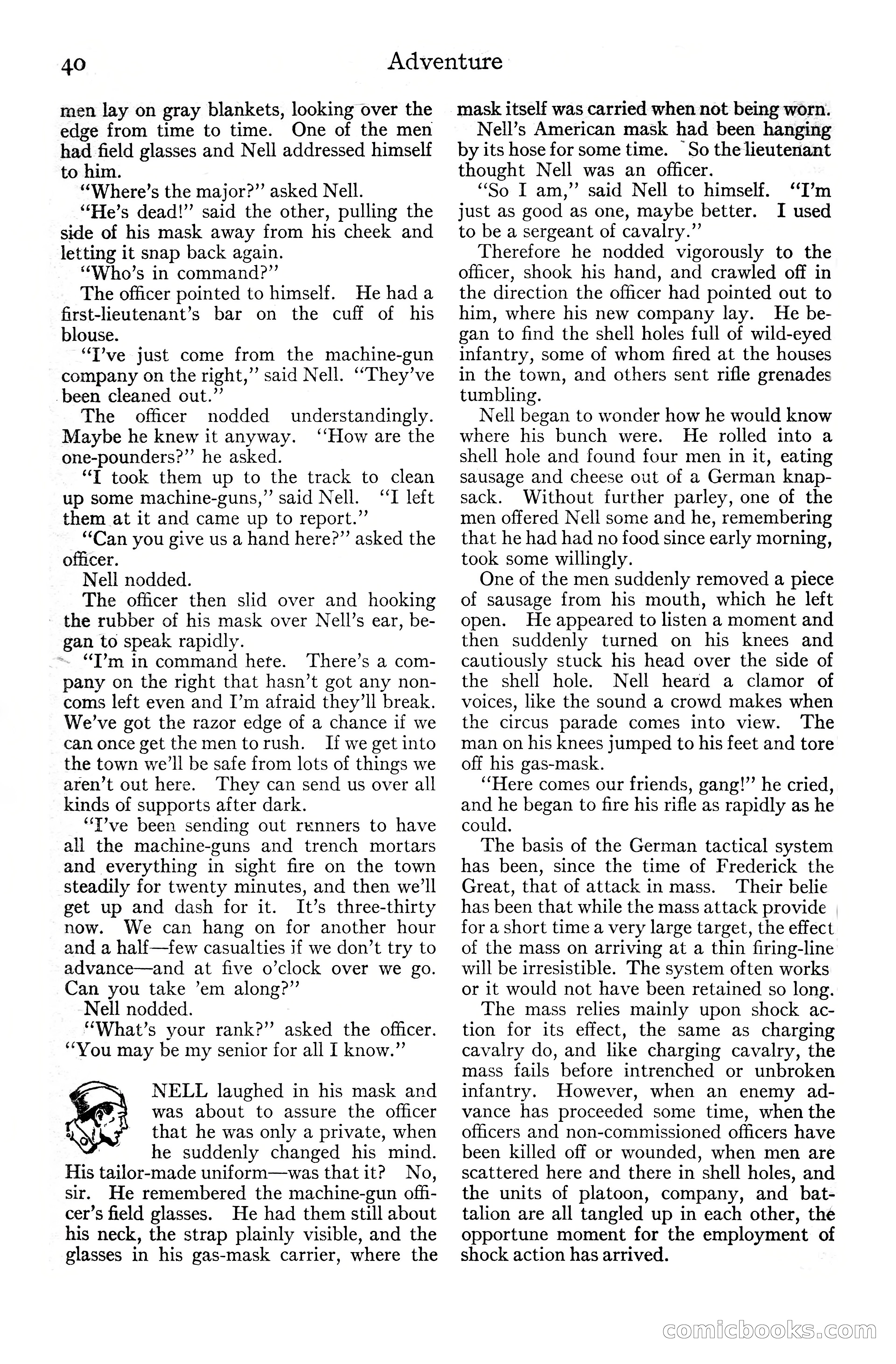
A restored page from Pulp Fiction, 1925. Page through the whole issue in the reader above.
📄 Transcribed text from this page (OCR, searchable)
Machine-transcribed from the original scan — historical spelling and the odd misread are preserved.
40 men lay on gray blankets, looking over the edge from time to time. One of the men had field glasses and Nell addressed himself to him. ‘“‘Where’s the major?”’ asked Nell. ‘“‘He’s dead!’’ said the other, pulling the side of his mask away from his cheek and letting it snap back again. “Who’s in command?” The officer pointed to himself. He hada first-lieutenant’s bar on the cuff of his blouse. “I’ve just come from the machine-gun company on the right,” said Nell. “They’ve -been cleaned out.” The officer nodded understandingly. Maybe he knew it anyway. ‘‘How are the one-pounders?”’ he asked. “Tt took them up to the track to clean up some machine-guns,” said Nell. “I left them at it and came up to report.” “Can you give us a hand here?” asked the officer. Nell nodded. The officer then slid over and hooking - the rubber of his mask over Nell’s ear, be- gan to speak rapidly. ~ “Tm in command hete. There’s a com- pany on the right that hasn’t got any non- coms left even and I’m afraid they’ll break. We've got the razor edge of a chance if we can once get the mentorush. If we get into the town we'll be safe from lots of things we aren’t out here. They can send us over all kinds of supports after dark. “Y’ve been sending out renners to have all the machine-guns and trench mortars and everything in sight fire on the town steadily for twenty minutes, and then we'll get up and dash for it. It’s three-thirty now. We can hang on for another hour and a half—few casualties if we don’t try to advance—and at five o’clock over we go. Can you take ’em along?” Nell nodded. “What’s your rank?” asked the officer. ‘You may be my senior for all I know.” NELL laughed in his mask and was about to assure the officer that he was only a private, when | he suddenly changed his mind. His tailor-made uniform—was that it? No, sir. He remembered the machine-gun off- cer’s field glasses. He had them still about his neck, the strap plainly visible, and the glasses in his gas-mask carrier, where the Adventure mask itself was carried when not being worn. Nell’s American mask had been hanging by its hose for some time. So the lieutenant thought Nell was an officer. ‘So I am,” said Nell to himself. just as good as one, maybe better. to be a sergeant of cavalry.” Therefore he nodded vigorously to the officer, shook his hand, and crawled off in the direction the officer had pointed out to him, where his new company lay. He be- gan to find the shell holes full of wild-eyed infantry, some of whom fired at the houses in the town, and others sent rifle grenades tumbling. Nell began to wonder how he would know where his bunch were. He rolled into a shell hole and found four men in it, eating sausage and cheese out of a German knap- sack. Without further parley, one of the men offered Nell some and he, remembering that he had had no food since early morning, took some willingly. One of the men suddenly removed a piece of sausage from his mouth, which he left open. He appeared to listen a moment and then suddenly turned on his knees and cautiously stuck his head over the side of the shell hole. Nell heard a clamor of voices, like the sound a crowd makes when the circus parade comes into view. The man on his knees jumped to his feet and tore off his gas-mask. ‘“‘Hlere comes our friends, gang!”’ he cried, and he began to fire his rifle as rapidly as he could. The basis of the German tactical system has been, since the time of Frederick the Great, that of attack in mass. Their belie has been that while the mass attack provide | for a short time a very large target, the effect of the mass on arriving at a thin firing-line will be irresistible. The system often works or it would not have been retained so long. The mass relies mainly upon shock ac- tion for its effect, the same as charging cavalry do, and like charging cavalry, the mass fails before intrenched or unbroken infantry. However, when an enemy ad- vance has proceeded some time, when the officers and non-commissioned officers have been killed off or wounded, when men are scattered here and there in shell holes, and the units of platoon, company, and bat- talion are all tangled up in each other, the opportune moment for the employment of shock action has arrived. “T’m I used COMIGDIOOKSEEO