
Pulp Fiction, 1925 · page 47 of 212
Adventure Magazine Cover, June 20, 1925 — page 47: what you’re looking at
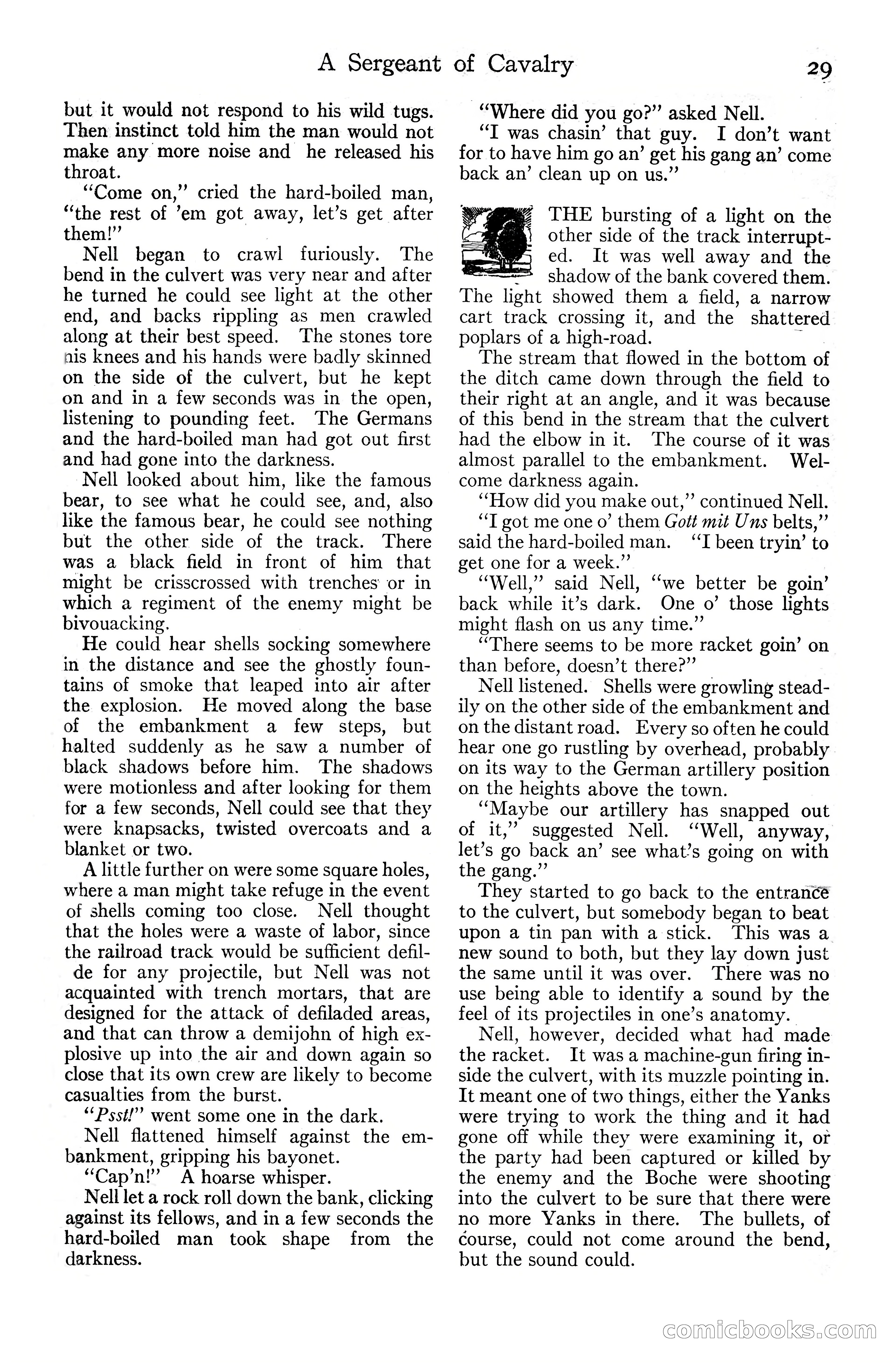
A restored page from Pulp Fiction, 1925. Page through the whole issue in the reader above.
📄 Transcribed text from this page (OCR, searchable)
Machine-transcribed from the original scan — historical spelling and the odd misread are preserved.
A Sergeant but it would not respond to his wild tugs. Then instinct told him the man would not make any more noise and he released his throat. “Come on,” cried the hard-boiled man, “the rest of ’em got away, let’s get after them!” Nell began to crawl furiously. The bend in the culvert was very near and after he turned he could see light at the other end, and backs rippling as men crawled along at their best speed. The stones tore nis knees and his hands were badly skinned on the side of the culvert, but he kept on and in a few seconds was in the open, listening to pounding feet. The Germans and the hard-boiled man had got out first and had gone into the darkness. Nell looked about him, like the famous bear, to see what he could see, and, also like the famous bear, he could see nothing but the other side of the track. There was a black field in front of him that might be crisscrossed with trenches’ or in which a regiment of the enemy might be bivouacking. He could hear shells socking somewhere in the distance and see the ghostly foun- tains of smoke that leaped into air after the explosion. He moved along the base of the embankment a few steps, but halted suddenly as he saw a number of black shadows before him. The shadows were motionless and after looking for them for a few seconds, Nell could see that they were knapsacks, twisted overcoats and a blanket or two. A little further on were some square holes, where a man might take refuge in the event of shells coming too close. Nell thought that the holes were a waste of labor, since the railroad track would be sufficient defil- de for any projectile, but Nell was not acquainted with trench mortars, that are designed for the attack of defiladed areas, and that can throw a demijohn of high ex- plosive up into the air and down again so close that its own crew are likely to become casualties from the burst. “Psst!” went some one in the dark. Nell flattened himself against the em- bankment, gripping his bayonet. “Cap'n!” A hoarse whisper. Nell let a rock roll down the bank, clicking against its fellows, and in a few seconds the hard-boiled man took shape from the darkness. ) of Cavalry 29 “Where did you go?” asked Nell. “T was chasin’ that guy. I don’ t want for to have him go an’ get his gang an’ come back an’ clean up on us.” THE bursting of a light on the other side of the track interrupt- ed. It was well away and the : shadow of the bank covered them. The he light showed them a field, a narrow cart track crossing it, and the shattered poplars of a high-road. The stream that flowed in the bottom of the ditch came down through the field to their right at an angle, and it was because of this bend in the stream that the culvert had the elbow in it. The course of it was almost parallel to the embankment. Wel- come darkness again. “How did you make out,” continued Nell. “T got me one o’ them Gott mit Uns belts,”’ said the hard-boiled man. “TI been tryin’ to get one for a week.” | “Well,” said Nell, “we better be goin’ back while it’s dark. One o’ those lights might flash on us any time.” “There seems to be more racket goin’ on than before, doesn’t there?” Nell listened. Shells were growling stead- ily on the other side of the embankment and on the distant road. Every so often he could hear one go rustling by overhead, probably on its way to the German artillery position on the heights above the town. “Maybe our artillery has snapped out of it,’ suggested Nell. “Well, anyway, let’s go back an’ see what’s going on with the gang.” They started to go back to the entrancé to the culvert, but somebody began to beat upon a tin pan with a stick. This was a new sound to both, but they lay down just the same until it was over. There was no use being able to identify a sound by the feel of its projectiles in one’s anatomy. Nell, however, decided what had made the racket. It was a machine-gun firing in- side the culvert, with its muzzle pointing in. It meant one of two things, either the Yanks were trying to work the thing and it had gone off while they were examining it, or the party had been captured or killed by the enemy and the Boche were shooting into the culvert to be sure that there were no more Yanks in there. The bullets, of course, could not come around the bend, but the sound could. MICLOOOK CO