
Pulp Fiction, 1925 · page 39 of 212
Adventure Magazine Cover, June 20, 1925 — page 39: what you’re looking at
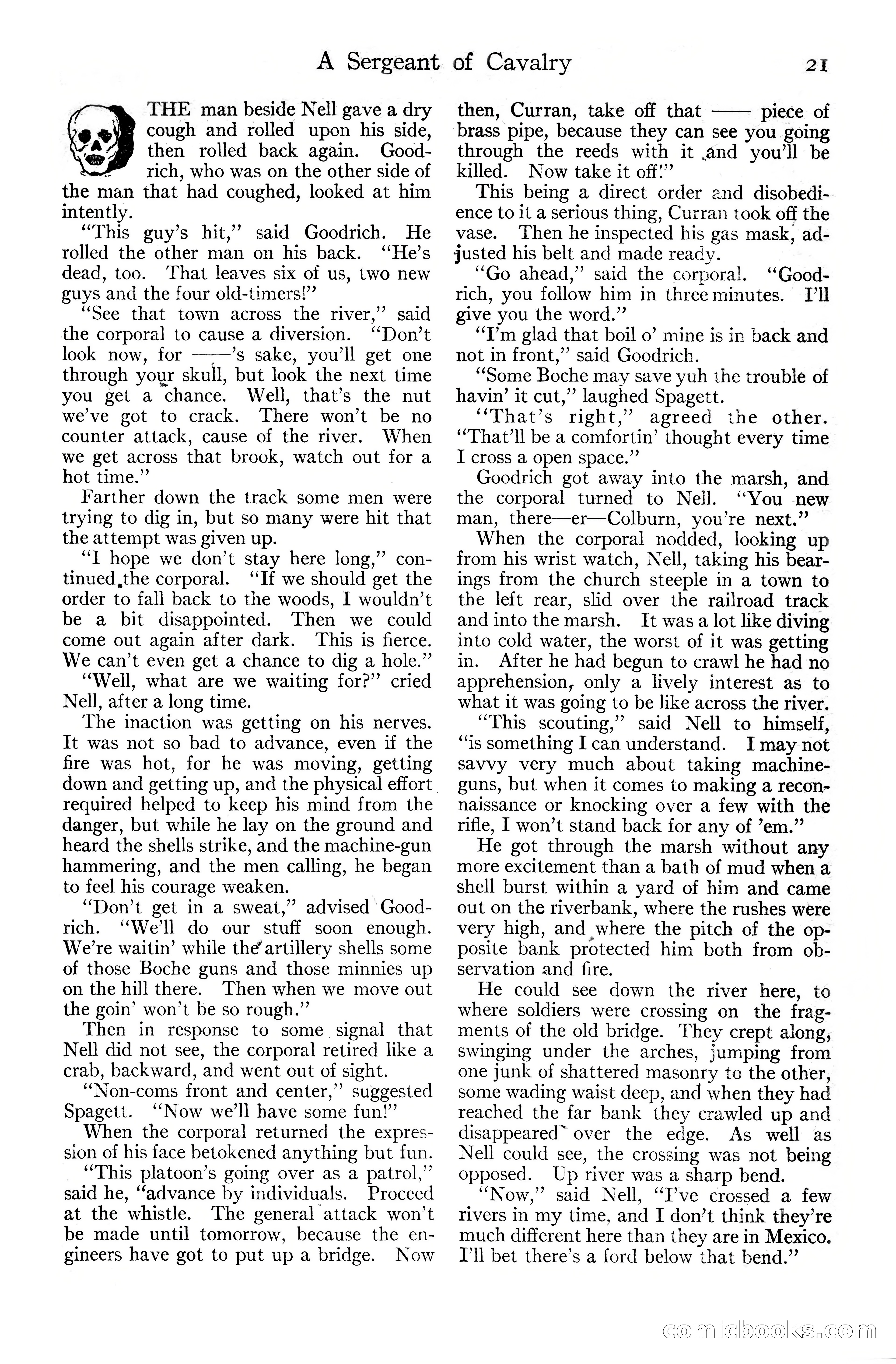
A restored page from Pulp Fiction, 1925. Page through the whole issue in the reader above.
📄 Transcribed text from this page (OCR, searchable)
Machine-transcribed from the original scan — historical spelling and the odd misread are preserved.
A Sergeant of Cavalry THE man beside Nell gave a dry cough and rolled upon his side, then rolled back again. Good- ~» rich, who was on the other side of the man that had coughed, looked at him intently. “This guy’s hit,’ said Goodrich. He rolled the other man on his back. ‘He’s dead, too. That leaves six of us, two new guys and the four old-timers!” ‘See that town across the river,” said the corporal to cause a diversion. “Don’t look now, for ’s sake, you'll get one through your skull, but look the next time you get a chance. Well, that’s the nut we've got to crack. There won’t be no counter attack, cause of the river. When we get across that brook, watch out for a hot time.” Farther down the track some men were trying to dig in, but so many were hit that the attempt was given up. “TI hope we don’t stay here long,” con- tinued,the corporal. “If we should get the order to fall back to the woods, I wouldn’t be a bit disappointed. Then we could come out again after dark. This is fierce. We can’t even get a chance to dig a hole.” “Well, what are we waiting for?” cried Nell, after a long time. The inaction was getting on his nerves. It was not so bad to advance, even if the fire was hot, for he was moving, getting down and getting up, and the physical effort. required helped to keep his mind from the danger, but while he lay on the ground and heard the shells strike, and the machine-gun hammering, and the men calling, he began to feel his courage weaken. “Don’t get in a sweat,” advised Good- rich. “We'll do our stuff soon enough. We’re waitin’ while the artillery shells some of those Boche guns and those minnies up on the hill there. Then when we move out the goin’ won’t be so rough.” Then in response to some signal that Nell did not see, the corporal retired like a crab, backward, and went out of sight. ‘“‘Non-coms front and center,” suggested Spagett. “Now we’]l have some fun!”’ When the corpora! returned the expres- sion of his face betokened anything but fun. _ “This platoon’s going over as a patrol,” said he, “advance by individuals. Proceed at the whistle. The general attack won’t be made until tomorrow, because the en- gineers have got to put up a bridge. Now 21 then, Curran, take off that piece of brass pipe, because they can see you going through the reeds with it and you'll be killed. Now take it off!’ This being a direct order and disobedi- ence to it a serious thing, Curran took off the vase. Then he inspected his gas mask, ad- justed his belt and made ready. “Go ahead,” said the corporal. ‘‘Good- rich, you follow him in threeminutes. I'll give you the word.” “T’m glad that boil 0’ mine is in back and not in front,’’ said Goodrich. ‘Some Boche may save yuh the trouble of havin’ it cut,” laughed Spagett. “‘That’s right,’ agreed the other. “That’ll be a comfortin’ thought every time I cross a open space.” Goodrich got away into the marsh, and the corporal turned to Nell. ‘You new man, there—er—Colburn, you’re next.” When the corporal nodded, looking up from his wrist watch, Nell, taking his bear- ings from the church steeple in a town to the left rear, slid over the railroad track and into the marsh. It wasa lot like diving into cold water, the worst of it was getting in. After he had begun to crawl he had no apprehension, only a lively interest as to what it was going to be like across the river. “This scouting,” said Nell to himself, “is something I can understand. I may not savvy very much about taking machine- guns, but when it comes to making a recon- naissance or knocking over a few with the rifle, I won’t stand back for any of ’em.” He got through the marsh without any more excitement than a bath of mud when a shell burst within a yard of him and came out on the riverbank, where the rushes were very high, and where the pitch of the op- posite bank protected him both from ob- servation and fire. He could see down the river here, to where soldiers were crossing on the frag- ments of the old bridge. They crept along, swinging under the arches, jumping from one junk of shattered masonry to the other, some wading waist deep, and when they had reached the far bank they crawled up and disappeared” over the edge. As well as Nell could see, the crossing was not being opposed. Up river was a sharp bend. “Now,” said Nell, “I’ve crossed a few rivers in my time, and I don’t think they’re much different here than they are in Mexico. I'll bet there’s a ford below that bend.” COMIGDIOOKSEEO