
Pulp Fiction, 1925 · page 209 of 212
Adventure Magazine Cover, June 20, 1925 — page 209: what you’re looking at
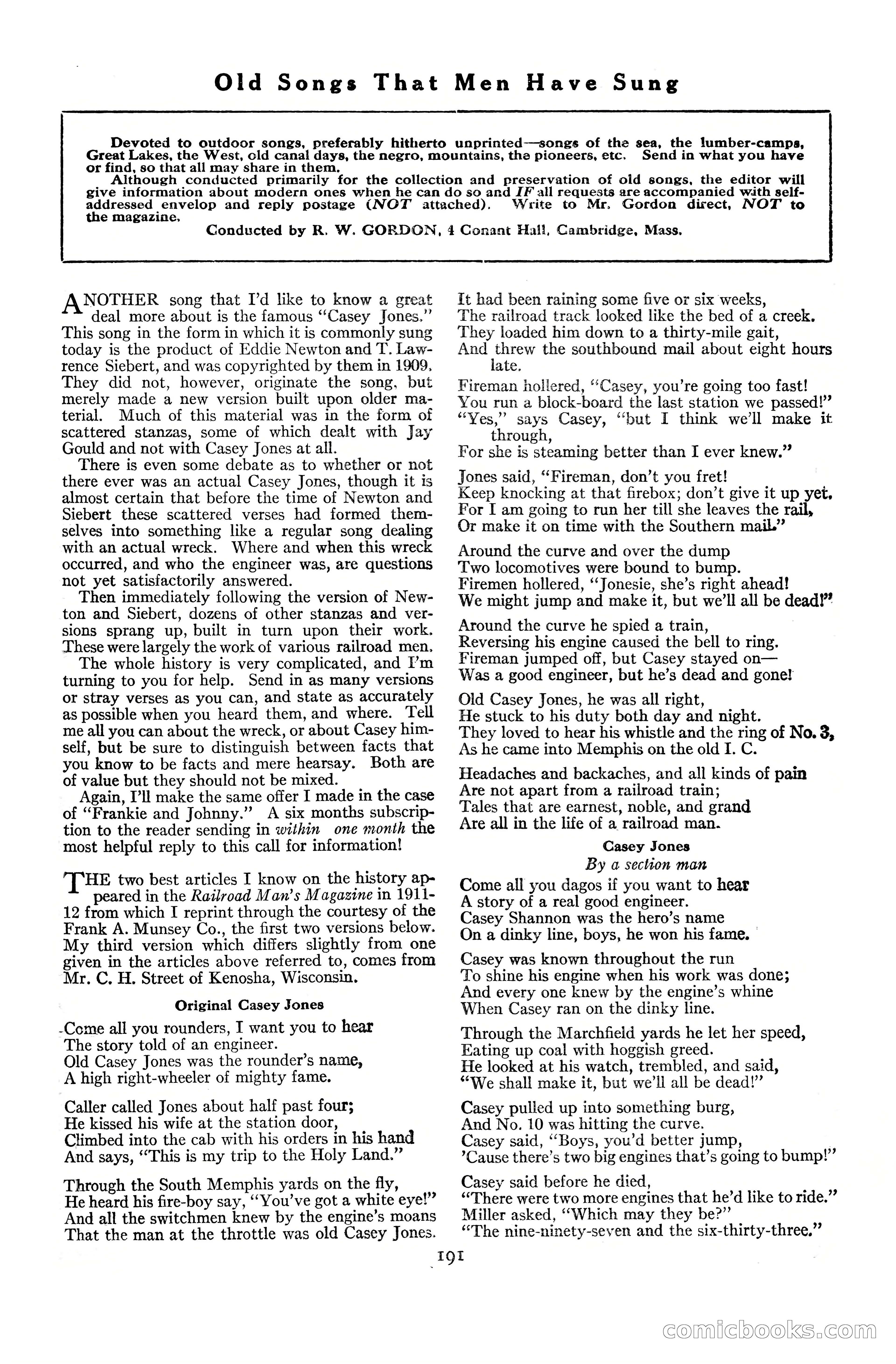
A restored page from Pulp Fiction, 1925. Page through the whole issue in the reader above.
📄 Transcribed text from this page (OCR, searchable)
Machine-transcribed from the original scan — historical spelling and the odd misread are preserved.
Old Songs That Men Have Sung Devoted to outdoor songs, preferably hitherto unprinted—songs of the sea, the lumber-camps, Great Lakes, the West, old canal days, the negro, mountains, the pioneers, etc. or find, so that all may share in them. Send in what you have Although conducted primarily for the collection and preservation of old songs, the editor will give information about modern ones when he can do so and IF all requests are accompanied with self- addressed envelop and reply postage (NOT attached). the magazine. Write to Mr, Gordon direct, NOT to Conducted by R. W. GORDON, 4 Conant Hall, Cambridge, Mass, ANOTHER song that I’d like to know a great deal more about is the famous ‘‘Casey Jones.” This song in the form in which it is commonly sung today is the product of Eddie Newton and T. Law- rence Siebert, and was copyrighted by them in 1909, They did not, however, originate the song, but merely made a new version built upon older ma- terial. Much of this material was in the form of scattered stanzas, some of which dealt with Jay Gould and not with Casey Jones at all. There is even some debate as to whether or not there ever was an actual Casey Jones, though it is almost certain that before the time of Newton and Siebert these scattered verses had formed them- selves into something like a regular song dealing with an actual wreck. Where and when this wreck occurred, and who the engineer was, are questions not yet satisfactorily answered. Then immediately following the version of New- ton and Siebert, dozens of other stanzas and ver- sions sprang up, built in turn upon their work. These were largely the work of various railroad men. The whole history is very complicated, and I’m turning to you for help. Send in as many versions or stray verses as you can, and state as accurately as possible when you heard them, and where. Tell me all you can about the wreck, or about Casey him- self, but be sure to distinguish between facts that you know to be facts and mere hearsay. Both are of value but they should not be mixed. Again, I’ll make the same offer I made in the case of “Frankie and Johnny.” <A six months subscrip- tion to the reader sending in within one month the most helpful reply to this call for information! HE two best articles I know on the history ap- peared in the Railroad Man’s Magazine in 1911- 12 from which I reprint through the courtesy of the Frank A. Munsey Co., the first two versions below. My third version which differs slightly from one given in the articles above referred to, comes from Mr. C. H. Street of Kenosha, Wisconsin. Original Casey Jones -Ceme all you rounders, I want you to hear The story told of an engineer. Old Casey Jones was the rounder’s name, A high right-wheeler of mighty fame. Caller called Jones about half past four; He kissed his wife at the station door, Climbed into the cab with his orders in his hand And says, “This is my trip to the Holy Land.” Through the South Memphis yards on the fly, He heard his fire-boy say, ““You’ve got a white eye!”” And all the switchmen knew by the engine’s moans That the man at the throttle was old Casey Jones. {t had been raining some five or six weeks, The railroad track looked like the bed of a creek. They loaded him down to a thirty-mile gait, And hal the southbound mail about eight hours ate, Fireman hoilered, “Casey, you’re going too fast! You run a block-board the last station we passed!” “Yes,” says Casey, “but I think we’ll make it through, For she is steaming better than I ever knew.” Jones said, “Fireman, don’t you fret! Keep knocking at that firebox; don’t give it up yet, For I am going to run her till she leaves the rail, Or make it on time with the Southern mail.” Around the curve and over the dump Two locomotives were bound to bump. Firemen hollered, “‘Jonesie, she’s right ahead! We might jump and make it, but we’ll all be dead!” Around the curve he spied a train, Reversing his engine caused the bell to ring. Fireman jumped off, but Casey stayed on— Was a good engineer, but he’s dead and gone! Old Casey Jones, he was all right, He stuck to his duty both day and night. They loved to hear his whistle and the ring of No. 8, As he came into Memphis on the old I. C. Headaches and backaches, and all kinds of pain Are not apart from a railroad train; Tales that are earnest, noble, and grand Are all in the life of a railroad man. Casey Jones By a section man Come all you dagos if you want to hear A story of a real good engineer. Casey Shannon was the hero’s name On a dinky line, boys, he won his fame. Casey was known throughout the run To shine his engine when his work was done; And every one knew by the engine’s whine When Casey ran on the dinky line. Through the Marchfield yards he let her speed, Eating up coal with hoggish greed. He looked at his watch, trembled, and said, “We shall make it, but we’ll all be dead!” Casey pulled up into something burg, And No. 10 was hitting the curve. Casey said, “Boys, you’d better jump, | ’Cause there’s two big engines that’s going to bump!” Casey said before he died, “There were two more engines that he’d like to ride.” Miller asked, ““Which may they be?” “The nine-ninety-seven and the six-thirty-three,”’ IgI COMmiCcboooks.Gom