
Pulp Fiction, 1925 · page 20 of 212
Adventure Magazine Cover, June 20, 1925 — page 20: what you’re looking at
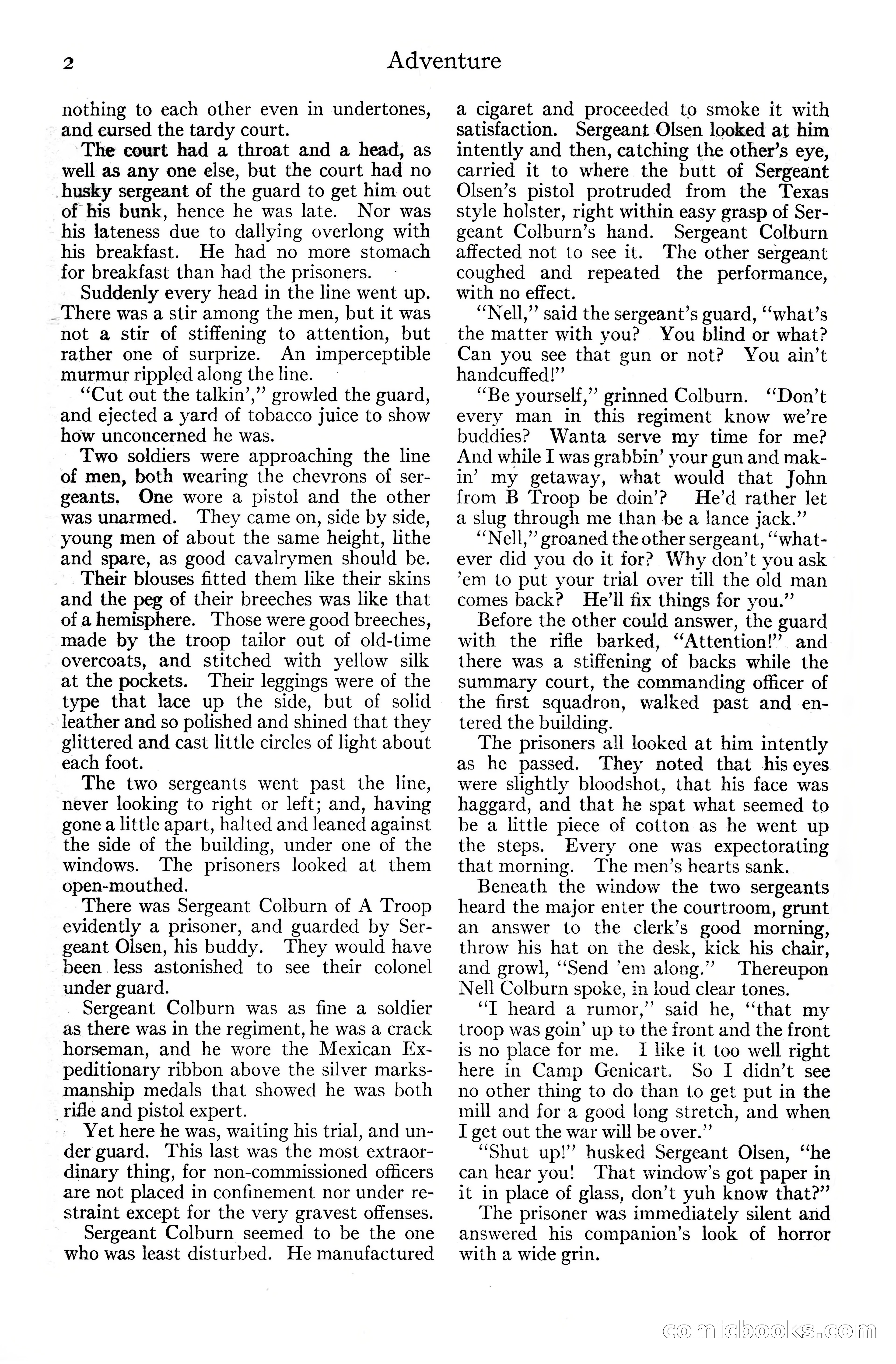
A restored page from Pulp Fiction, 1925. Page through the whole issue in the reader above.
📄 Transcribed text from this page (OCR, searchable)
Machine-transcribed from the original scan — historical spelling and the odd misread are preserved.
2 Adventure nothing to each other even in undertones, and cursed the tardy court. The court had a throat and a head, as well as any one else, but the court had no husky sergeant of the guard to get him out of his bunk, hence he was late. Nor was his lateness due to dallying overlong with his breakfast. He had no more stomach for breakfast than had the prisoners. Suddenly every head in the line went up. _ There was a stir among the men, but it was not a stir of stiffening to attention, but rather one of surprize. An imperceptible murmur rippled along the line. “Cut out the talkin’,” growled the guard, and ejected a yard of tobacco juice to show how unconcerned he was. Two soldiers were approaching the line of men, both wearing the chevrons of ser- geants. One wore a pistol and the other was unarmed. They came on, side by side, young men of about the same height, lithe and spare, as good cavalrymen should be. Their blouses fitted them like their skins and the peg of their breeches was like that of a hemisphere. Those were good breeches, made by the troop tailor out of old-time overcoats, and stitched with yellow silk at the pockets. Their leggings were of the type that lace up the side, but of solid - leather and so polished and shined that they glittered and cast little circles of light about each foot. The two sergeants went past the line, never looking to right or left; and, having gone a little apart, halted and leaned against the side of the building, under one of the windows. The prisoners looked at them open-mouthed. There was Sergeant Colburn of A Troop evidently a prisoner, and guarded by Ser- geant Olsen, his buddy. They would have been less astonished to see their colonel under guard. _ Sergeant Colburn was as fine a soldier as there was in the regiment, he was a crack horseman, and he wore the Mexican Ex- peditionary ribbon above the silver marks- manship medals that showed he was both rifle and pistol expert. Yet here he was, waiting his trial, and un- der guard. This last was the most extraor- dinary thing, for non-commissioned officers are not placed in confinement nor under re- straint except for the very gravest offenses. Sergeant Colburn seemed to be the one who was least disturbed. He manufactured a cigaret and proceeded to smoke it with satisfaction. Sergeant Olsen looked at him intently and then, catching the other’s eye, carried it to where the butt of Sergeant Olsen’s pistol protruded from the Texas style holster, right within easy grasp of Ser- geant Colburn’s hand. Sergeant Colburn affected not to see it. The other sergeant coughed and repeated the performance, with no effect. “Nell,” said the sergeant’s guard, “‘what’s the matter with you? You blind or what? Can you see that gun or not? You ain’t handcuffed!” ‘Be yourself,” grinned Colburn. ‘Don’t every man in this regiment know we’re buddies? Wanta serve my time for me? And while I was grabbin’ your gun and mak- in’? my getaway, what would that John from B Troop be doin’? MHe’d rather let a slug through me than be a lance jack.” “Nell,” groaned the other sergeant, ‘‘what- ever did you do it for? Why don’t you ask "em to put your trial over till the old man comes back? He’ll fix things for you.” Before the other could answer, the guard with the rifle barked, “Attention!” and there was a stiffening of backs while the summary court, the commanding officer of the first squadron, walked past and en- tered the building. The prisoners all looked at him intently as he passed. They noted that his eyes were slightly bloodshot, that his face was haggard, and that he spat what seemed to be a little piece of cotton as he went up the steps. Every one was expectorating that morning. The men’s hearts sank. Beneath the window the two sergeants heard the major enter the courtroom, grunt an answer to the clerk’s good morning, throw his hat on the desk, kick his chair, and growl, ‘Send ’em along.” Thereupon Nell Colburn spoke, in loud clear tones. “T heard a rumor,” said he, “that my troop was goin’ up to the iront and the front is no place for me. I like it too well right here in Camp Genicart. So I didn’t see no other thing to do than to get put in the mill and for a good long stretch, and when I get out the war will be over.” “Shut up!” husked Sergeant Olsen, ‘‘he can hear you! That window’s got paper in it in place of glass, don’t yuh know that?” The prisoner was immediately silent and answered his companion’s look of horror with a wide grin. COMIGDIOOKSEEO