
Pulp Fiction, 1925 · page 115 of 212
Adventure Magazine Cover, June 20, 1925 — page 115: what you’re looking at
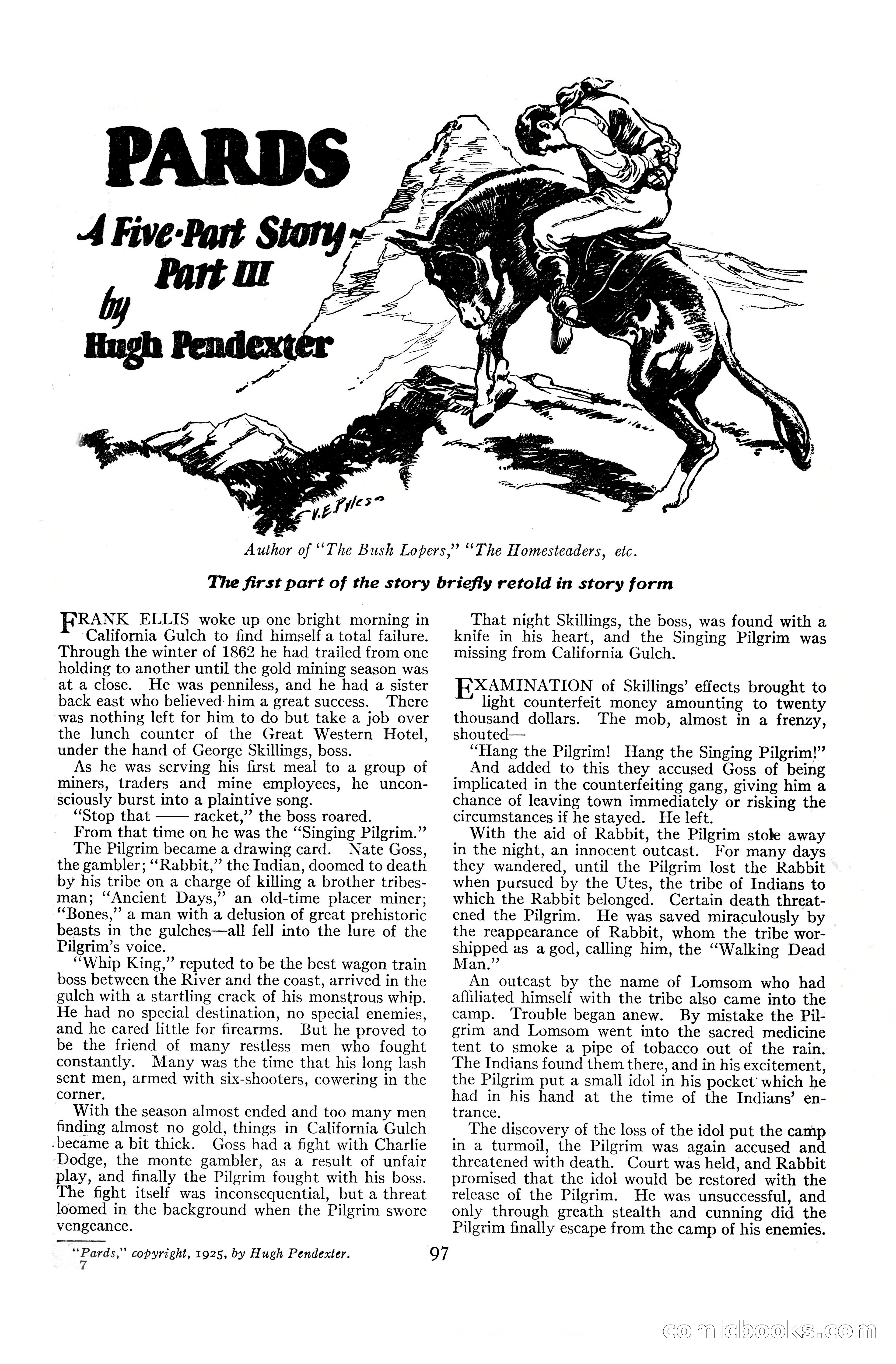
A restored page from Pulp Fiction, 1925. Page through the whole issue in the reader above.
📄 Transcribed text from this page (OCR, searchable)
Machine-transcribed from the original scan — historical spelling and the odd misread are preserved.
8 ON Po ata Author of “The Bush Lopers,’”’ “The Homesteaders, etc. The first part of the story briefly retold in story form FRAN K ELLIS woke up one bright morning in California Gulch to find himself a total failure. Through the winter of 1862 he had trailed from one holding to another until the gold mining season was at a close. He was penniless, and he had a sister back east who believed-him a great success. There was nothing left for him to do but take a job over the lunch counter of the Great Western Hotel, under the hand of George Skillings, boss. As he was serving his first meal to a group of miners, traders and mine employees, he uncon- sciously burst into a plaintive song. “Stop that racket,” the boss roared. From that time on he was the “Singing Pilgrim.”’ The Pilgrim became a drawing card. Nate Goss, the gambler; ‘“‘Rabbit,”’ the Indian, doomed to death by his tribe on a charge of killing a brother tribes- man; “Ancient Days,” an old-time placer miner; “Bones,” a man with a delusion of great prehistoric beasts in the gulches—all fell into the lure of the Pilgrim’s voice. ‘Whip King,” reputed to be the best wagon train boss between the River and the coast, arrived in the gulch with a startling crack of his monstrous whip. He had no special destination, no special enemies, and he cared little for firearms. But he proved to be the friend of many restless men who fought constantly. Many was the time that his long lash sent men, armed with six-shooters, cowering in the corner. With the season almost ended and too many men finding almost no gold, things in California Gulch -became a bit thick. Goss had a fight with Charlie Dodge, the monte gambler, as a result of unfair play, and finally the Pilgrim fought with his boss. The fight itself was inconsequential, but a threat loomed in the background when the Pilgrim swore vengeance. aan copyright, 1925, by Hugh Pendexter. 97 That night Skillings, the boss, was found with a knife in his heart, and the Singing Pilgrim was missing from California Gulch. HXAMINATION of Skillings’ effects brought to light counterfeit money amounting to twenty thousand dollars. The mob, almost in a frenzy, shouted— “Hang the Pilgrim! Hang the Singing Pilgrim!” And added to this they accused Goss of being implicated in the counterfeiting gang, giving him a chance of leaving town immediately or risking the circumstances if he stayed. He left. With the aid of Rabbit, the Pilgrim stoke away in the night, an innocent outcast. For many days they wandered, until the Pilgrim lost the Rabbit when pursued by the Utes, the tribe of Indians to which the Rabbit belonged. Certain death threat- ened the Pilgrim. He was saved miraculously by the reappearance of Rabbit, whom the tribe wor- shipped as a god, calling him, the ‘‘Walking Dead Man.” An outcast by the name of Lomsom who had affiliated himself with the tribe also came into the camp. Trouble began anew. By mistake the Pil- grim and Lomsom went into the sacred medicine tent to smoke a pipe of tobacco out of the rain. The Indians found them there, and in his excitement, the Pilgrim put a small idol in his pocket’ which he had in his hand at the time of the Indians’ en- trance, The discovery of the loss of the idol put the camp in a turmoil, the Pilgrim was again accused and threatened with death. Court was held, and Rabbit promised that the idol would be restored with the release of the Pilgrim. He was unsuccessful, and only through greath stealth and cunning did the Pilgrim finally escape from the camp of his enemies. LOOOLK 1e@)