
Pulp Fiction, 1925 · page 90 of 196
Adventure Magazine Cover — page 90: what you’re looking at
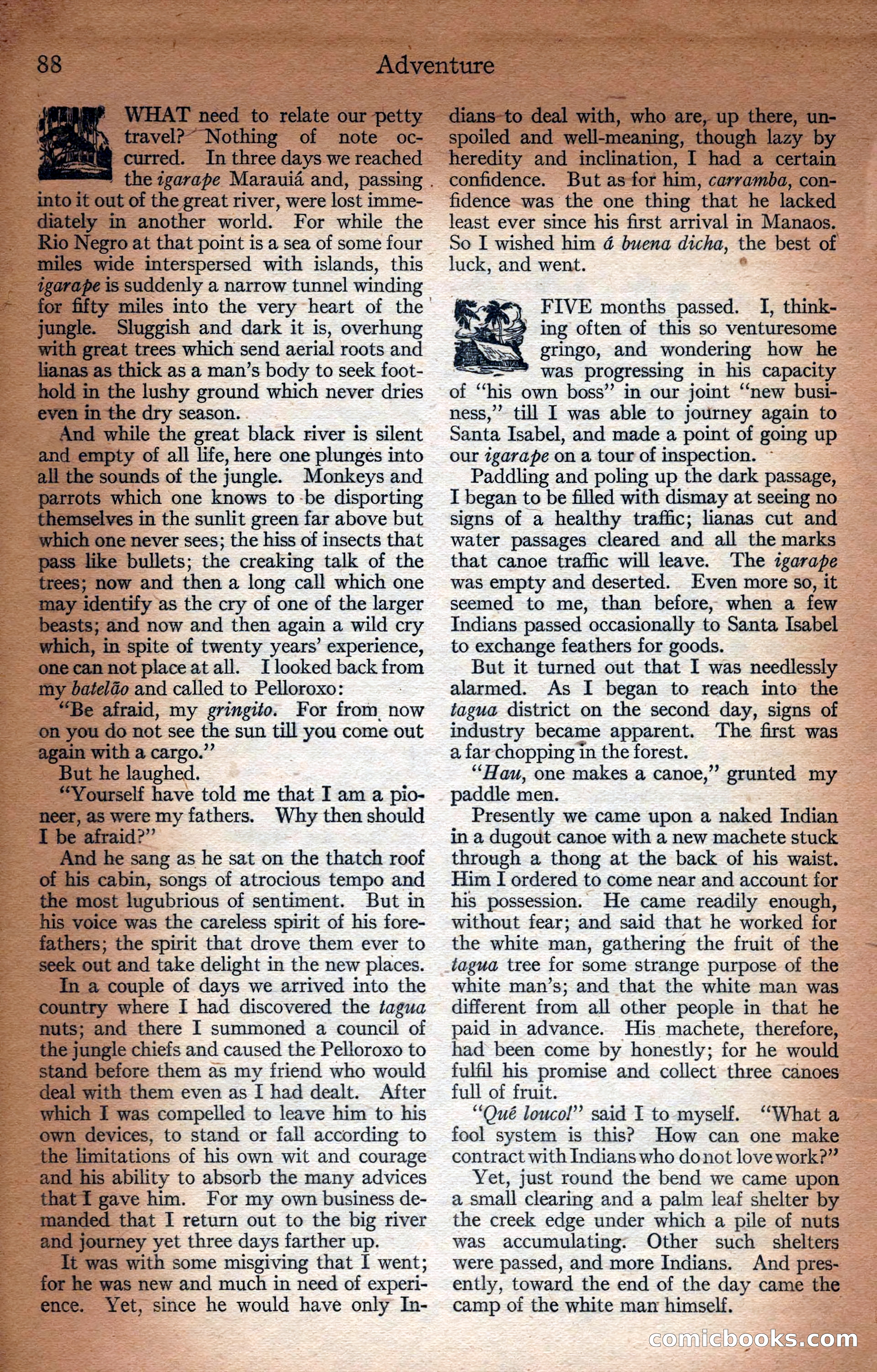
A restored page from Pulp Fiction, 1925. Page through the whole issue in the reader above.
📄 Transcribed text from this page (OCR, searchable)
Machine-transcribed from the original scan — historical spelling and the odd misread are preserved.
ier )=©6WHAT need to relate our petty @agmewts travel?~ Nothing of note oc- waeekee curred. In three days we reached into it out of the great river, were lost imme- diately in another world. For while the Rio Negro at that point is a sea of some four miles wide interspersed with islands, this igarape is suddenly a narrow tunnel winding for ifty miles into the very heart of the jungle. Sluggish and dark it is, overhung with great trees which send aerial roots and lianas as thick as a man’s body to seek foot- hold in the lushy ground which never dries even in the dry season. And while the great black river is silent and empty of all life, here one plunges into all the sounds of the jungle. Monkeys and parrots which one knows to -be disporting themselves in the sunlit green far above but which one never sees; the hiss of insects that pass like bullets; the creaking talk of the trees; now and then a long call which one may identify as the cry of one of the larger beasts; and now and then again a wild cry which, in spite of twenty years’ experience, one cannot placeatall. I looked back from my bateldo and called to Pelloroxo: “Be afraid, my gringito. For from now on you do not see the sun till you come out ain with a cargo.” But he laughed. “Yourself have told me that I am a pio- neer, as were my fathers. Why then should I be afraid?”’ And he sang as he sat on the thatch roof of his cabin, songs of atrocious tempo and the most lugubrious of sentiment. But in his voice was the careless spirit of his fore- fathers; the spirit that drove them ever to seek out and take delight in the new places. In a couple of days we arrived into the country where I had discovered the tagua nuts; and there I summoned a council of the jungle chiefs and caused the Pelloroxo to Stand before them as my friend who would deal with them even as I had dealt. After which I was compelled to leave him to his Own devices, to stand or fall according to the limitations of his own wit and courage and his ability to absorb the many advices thati gave him. For my own business de- manded that I return out to the big river and journey yet three days farther up. lt was with some misgiving that I went; for he was new and much in need of experi- ence. Yet, since he would have only In- the igarape Marauia and, passing . Adventure dians-to deal with, who are, up there, un- spoiled and well-meaning, though lazy by heredity and inclination, I had a certain confidence. But asfor him, carramba, con- fidence was the one thing that he lacked least ever since his first arrival in Manaos. So I wished him @ buena dicha, the best of luck, and went. FIVE months passed. I, think- } ing often of this so venturesome gringo, and wondering how he was progressing in his capacity of “Chis own boss” in our joint ‘‘new busi- ness,” till I was able to journey again to Santa Isabel, and made a point of going up our igarape on a tour of inspection. Paddling and poling up the dark passage, I began to be filled with dismay at seeing no signs of a healthy traffic; lianas cut and water passages cleared and all the marks that canoe traffic will leave. The zgarape was empty and deserted. Even more 50, it seemed to me, than before, when a few Indians passed occasionally to Santa Isabel to exchange feathers for goods. But it turned out that I was needlessly alarmed. As I began to reach into the tagua district on the second day, signs of industry became apparent. ‘The first was a far chopping in the forest. “Hau, one makes a canoe,” grunted my paddle men. Presently we came upon a naked Indian in a dugout canoe with a new machete stuck through a thong at the back of his waist. Him I ordered to come near and account for his possession. He came readily enough, without fear; and said that he worked for the white man, gathering the fruit of the tagua tree for some strange purpose of the white man’s; and that the white man was different from all other people in that he paid in advance. His machete, therefore, had been come by honestly; for he would fulfil his promise and collect three canoes full of fruit. “Oué louco!l” said I to myself. “What a fool system is this? How can one make contract with Indians who donot love work?” Yet, just round the bend we came upon a small clearing and a palm leaf shelter by the creek edge under which a pile of nuts was accumulating: Other such shelters were passed, and more Indians. And pres- ently, toward the end of the day came the camp of the white man himself. CONRMIELOCL) cS com