
Pulp Fiction, 1925 · page 87 of 196
Adventure Magazine Cover — page 87: what you’re looking at
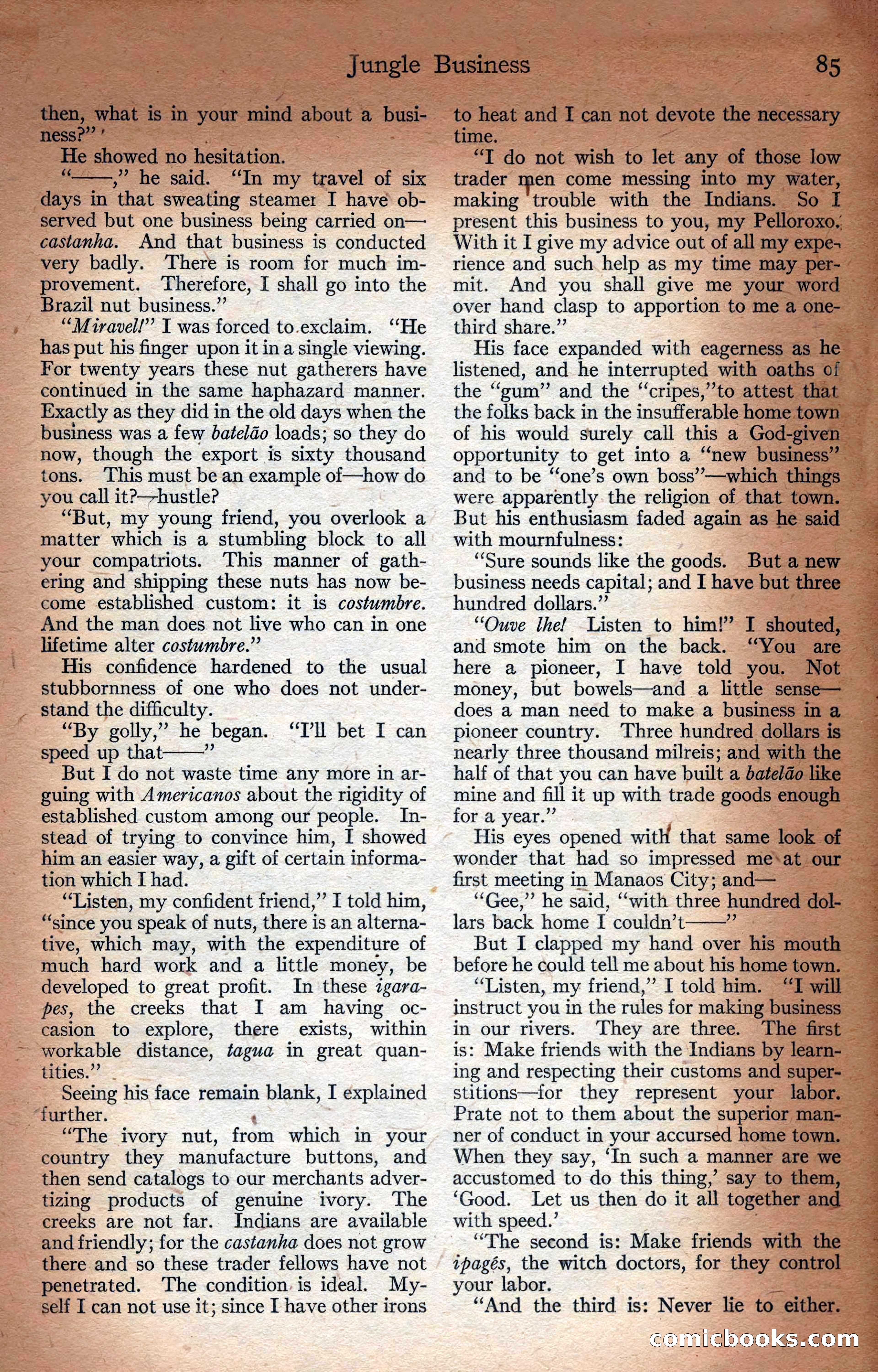
A restored page from Pulp Fiction, 1925. Page through the whole issue in the reader above.
📄 Transcribed text from this page (OCR, searchable)
Machine-transcribed from the original scan — historical spelling and the odd misread are preserved.
Jungle Business — 85 | then, what is in your mind about a busi- ness?” ’ He showed no hesitation. “——..”” he said. “In my travel of six days in that sweating steamer I have ob- served but one business being carried on— castanha. And that business is conducted very badly. There is room for much im- provement. ‘Therefore, I shall go into the Brazil nut business.” “Miuravell” I was forced to.exclaim. ‘‘He has put his finger upon it in a single viewing. For twenty years these nut gatherers have continued in the same haphazard manner. Exactly as they did in the old days when the business was a few bateldo loads; so they do now, though the export is sixty thousand tons. This must be an example of—how do you call it?—hustle? “But, my young friend, you overlook a matter which is a stumbling block to all your compatriots. This manner of gath- ering and shipping these nuts has now be- come established custom: it is costumbre. And the man does not live who can in one lifetime alter costumbre.” His confidence hardened to the usual stubbornness of one who does not under- stand the difficulty. “By golly,” he began. speed up tha But I do not waste time any more in ar- guing with Americanos about the rigidity of established custom among our people. In- stead of trying to convince him, I showed him an easier way, a gift of certain informa- tion which I had. “Listen, my confident friend,” I told him, “since you speak of nuts, there is an alterna- tive, which may, with the expenditure of much hard work and a little money, be developed to great profit. In these zgara- pes, the creeks that I am having oc- casion to explore, there exists, within workable distance, tagua in great quan- tities.” Seeing his face remain blank, I explained ‘further. “The ivory nut, from which in your country they manufacture buttons, and then send catalogs to our merchants adver- tizing products of genuine ivory. The creeks are not far. Indians are available and friendly; for the castanha does not grow there and so these trader fellows have not penetrated. The condition is ideal. My- self I can not use it; since I have other irons “Tl bet I can to heat and I can not devote the necessary time. : “T do not wish to let any of those low trader men come messing into my water, making ‘trouble with the Indians. So I present this business to you, my Pelloroxo, With it I give my advice out of all my expe: rience and such help as my time may per- mit. And you shall give me your word over hand clasp to apportion to me 4 one- third share.” His face expanded with eagerness as he listened, and he interrupted with oaths o7 the “gum” and the “‘cripes,’’to attest that the folks back in the insufferable home town of his would surely call this a God-given opportunity to get into a “new business” and to be ‘‘one’s own boss”—which things were apparently the religion of that town. But his enthusiasm faded again as he said with mournfulness: | “Sure sounds like the goods. But a new business needs capital; and I have but three hundred dollars.” “Ouve lhe! Listen to him!” I shouted, and smote him on the back. “You are here a pioneer, I have told you. Not money, but bowels—and a little sense— does a man need to make a business in @ pioneer country. Three hundred dollars is nearly three thousand milreis; and with the half of that you can have built a bateldao like mine and fill it up with trade goods enough for a year.” | His eyes opened with that same look of wonder that had so impressed me*at our first meeting in Manaos City; and— “Gee,” he said, ‘‘with three hundred dol- lars back home I couldn’t bi But I clapped my hand over his mouth before he could tell me about his home town. “Listen, my friend,” I told him. “I will instruct you in the rules for making business in our rivers. ‘They are three. The first is: Make friends with the Indians by learn-= ing and respecting their customs and super- stitions—for they represent your labor, Prate not to them about the superior man- ner of conduct in your accursed home town. When they say, ‘In such a manner are we accustomed to do this thing,’ say to them, ‘Good. Let us then do it all together and with speed.’ | “The second is: Make friends with the ipagés, the witch doctors, for they control your labor. “And the third is: Never lie to either. Gomicbooks.com