
Pulp Fiction, 1925 · page 84 of 196
Adventure Magazine Cover — page 84: what you’re looking at
A restored page from Pulp Fiction, 1925. Page through the whole issue in the reader above.
📄 Transcribed text from this page (OCR, searchable)
Machine-transcribed from the original scan — historical spelling and the odd misread are preserved.
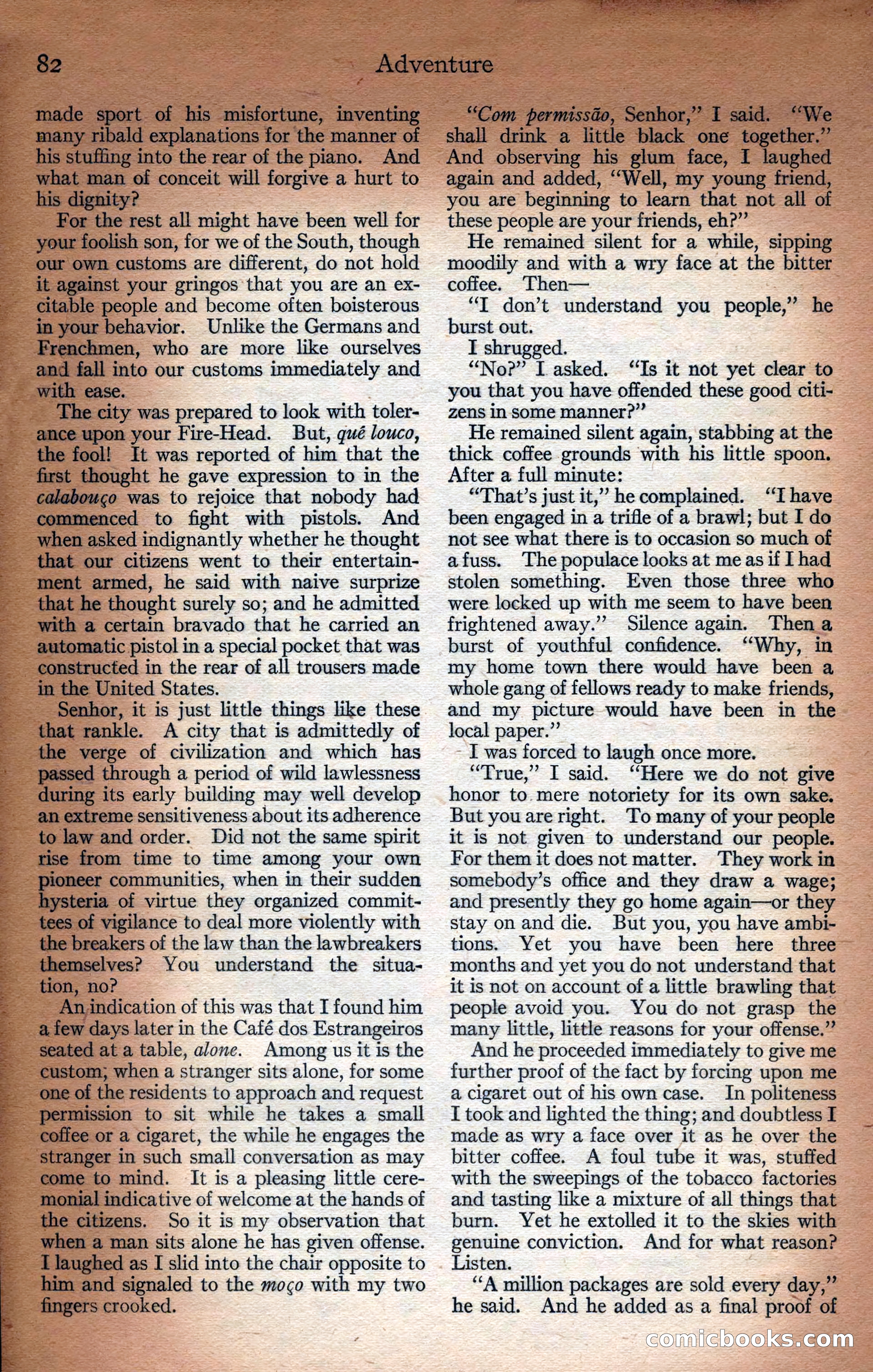
On Ra ee eee hak RR fa"? a = ° 82 / _ Adventure made sport of his misfortune, inventing many ribald explanations for the manner of his stuffing into the rear of the piano. And what man of conceit will forgive a hurt to his dignity? For the rest all might have been well for your foolish son, for we of the South, though our own customs are different, do not hold it against your gringos that you are an ex- citable people and become often boisterous in your behavior. Unlike the Germans and Frenchmen, who are more like ourselves and fall into our customs immediately and with ease. The city was prepared to look with toler- ance upon your Fire-Head. But, qué louco, the fool! It was reported of him that the first thought he gave expression to in the calabouco was to rejoice that nobody had commenced to fight with pistols. And when asked indignantly whether he thought that our citizens went to their entertain- ment armed, he said with naive surprize that he thought surely so; and he admitted with a certain bravado that he carried an automatic pistol in a special pocket that was constructed in the rear of all trousers made in the United States. Senhor, it is just little things like these that rankle. A city that is admittedly of the verge of civilization and which has passed through a period of wild lawlessness during its early building may well develop an extreme sensitiveness about its adherence to law and order. Did not the same spirit rise from time to time among your own pioneer communities, when in their sudden hysteria of virtue they organized commit- tees of vigilance to deal more violently with the breakers of the law than the lawbreakers themselves? You understand the situa- tion, no? An indication of this was that I found him a. few days later in the Café dos Estrangeiros seated ata table, alone. Among us it is the custom, when a stranger sits alone, for some one of the residents to approach and request permission to sit while he takes a small coffee or a cigaret, the while he engages the Stranger in such small conversation as may come to mind. It is a pleasing little cere- monial indicative of welcome at the hands of the citizens. So it is my observation that when a man sits alone he has given offense. I laughed as I slid into the chair opposite to him and signaled to the moco with my two fingers crooked. “Com permissdo, Senhor,” I said. “We shall drink a little black one together.” And observing his glum face, I laughed again and added, ‘Well, my young friend, you are beginning to learn that not all of these people are your friends, eh?” He remained silent for a while, sipping moodily and with a wry face at the bitter coffee. Then— “T don’t understand you people,” he burst out. I shrugged. “No?” L asked. “Is it not yet clear to you that you have offended these good citi- zens In some manner?” He remained silent again, stabbing at the thick coffee grounds with his little spoon. After a full minute: “That’s just it,” he complained. “TI have been engaged in a trifle of a brawl; but I do not see what there is to occasion so much of afuss. The populace looks at meas if I had stolen something. Even those three who were locked up with me seem to have been frightened away.” Silence again. Then a burst of youthful confidence. “‘Why, in my home town there would have been a whole gang of fellows ready to make friends, and my picture would have been in the local paper.” I was forced to laugh once more. ‘True,’ I said. “Here we do not give honor to.mere notoriety for its own sake. But you are right. To many of your people it is not given to understand our people. For them it does not matter. They work in somebody’s office and they draw a wage; and presently they go home again—or they stay on and die. But you, you have ambi- tions. Yet you have been here three months and yet you do not understand that it is not on account of a little brawling that people avoid you. You do not grasp the many little, little reasons for your offense.” And he proceeded immediately to give me further proof of the fact by forcing upon me a cigaret out of his own case. In politeness I took and lighted the thing; and doubtless I made as wry a face over it as he over the bitter coffee. A foul tube it was, stuffed with the sweepings of the tobacco factories and tasting like a mixture of all things that burn. Yet he extolled it to the skies with genuine conviction. And for what reason? Listen. ‘‘A million packages are sold every day,” he said. And he added as a final proof of Gomichbooks.com