
Pulp Fiction, 1925 · page 70 of 196
Adventure Magazine Cover — page 70: what you’re looking at
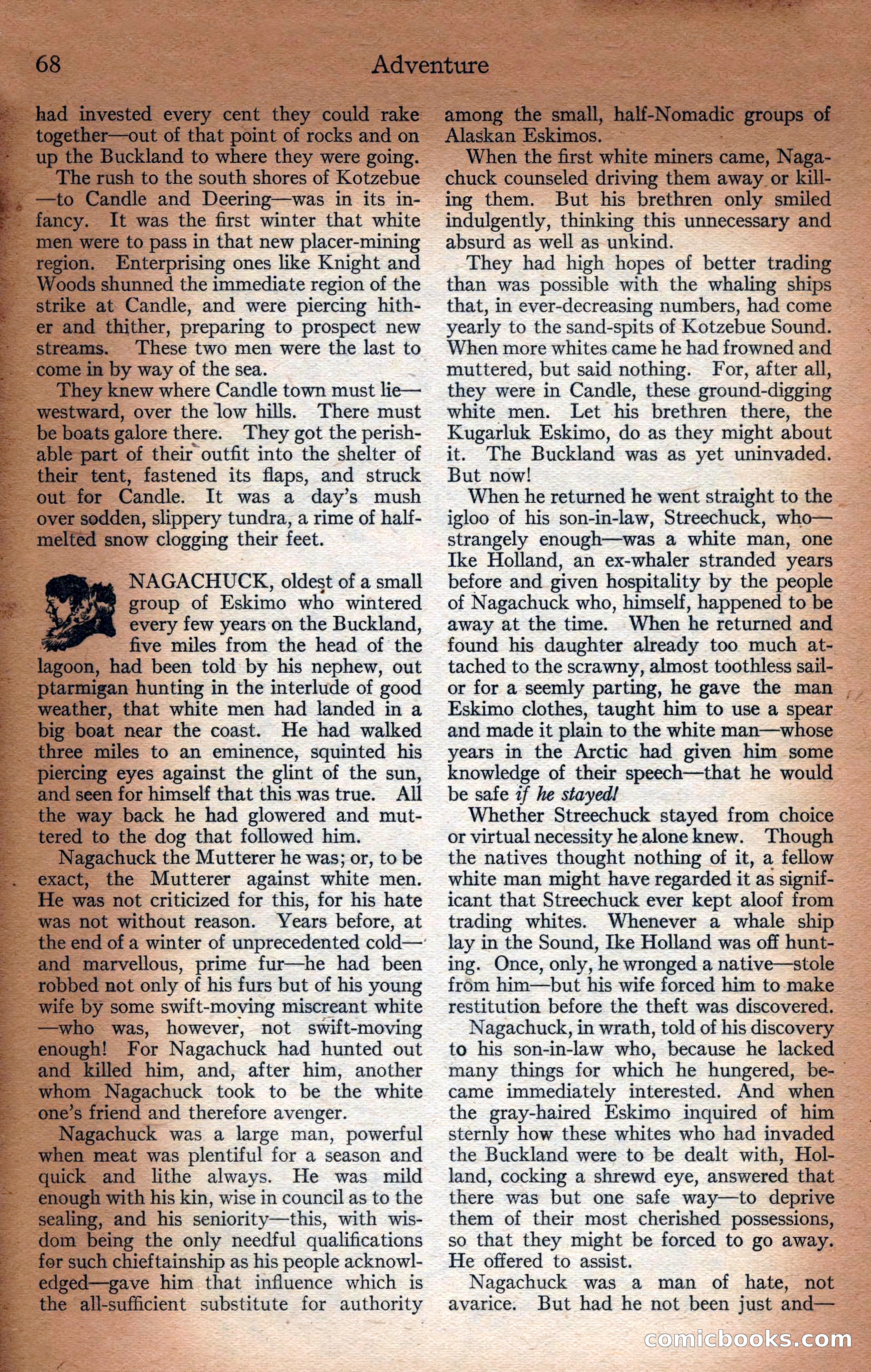
A restored page from Pulp Fiction, 1925. Page through the whole issue in the reader above.
📄 Transcribed text from this page (OCR, searchable)
Machine-transcribed from the original scan — historical spelling and the odd misread are preserved.
"; 68 * had invested every cent they could rake together—out of that point of rocks and on up the Buckland to where they were going. The rush to the south shores of Kotzebue . —to Candle and Deering—was in its in- - fancy. It was the first winter that white men were to pass in that new placer-mining region. Enterprising ones like Knight and Woods shunned the immediate region of the strike at Candle, and were piercing hith- er and thither, preparing to prospect new Streams. [hese two men were the last to come in by way of the sea. They knew where Candle town must lie— westward, over the low hills. There must be boats galore there. They got the perish- able part of their outfit into the shelter of their tent, fastened its flaps, and struck out for Candle. It was a day’s mush over sodden, slippery tundra, a rime of half- melted snow clogging their feet. NAGACHUCK, oldest of a small group of Eskimo who wintered every few years on the Buckland, five miles from the head of the lagoon, had been told by his nephew, out ptarmigan hunting in the interlude of good weather, that white men had landed in a big boat near the coast. He had walked three miles to an eminence, squinted his piercing eyes against the glint of the sun, and seen for himself that this was true. All the way back he had glowered and mut- tered to the dog that followed him. Nagachuck the Mutterer he was; or, to be exact, the Mutterer against white men. He was not criticized for this, for his hate was not without reason. Years before, at the end of a winter of unprecedented cold—' and marvellous, prime fur—he had been robbed not only of his furs but of his young wile by some swift-moving miscreant white —who was, however, not swift-moving enough! For Nagachuck had hunted out and killed him, and, after him, another whom Nagachuck took to be the white one’s friend and therefore avenger. Nagachuck was a large man, powerful when meat was plentiful for a season and quick and lithe always. He was mild enough with his kin, wise in council as to the sealing, and his seniority—this, with wis- dom being the only needful qualifications fer such chieftainship as his people acknowl- edged—gave him that influence which is the all-sufficient substitute for authority Adventure among the small, aoe groups of Alaskan Eskimos. When the first white miners came, Naga- — chuck counseled driving them away or kill- ing them. But his brethren only smiled indulgently, thinking this unnecessary and absurd as well as unkind. They had high hopes of better trading than was possible with the whaling ships that, in ever-decreasing numbers, had come yearly to the sand-spits of Kotzebue Sound. When more whites came he had frowned and muttered, but said nothing. For, after all, they were in Candle, these ground-digging white men. Let his brethren there, the Kugarluk Eskimo, do as they might about it. The Buckland was as yet uninvaded. But now! When he returned he went straight to the igloo of his son-in-law, Streechuck, who— strangely enough—was a white man, one Ike Holland, an ex-whaler stranded years before and given hospitality by the people of Nagachuck who, himself, happened to be away at the time. When he returned and found his daughter already too much at- tached to the scrawny, almost toothless sail- or for a seemly parting, he gave the man © Eskimo clothes, taught him to use a spear and made it plain to the white man—whose years in the Arctic had given him some knowledge of their speech—that he would be safe if he stayed! Whether Streechuck stayed from choice or virtual necessity he alone knew. Though the natives thought nothing of it, a fellow white man might have regarded it as signif- icant that Streechuck ever kept aloof from trading whites. Whenever a whale ship lay in the Sound, Ike Holland was off hunt- ing. Once, only, he wronged a native—stole from him—but his wife forced him to make restitution before the theft was discovered. Nagachuck, in wrath, told of his discovery to his son-in-law who, because he lacked many things for which he hungered, be-— came immediately interested. And when the gray-haired Eskimo inquired of him sternly how these whites who had invaded the Buckland were to be dealt with, Hol- land, cocking a shrewd eye, answered that there was but one safe way—to deprive them of their most cherished possessions, so that they might be forced to go away. He offered to assist. Nagachuck was a man of hate, not avarice. But had he not been just and— GoOmicboo cS com