
Pulp Fiction, 1925 · page 40 of 196
Adventure Magazine Cover — page 40: what you’re looking at
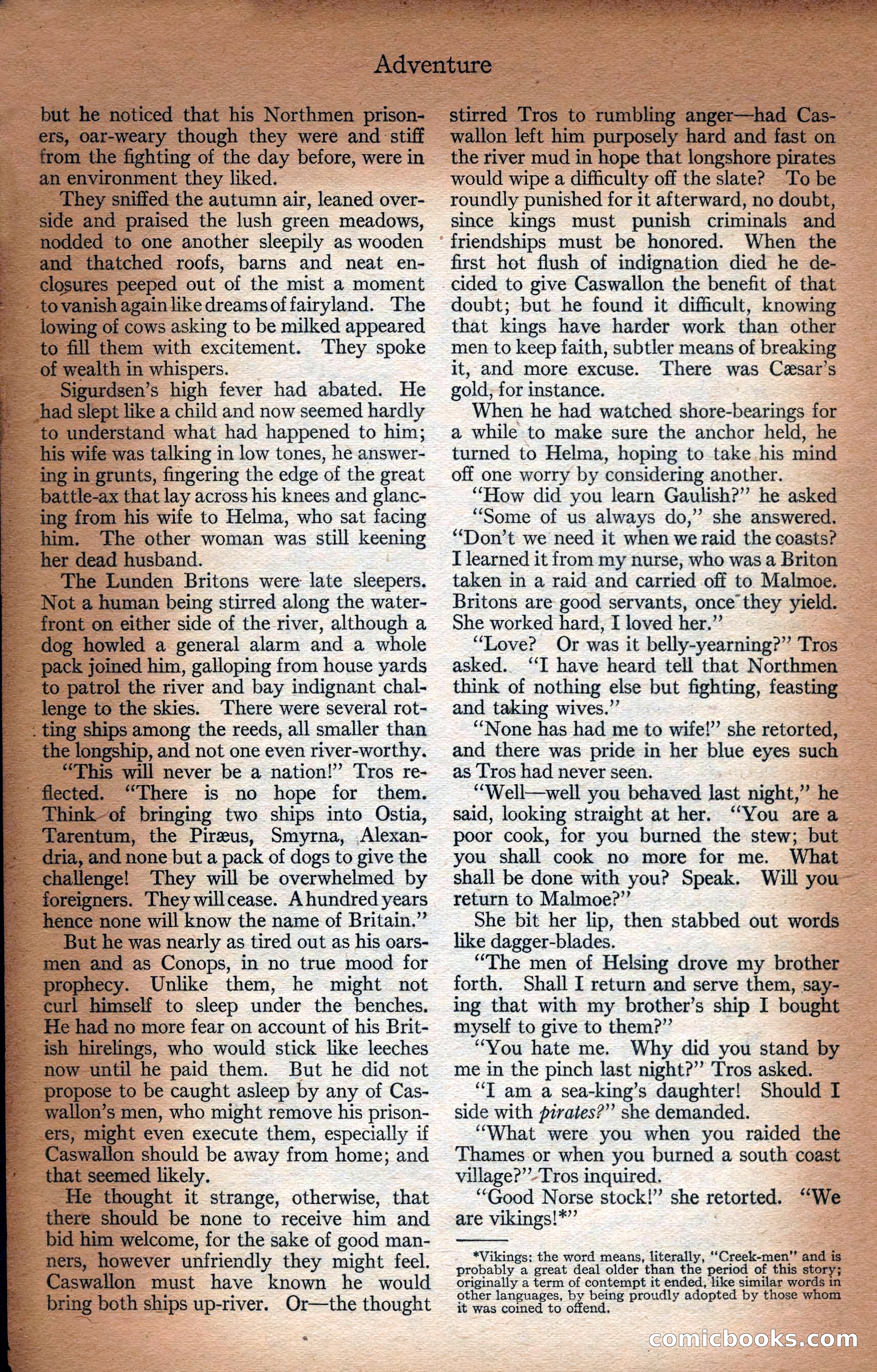
A restored page from Pulp Fiction, 1925. Page through the whole issue in the reader above.
📄 Transcribed text from this page (OCR, searchable)
Machine-transcribed from the original scan — historical spelling and the odd misread are preserved.
Adventure but he noticed that his Northmen prison- ers, oar-weary though they were and ‘stiff from the fighting of the day before, were in an environment they liked. They sniffed the autumn air, leaned over- side and praised the lush green meadows, nodded to one another sleepily as wooden and thatched roofs, barns and neat en- closures peeped out of the mist a moment - tovanish againlike dreamsoffairyland. The lowing oi cows asking to be milked appeared to fill them with excitement. They spoke of wealth in whispers. = Sigurdsen’s high fever had abated. He » had slept like a child and now seemed hardly > to understand what had happened to him; his wife was talking in low tones, he answer- ing in grunts, fingering the edge of the great battle-ax that lay across his knees and glanc- ing irom his wife to Helma, who sat facing him. The other woman was still keening her dead husband. The Lunden Britons were late sleepers. Not a human being stirred along the water- front on either side of the river, although a dog howled a general alarm and a whole = pack joined him, galloping from house yards to patrol the river and bay indignant chal- lenge to the skies. There were several rot- _ ting ships among the reeds, all smaller than the longship, and not one even river-worthy. “This will never be a nation!” Tros re- 'fiected. “There is no hope for them. Think of bringing two ships into Ostia, Tarentum, the Pirzus, Smyrna, Alexan- dria, and none but a pack of dogs to give the challenge! They will be overwhelmed by foreigners. They willcease. Ahundred years hence none will know the name of Britain.” But he was nearly as tired out as his oars- men and as Conops, in no true mood for prophecy. Unlike them, he might not curl himself to sleep under the benches. He had no more fear on account of his Brit- ish hirelings, who would stick like leeches now until he paid them. But he did not propose to be caught asleep by any of Cas- wallon’s men, who might remove his prison- ers, might even execute them, especially if Caswalion should be away from home; and that seemed likely. He thought it strange, otherwise, that there should be none to receive him and bid him welcome, for the sake of good man- ners, however unfriendly they might feel. Caswallon must have known he would bring both ships up-river. Or—the thought stirred Tros to rumbling anger—had Cas- wallon left him purposely hard and fast on the river mud in hope that longshore pirates would wipe a difficulty off the slate? ‘To be roundly punished for it afterward, no doubt, since kings must punish criminals and friendships must be honored. When the first hot flush of indignation died he de- cided to give Caswallon the benefit of that doubt; but he found it difficult, knowing that kings have harder work than other men to keep faith, subtler means of breaking it, and more excuse. There was Cesar’s gold; for instance. When he had watched shore-bearings for a while to make sure the anchor held, he turned to Helma, hoping to take his mind off one worry by considering another. “How did you learn Gaulish?” he asked “Some of us always do,” she answered. “Don’t we need it when we raid the coasts? I learned it from my nurse, who was a Briton taken in a raid and carried off to Malmoe. Britons are good servants, once they yield. She worked hard, I loved her.” “Love? Or was it belly-yearning?” Tros asked. “TI have heard tell that Northmen think of nothing else but fighting, feasting and taking wives.” ‘None has had me to wife!” she retorted, and there was pride in her blue eyes such as Tros had never seen. ‘‘Well—well you behaved last night,” he said, looking straight at her. ‘You are a poor cook, for you burned the stew; but you shall cook no more for me. What shall be done with you? Speak. Will you return to Malmoe?”’ She bit her lip, then stabbed out words like dagger-blades. “The men of Helsing drove my brother forth. Shall I return and serve them, say- ing that with my brother’s ship I bought myself to give to them?” “You hate me. Why did you stand by me in the pinch last night?” Tros asked. “T am a sea-king’s daughter! Should I side with pirates?” she demanded. ‘What were you when you raided the Thames.or when you burned a south coast village?’”-Tros inquired. ‘Good Norse stock!” she retorted. are vikings!*” “We *Vikings: the word means, literally, ‘‘Creek-men” and is probably a great deal older than the period of this story; originally a term of contempt it ended, like similar words in other languages, by being proudly adopted by those whom it was coined to offend. Comicbooks eer ae com