
Pulp Fiction, 1925 · page 190 of 196
Adventure Magazine Cover — page 190: what you’re looking at
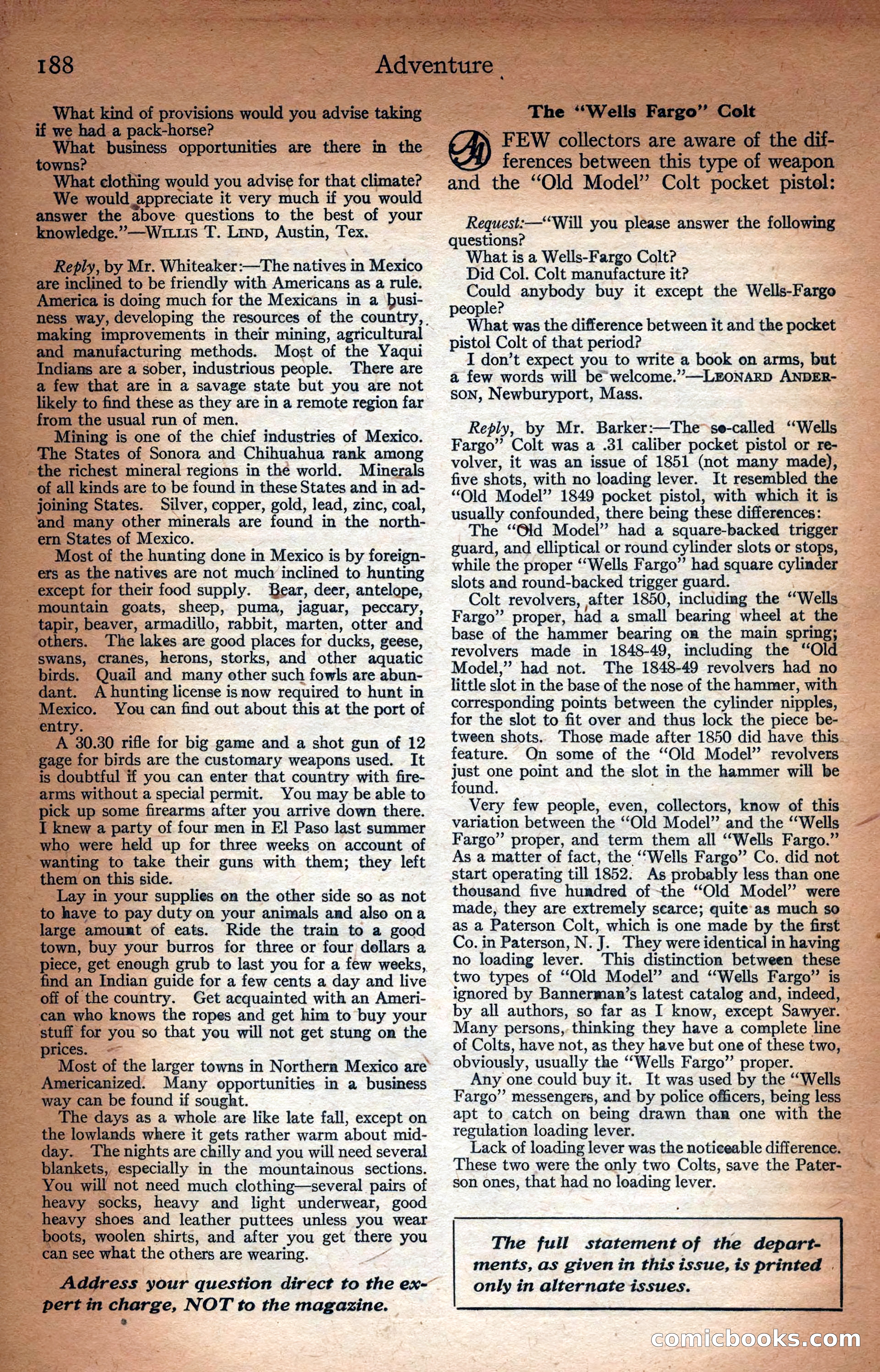
A restored page from Pulp Fiction, 1925. Page through the whole issue in the reader above.
📄 Transcribed text from this page (OCR, searchable)
Machine-transcribed from the original scan — historical spelling and the odd misread are preserved.
~vs-. 49. 188 What kind of provisions would you advise taking if we had a pack-horse? What business opportunities are there in the towns? What clothing would you advise for that climate? We would appreciate it very much if you would answer the above questions to the best of your knowledge.”—Wrus T. Linp, Austin, Tex. Reply, by Mr. Whiteaker:—The natives in Mexico are inclined to be friendly with Americans as a rule. America is doing much for the Mexicans in a busi- ness way, developing the resources of the country, making improvements in their mining, agricultural and manufacturing methods. Most of the Yaqui Indians are a sober, industrious people. There are a few that are in a savage state but you are not likely to find these as they are in a remote region far from the usual run of men. Mining is one of the chief industries of Mexico. The States of Sonora and Chihuahua rank among _the richest mineral regions in the world. Minerals of all kinds are to be found in these States and in ad- joining States. Silver, copper, gold, lead, zinc, coal, and many other minerals are found in the north- ern States of Mexico. Most of the hunting done in Mexico is by foreign- ers as the natives are not much inclined to hunting except for their food supply. Bear, deer, antelope, Mountain goats, sheep, puma, jaguar, peccary, tapir, beaver, armadillo, rabbit, marten, otter and others. The lakes are good places for ducks, geese, Swans, cranes, herons, storks, and other aquatic birds. Quail and many other such fowls are abun- dant. A hunting license is now required to hunt in Mexico. You can find out about this at the port of entry. A 30.30 rifle for big game and a shot gun of 12 gage for birds are the customary weapons used. It is doubtful if you can enter that country with fire- arms without a special permit. You may be able to pick up some firearms after you arrive down there. T knew a party of four men in El Paso last summer who were held up for three weeks on account of wanting to take their guns with them; they left them on this side. Lay in your supplies on the other side so as not to have to pay duty on your animals and also ona large amoumt of eats. Ride the train to a good town, buy your burros for three or four dollars a piece, get enough grub to last you for a few weeks, find an Indian guide for a few cents a day and live Off of the country. Get acquainted with an Ameri- can who knows the ropes and get him to buy your stuff for you so that you will not get stung on the prices. Most of the larger towns in Northern Mexico are Americanized. Many opportunities in a business way can be found if sought. The days as a whole are like late fall, except on the lowlands where it gets rather warm about mid- day. The nights are chilly and you will need several blankets, especially in the mountainous sections. You will not need much clothing—several pairs of heavy socks, heavy and light underwear, good heavy shoes and leather puttees unless you wear boots, woolen shirts, and after you get there you can see what the others are wearing. Address your question direct to the ex- pert in charge, NOT to the magazine. 2 Adventure. The ‘Wells Fargo” Colt 4) FEW collectors are aware of the dif- ferences between this type of weapon and the “Old Model” Colt pocket pistol: Request: —‘Will you please answer the following questions? What is a Wells-Fargo Colt? Did Col. Colt manufacture it? Could anybody buy it except the Wells-Fargo people? What was the difference between it and the pocket pistol Colt of that period? I don’t expect you to write a book on arms, but a few words will be welcome.”—LEONARD ANDER- son, Newburyport, Mass. Reply, by Mr. Barker:—The~se-called ‘‘Wells Fargo” Colt was a .31 caliber pocket pistol or re- volver, it was an issue of 1851 (not many made), five shots, with no loading lever. It resembled the “Old Model” 1849 pocket pistol, with which it is usually confounded, there being these differences: The “Old Model” had a square-backed trigger guard, and elliptical or round cylinder slots or stops, while the proper ‘“‘Wells Fargo” had square cylinder slots and round-backed trigger guard. Colt revolvers, after 1850, including the “Wells Fargo” proper, had a small bearing wheel at the base of the hammer bearing om the main spring; revolvers made in 1848-49, including the “Old Model,” had not. The 1848-49 revolvers had no little slot in the base of the nose of the hammer, with corresponding points between the cylinder nipples, for the slot to fit over and thus lock the piece be- tween shots. Those made after 1850 did have this feature. On some of the “Old Model” revolvers just one point and the slot in the hammer will be found. Very few people, even, collectors, know of this variation between the ‘Old Model” and the ‘“‘Wells Fargo” proper, and term them all ‘‘Wells Fargo.” As a matter of fact, the ‘‘Wells Fargo” Co. did not start operating till 1852: As probably less than one thousand five hundred of -the “Old Model” were made, they are extremely searce; quite'as much so as a Paterson Colt, which is one made by the first Co. in Paterson, N. J. They were identical in having no loading lever. This distinction between these two types of “Old Model” and “Wells Fargo” is ignored by Bannerman’s latest catalog and, indeed, by all authors, so far as I know, except Sawyer. Many persons, thinking they have a complete line of Colts, have not, as they have but one of these two, obviously, usually the ‘“Wells Fargo”’ proper. Any one could buy it. It was used by the ‘Wells Fargo’’ messengers, and by police officers, being less apt to catch on being drawn than one with the regulation loading lever. Lack of loading lever was the noticeable difference. These two were the only two Colts, save the Pater- son ones, that had no loading lever. The full statement of the depart- ments, as givenin this issue, is printed . only in alternate issues. Gomicbook com