
Pulp Fiction, 1925 · page 182 of 196
Adventure Magazine Cover — page 182: what you’re looking at
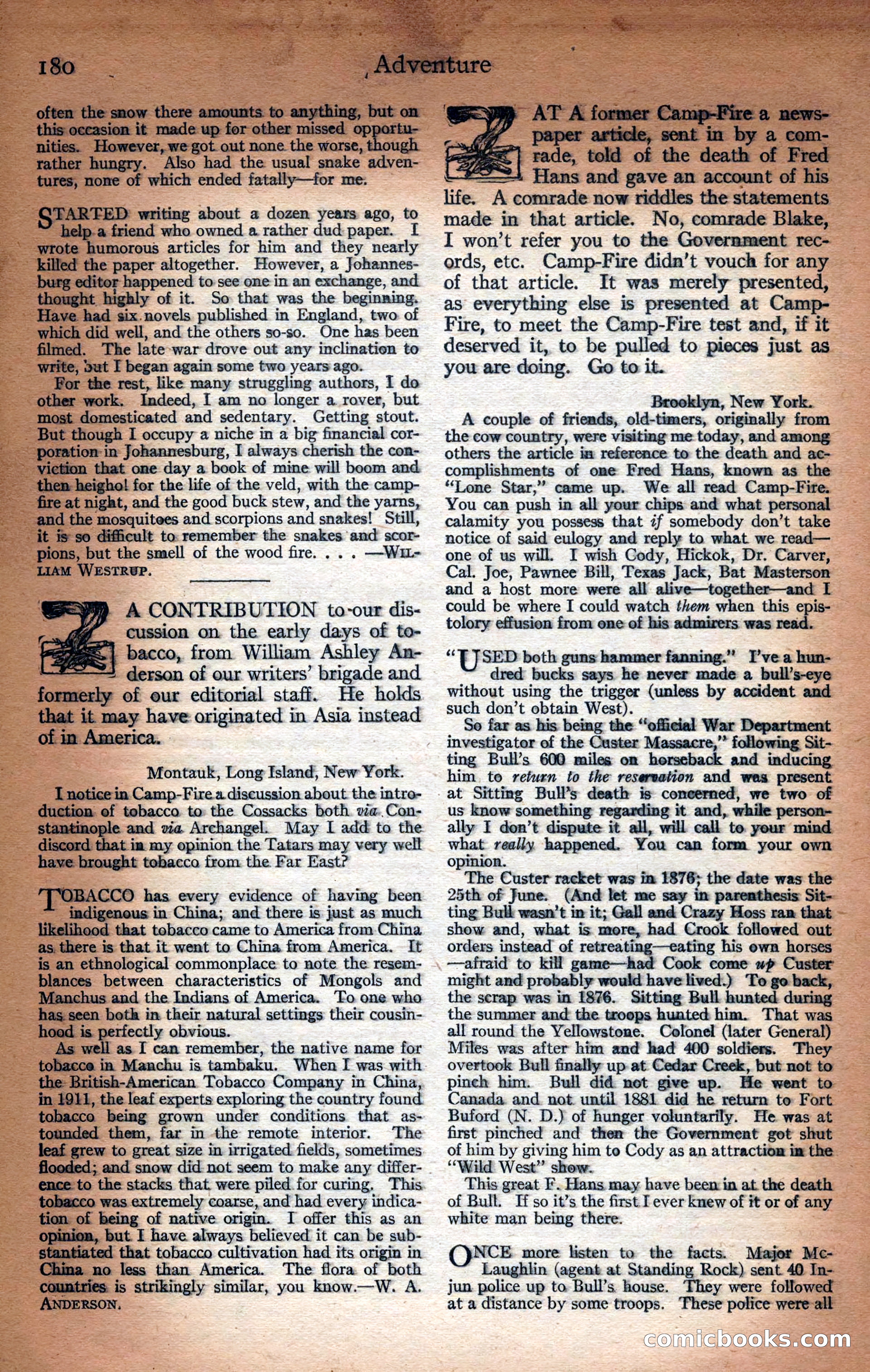
A restored page from Pulp Fiction, 1925. Page through the whole issue in the reader above.
📄 Transcribed text from this page (OCR, searchable)
Machine-transcribed from the original scan — historical spelling and the odd misread are preserved.
mane Ee) 180 often the snow there amounts to anything, but on this occasion it made up for other missed op ni KA nities. However, we got out none the worse, though rather hungry. Also had the usual snake adven- tures, none of which ended fatally—for me. STARTED writing about a dozen years ago, to help.a friend who owned a. rather dud paper. [ wrote humorous articles for him and they nearly killed the paper altogether. However, a Johannes- burg editor happened to see one in an exchange, and thought highly of it. So that was the beginning. Have had six.novels published in England, two of which did well, and the others so-so. One has been filmed. The late war drove out any inclination to write, dut I began again some two years ago. For the rest, like many struggling authors, I do other work. Indeed, I am no longer a rover, but most domesticated and sedentary. Getting stout. - But though I occupy a niche in a big financial cor- poration: in Johannesburg, I always cherish the con- ’ vietion that one day a book of mine will boom and then heigho! for the life of the veld, with the camp- fire at night, and the good buck stew, and the yarns, and the mosquitees and scorpions and snakes! Still, it is so difficult to. remember the snakes and scor- pions, but the smell of the wood fire... . —Wu- LIAM WESTRUP. A CONTRIBUTION to-our dis- cussion on. the early days of to- bacco, from William Ashley An- #—— derson of our writers’ brigade and ey of eur editorial staff. He holds that it may have originated in Asia instead of in America. Montauk, Long Island, New York. I notice in Camp-Fire a discussion about the intro- duction of tobacco to the Cossacks both. wa..Con- stamtinople and va Archangel. May I add to the discord that im my opinion the Tatars may very well have brought tobacco from the Far East? ‘T OBACcCco has. every evidence of having been indigenous in China; and there is just as much likelihordt that tobacco came to America from China as there is that it went to China from America. It is an ethnological commonplace to note the resem- blances between characteristics of Mongols and Manchus and the Indians of America. To one who has seen both in their natural settings their cousin- hoad is perfectly obvious. As well as [ can remember, the native name for tobacce in Manchu is tambaku. When I was with the British-American Tobacco Company in China, in 1911, the leaf experts exploring the country found tobacco being grown under conditions that as- them, far in the remote interior. The leaf grew to great size in irrigated. fields, sometimes flooded; and snow did: not seem to make any differ- ence to ‘the stacks that. were piled for curing, This tobacco was extremely coarse, and had every indica- tion of being of native origin. I offer this as an opinion, but f have always believed it can be sub- stantiated that tobacco cultivation had its origin in Chima no less than America. The flora of both Imtries is strikingly similar, you know.—W. A. ANDERSON. - at Sitting Bull’s let 2 t. St EP at Vitter. a 8-2 oS a W053 > - A ew oh ptt OA he NO, y — ee eS Sy = wth s - =* ss x ee rl 5 SO ie ot of > Pan ee . . Pa = a aed é ee 3 : ——— ee J : i ~ paper article, soni in +s - rade, told of the death of Fred Hans and gave an account of his life. A comrade now riddles the statements made in that article. No, comrade Blake, I won’t refer you to the Government rec- ords, etc. Camp-Fire didn’t vouch for any of that article. It was merely presented, as everything else is presented at Camp- Fire, to meet the Camp-Fire test and, if it deserved it, to be pulled to pieces just as you are doing. Go to it. Brooklyn, New York. A couple of friends, old-timers, originally from the cow country, were visiting me today, and among others the article im reference to the death and ac- complishments of one Fred Hans, known as the “Lone Star,” came up. We all read Camp-Fire. You can push in all your chips and what personal calamity you possess that if somebody don’t take notice of said eulogy and reply to what we read— one of us will. I wish Cody, Hickok, Dr. Carver, Cal. Joe, Pawnee Bill, Texas Jack, Bat Masterson and a host more were alive—together—and I could be where I could watch them when this epis- tolory effusion from one of his admirers was read. “USED both guns hammer fanning.” I’ve a hun- dred bucks says he never made a bull’s-eye without using the trigger (unless by accident and such don’t obtain West). Se far as his being the “official War Department investigator of the Custer Massacre,” following Sit- ting Bull’s 600 miles om horseback and inducing him to return to the reservation and wes present death is coneerned, we two of us know something regarding it and,. while person- ally I don’t dispute it all, will call "to your mind what ani happened. You can form your own opiio rhe | Custer racket was in 1876; the date was the 25th of June. (And let me say in parenthesis Sit- ting Bull wasn’t in it; Gall and Crazy Hoss ram that show and, what is more, had Crook followed out orders instead of retreati —eating his own horses —afraid to kill game—h had Cook come wp Custer might and probably would have lived.) To go back, the scrap was in 1876. Sitting Bull hunted during the summer and the troops huated him. That was all round the Velawsians Colonel (later General) Miles was after him and had 400 soldiers. They overtook Bull finally up at Cedar Creek, but not to pinch him. Bull did net give up. He went to Canada and not. until 1881 did he return to Fort Buford (N. D.) of hunger voluntarily. He was at first pinched and then the Government got shut of him by giving him to Cody as an attractiom im the “Wild West” show. This great F. Hans may have beem in at. the death of Bull. If so it’s the first I ever knew of it or of any white man being there. (NCE more listen to the facts. Major Me- Laughlin (agent at Standing Rock) sent 40 In- jun police up to Bull’s house. They were followed at a distance by some troops. These police were all Gomicbooks.com