
Pulp Fiction, 1925 · page 18 of 196
Adventure Magazine Cover — page 18: what you’re looking at
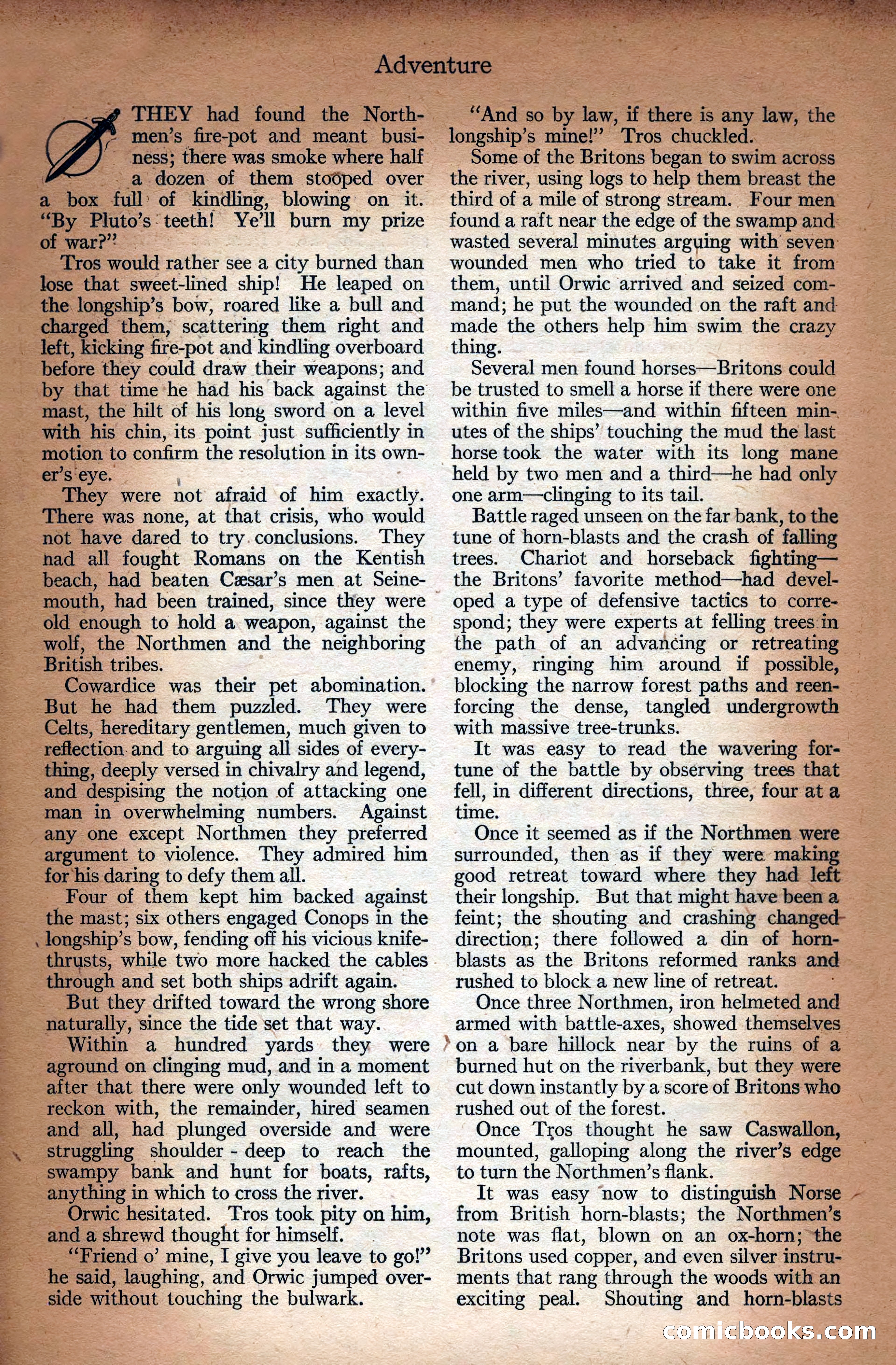
A restored page from Pulp Fiction, 1925. Page through the whole issue in the reader above.
📄 Transcribed text from this page (OCR, searchable)
Machine-transcribed from the original scan — historical spelling and the odd misread are preserved.
Net egg SR: Se ae Pegg es: St = pe Adventure THEY had found the North- = men’s fire-pot and meant busi- ness; there was smoke where half a dozen of them stodped over a box full: of kindling, blowing on it. “By Pluto’s‘ teeth! Ye’ll burn my prize of war?” Tros would rather see a city burned than lose that sweet-lined ship! He leaped on the longship’s bow, roared like a bull and charged them, scattering them right and left, kicking fire-pot and kindling overboard before they could draw their weapons; and by that time he had his back against the mast, the hilt of his long sword on a level with his chin, its point just sufficiently in motion to confirm the resolution in its own- er’s eye. They were not afraid of him exactly. There was none, at that crisis, who would not have dared to try conclusions. T hey had all fought Romans on the Kentish beach, had beaten Cesar’s men at Seine- mouth, had been trained, since they were © old enough to hold a weapon, against the wolf, the Northmen and the neighboring British tribes. Cowardice was their pet abomination. But he had them puzzled. They were Celts, hereditary gentlemen, much given to reflection and to arguing all sides of every- thing, deeply versed in chivalry and legend, and despising the notion of attacking one man in overwhelming numbers. Against any one except Northmen they preferred argument to violence. They admired him for his daring to defy them all. Four of them kept him backed against the mast; six others engaged Conops in the longship’s bow, fending off his vicious knife- thrusts, while two more hacked the cables through and set both ships adrift again. But they drifted toward the wrong shore naturally, since the tide set that way. Within a hundred yards they were aground on clinging mud, and in a moment aiter that there were only wounded left to reckon with, the remainder, hired seamen and all, had plunged overside and were struggling shoulder - deep to reach the swampy bank and hunt for boats, rafts, anything in which to cross the river. Orwic hesitated. Tros took pity on him, and a shrewd thought for himself. “Friend o’ mine, I give you leave to go!” he said, laughing, and Orwic jumped over- side without touching the bulwark. ‘“‘And so by law, if there is any law, the longship’s mine!” ‘Tros chuckled. Some of the Britons began to swim across the river, using logs to help them breast the third of a mile of strong stream. Four men found a raft near the edge of the swamp and: wasted several minutes arguing with seven: wounded men who tried to take it from them, until Orwic arrived and seized com- mand; he put the wounded on the raft and made the others help him swim the crazy thing. Several men found horses—Britons could be trusted to smell a horse if there were one within five miles—and within fifteen min- utes of the ships’ touching the mud the last horse took the water with its long mane held by two men and a third—he had only one arm—clinging to its tail. Battle raged unseen on the far bank, to the tune of horn-blasts and the crash of falling trees. Chariot and horseback fighting— the Britons’ favorite method—had devel- oped a type of defensive tactics to corre- spond; they were experts at felling trees in the path of an advancing or retreating enemy, ringing him around if possible, blocking the narrow forest paths and reen- forcing the dense, tangled undergrowth with massive tree-trunks. It was easy to read the wavering for- tune of the battle by observing trees that fell, in different directions, three, four at a time. Once it seemed as if the Northmen were surrounded, then as if they were making good retreat toward where they had left their longship. But that might have been a feint; the shouting and crashing changed direction; there followed a din of horn- blasts as the Britons reformed ranks and rushed to block a new line of retreat. Once three Northmen, iron helmeted and armed with battle-axes, showed themselves ‘on a bare hillock near by the ruins of a burned hut on the riverbank, but they were cut down instantly by a score of Britons who rushed out of the forest. Once Tros thought he saw Caswallon, mounted, galloping along the river’s edge to turn the Northmen’s flank. ge ai Oe . It was easy now to distinguish Norse - from British horn-blasts; the Northmen’s note was flat, blown on an ox-horn; the Britons used copper, and even silver instru- ments that rang through the woods with an exciting peal. Shouting and horn-blasts Gomicbooks (ei @)