
Pulp Fiction, 1925 · page 153 of 196
Adventure Magazine Cover — page 153: what you’re looking at
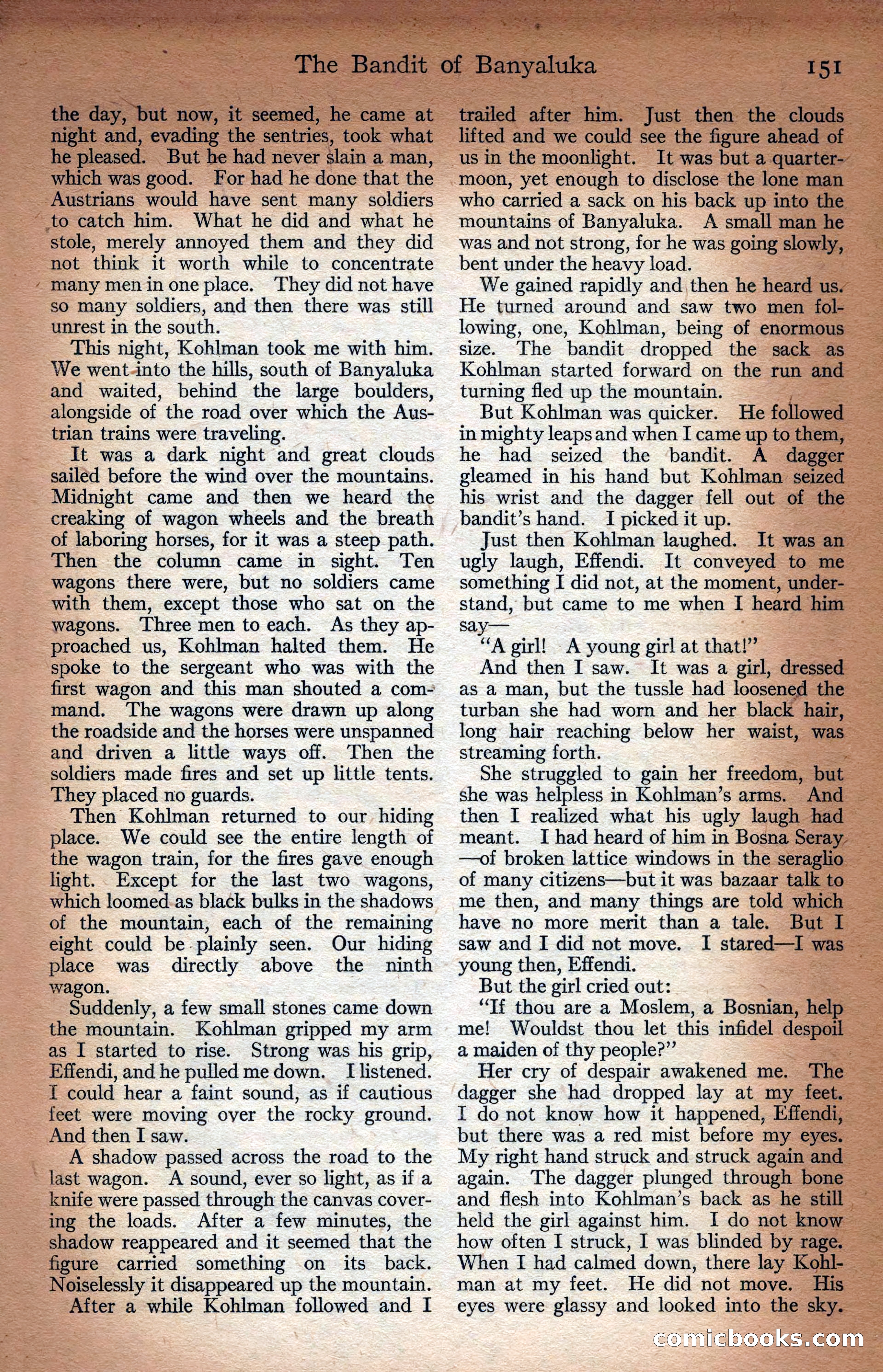
A restored page from Pulp Fiction, 1925. Page through the whole issue in the reader above.
📄 Transcribed text from this page (OCR, searchable)
Machine-transcribed from the original scan — historical spelling and the odd misread are preserved.
Yo setae relate SS ae The Bandit of Banyaluka the day, but now, it seemed, he came at night and, evading the sentries, took what he pleased. But he had never slain a man, which was good. For had he done that the Austrians would have sent many soldiers to catch him. What he did and what he stole, merely annoyed them and they did not think it worth while to concentrate “many meninone place. They did not have so many soldiers, and then there was still unrest in the south. This night, Kohlman took me with him. We went-nto the hills, south of Banyaluka and waited, behind the large boulders, alongside of the road over which the Aus- trian trains were traveling. It was a dark night and great clouds sailed before the wind over the mountains. Midnight came and then we heard the creaking of wagon wheels and the breath of laboring horses, for it was a steep path. Then the column came in sight. Ten wagons there were, but no soldiers came with them, except those who sat on the wagons. Three men to each. As they ap- proached us, Kohlman halted them. He spoke to the sergeant who was with the first wagon and this man shouted a com- mand. The wagons were drawn up along the roadside and the horses were unspanned and driven a little ways off. Then the soldiers made fires and set up little tents. They placed no guards. Then Kohlman returned to our hiding place. We could see the entire length of the wagon train, for the fires gave enough light. Except for the last two wagons, which loomed.as black bulks in the shadows of the mountain, each of the remaining eight could be-plainly seen. Our hiding place was directly above the ninth wagon. Suddenly, a few small stones came down the mountain. Kohlman gripped my arm as I started to rise. Strong was his grip, Effendi, and he pulled me down. [listened. ft could hear a faint sound, as if cautious feet were moving over the rocky ground. And then I saw. A shadow passed across the road to the last wagon. A sound, ever so light, as if a knife were passed through the canvas cover- ing the loads. After a few minutes, the shadow reappeared and it seemed that the figure carried something on its back. Noiselessly it disappeared up the mountain. After a while Kohlman followed and I ee 151 trailed after him. Just then the clouds lifted and we could see the figure ahead of us in the moonlight. It was but a quarter- moon, yet enough to disclose the lone man who carried a sack on his back up into the mountains of Banyaluka. A small man he was and not strong, for he was going slowly, bent under the heavy load. We gained rapidly and then he heard us. He turned around and saw two men fol lowing, one, Kohlman, being of enormous size. The bandit dropped the sack as Kohlman started forward on the run and turning fled up the mountain, | But Kohlman was quicker. He followed in mighty leapsand when I came up to them, he had seized the bandit. A dagger gleamed in his hand but Kohlman seized his wrist and the dagger fell out of the bandit’s hand. I picked it up. Just then Kohlman laughed. It was an ugly laugh, Effendi. It conveyed to me something I did not, at the moment, under- stand, but came to me when I heard him say— “A girl! A young girl at that And then I saw. It was a girl, dressed as a man, but the tussle had loosened the turban she had worn and her black hair, long hair reaching below her waist, was streaming forth. She struggled to gain her freedom, but she was helpless in Kohlman’s arms. And then I realized what his ugly laugh had meant. —of broken lattice windows in the seraglio of many citizens—but it was bazaar talk to me then, and many things are told which have no more merit than a tale. But I saw and I did not move. I stared—I was young then, Effendi. But the girl cried out: “Tf thou are a Moslem, a Bosnian, help me! Wouldst thou let this infidel despoil a maiden of thy people?”’ Her cry of despair awakened me. The dagger she had dropped lay at my feet. I do not know how it happened, Effendi, but there was a red mist before my eyes. My right hand struck and struck again and again. The dagger plunged through bone and flesh into Kohlman’s back as he still held the girl against him. I do not know how often I struck, I was blinded by rage. When I had calmed down, there lay Kohil- man at my feet. He did not move. His eyes were glassy and looked into the sky. |?? I had heard of him in Bosna Seray Eomicbooks.co