
Pulp Fiction, 1925 · page 144 of 196
Adventure Magazine Cover — page 144: what you’re looking at
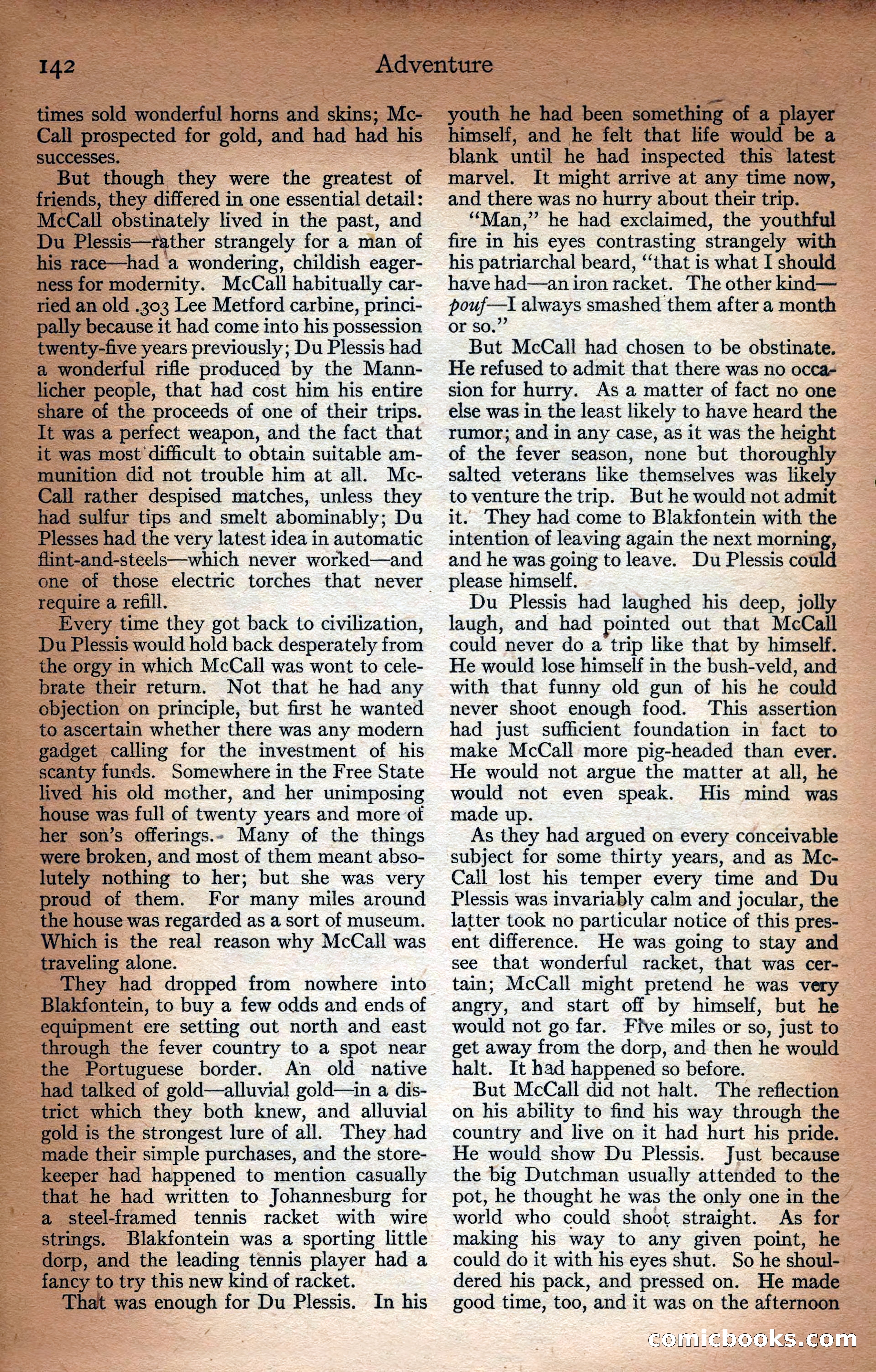
A restored page from Pulp Fiction, 1925. Page through the whole issue in the reader above.
📄 Transcribed text from this page (OCR, searchable)
Machine-transcribed from the original scan — historical spelling and the odd misread are preserved.
142 times sold wonderful horns and skins; Mc- Call prospected for gold, and had had his successes. But though they were the greatest of friends, they differed in one essential detail: McCall obstinately lived in the past, and Du Plessis—tather strangely for a man of his race—had a wondering, childish eager- ness for modernity. McCall habitually car- ried an old .303 Lee Metford carbine, princi- pally because it had come into his possession twenty-five years previously; Du Plessis had a wonderful rifle produced by the Mann- licher people, that had cost him his entire share of the proceeds of one of their trips. It was a perfect weapon, and the fact that it was most difficult to obtain suitable am- munition did not trouble him at all. Mc- Call rather despised matches, unless they had sulfur tips and smelt abominably; Du Plesses had the very latest idea in automatic flint-and-steels—which never worked—and one of those electric torches that never. require a refill. Every time they got back to civilization, Du Plessis would hold back desperately from the orgy in which McCall was wont to cele- brate their return. Not that he had any objection on principle, but first he wanted to ascertain whether there was any modern gadget calling for the investment of his scanty funds. Somewhere in the Free State lived his old mother, and her unimposing house was full of twenty years and more of her son’s offerings.- Many of the things were broken, and most of them meant abso- lutely nothing to her; but she was very proud of them. For many miles around the house was regarded as a sort of museum. Which is the real reason why McCall was traveling alone. They had dropped from nowhere into Blakfontein, to buy a few odds and ends of equipment ere setting out north and east through the fever country to a spot near the Portuguese border. An old native had talked of gold—alluvial gold—in a dis- trict which they both knew, and alluvial gold is the strongest lure of all. They had made their simple purchases, and the store- keeper had happened to mention casually that he had written to Johannesburg for a steel-framed tennis racket with wire strings. Blakfontein was a sporting little dorp, and the leading tennis player had a fancy to try this new kind of racket. That was enough for Du Plessis. In his Adventure youth he had been something of a player himself, and he felt that life would be a blank until he had inspected this latest marvel. It might arrive at any time now, and there was no hurry about their trip. “Man,” he had exclaimed, the youthful fire in his eyes contrasting strangely with his patriarchal beard, ‘“‘that is what I should have had—an iron racket. The other kind— pouf—I always smashed them after a month or so.” But McCall had chosen to be obstinate. He refused to admit that there was no occa- sion for hurry. As a matter of fact no one else was in the least likely to have heard the rumor; and in any case, as it was the height of the fever season, none but thoroughly salted veterans like themselves was likely to venture the trip. But he would not admit it. They had come to Blakfontein with the intention of leaving again the next morning, and he was going to leave. Du Plessis could please himself. Du Plessis had laughed his deep, jolly laugh, and had pointed out that McCall could never do a trip like that by himself. He would lose himself in the bush-veld, and with that funny old gun of his he could never shoot enough food. This assertion had just sufficient foundation in fact to make McCall more pig-headed than ever. He would not argue the matter at all, he would not even speak. His mind was made up. As they had argued on every conceivable subject for some thirty years, and as Mc- Call lost his temper every time and Du Plessis was invariably calm and jocular, the latter took no particular notice of this pres- ent difference. He was going to stay and see that wonderful racket, that was cer- tain; McCall might pretend he was very angry, and start off by himself, but he would not go far. Five miles or so, just to get away from the dorp, and then he would halt. It had happened so before. But McCall did not halt. The reflection on his ability to find his way through the country and live on it had hurt his pride. He would show Du Plessis. Just because the big Dutchman usually attended to the pot, he thought he was the only one in the world who could shoot straight. As for making his way to any given point, he could do it with his eyes shut. So he shoul- dered his pack, and pressed on. He made good time, too, and it was on the afternoon Comicbooks.com