
Pulp Fiction, 1925 · page 141 of 196
Adventure Magazine Cover — page 141: what you’re looking at
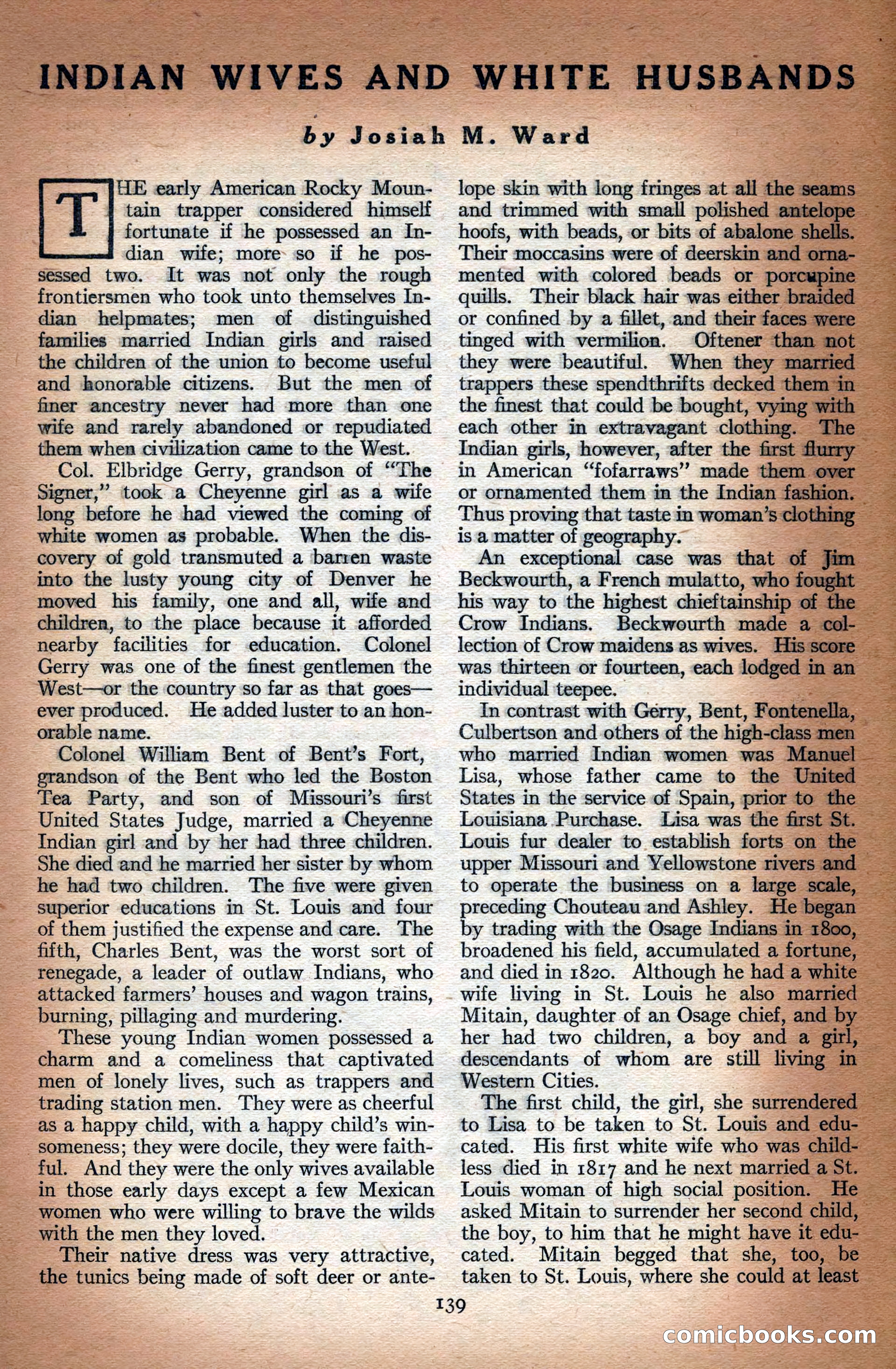
A restored page from Pulp Fiction, 1925. Page through the whole issue in the reader above.
📄 Transcribed text from this page (OCR, searchable)
Machine-transcribed from the original scan — historical spelling and the odd misread are preserved.
INDIAN WIVES AND WHITE HUSBANDS | £ Josiah M. Ward HE early American Rocky Moun- T tain trapper considered himself fortunate if he possessed an In- dian wife; more-so if he pos- sessed two. It was not only the rough frontiersmen who took unto themselves In- dian helpmates; men of distinguished families married Indian girls and raised the children of the union to become useful and honorable citizens. But the men of finer ancestry never had more than one wife and rarely abandoned or repudiated them when civilization came to the West. Col. Elbridge Gerry, grandson of “The Signer,” ‘took a Cheyenne girl as a wife long before he had viewed the coming of white women as probable. When the dis- covery of gold transmuted a barren waste into the lusty young city of Denver he moved his family, one and all, wife and children, to the place because it afforded nearby facilities for education. Colonel Gerry was one of the finest gentlemen the West—or the country so far as that goes— ever produced. He added luster to an hon- orable name. Colonel William Bent of Bent’s Fort, grandson of the Bent who led the Boston Tea Party, and son of Missouri’s first United States Judge, married a Cheyenne Indian girl and by her had three children. She died and he married her sister by whom he had two children. The five were given superior educations in St. Louis and four of them justified the expense and care. The fifth, Charles Bent, was the worst sort of renegade, a leader of outlaw Indians, who attacked farmers’ houses and wagon trains, burning, pillaging and murdering. These young Indian women possessed a charm and a comeliness that captivated men of lonely lives, such as trappers and trading station men. They were as cheerful as a happy child, with a happy child’s win- someness; they were docile, they were faith- ful. And they were the only wives available in those early days except a few Mexican women who were willing to brave the wilds with the men they loved. Their native dress was very attractive, the tunics being made of soft deer or ante- lope skin with long fringes at all the seams and trimmed with small polished antelope hoofs, with beads, or bits of abalone shells. Their moccasins were of deerskin and orna- mented with colored beads or porcupine quills. Their black hair was either braided or confined by a fillet, and their faces were tinged with vermilion. Oftener than not they were beautiful. When they married trappers these spendthrifts decked them in the finest that could be bought, vyimg with each other in extravagant clothing. The Indian girls, however, after the first flurry in American “fofarraws’” made them over or ornamented them in the Indian fashion. — Thus proving that taste in woman’s clothing is a matter of geography. An exceptional case was that of Jim Beckwourth, a French mulatto, who fought his way to the highest chieftainship of the Crow Indians. Beckwourth made a col- lection of Crow maidens as wives. His score was thirteen or fourteen, each lodged in an individual teepee. | In contrast with Gerry, Bent, Fontenella, Culbertson and others of the high-class men who married Indian women was Manuel Lisa, whose father came to the United States in the service of Spain, prior to the Louisiana Purchase. Lisa was the first St. Louis fur dealer to establish forts on the upper Missouri and Yellowstone rivers and to operate the business on a large scale, preceding Chouteau and Ashley. He began by trading with the Osage Indians in 1800, broadened his field, accumulated a fortune, and died in 1820. Although he had a white wife living in St. Louis he also married Mitain, daughter of an Osage chief, and by her had two children, a boy and a girl, descendants of whom are still living im Western Cities. The first child, the girl, she surrendered to Lisa to be taken to St. Louis and edu- cated. His first white wife who was child- less died in 1817 and he next married a St. Louis woman of high social position. He asked Mitain to surrender her second child, the boy, to him that he might have it edu- cated. Mitain begged that she, too, be taken to St. Louis, where she could at least 139 comicboo (@) <S:CO