
Pulp Fiction, 1925 · page 112 of 196
Adventure Magazine Cover — page 112: what you’re looking at
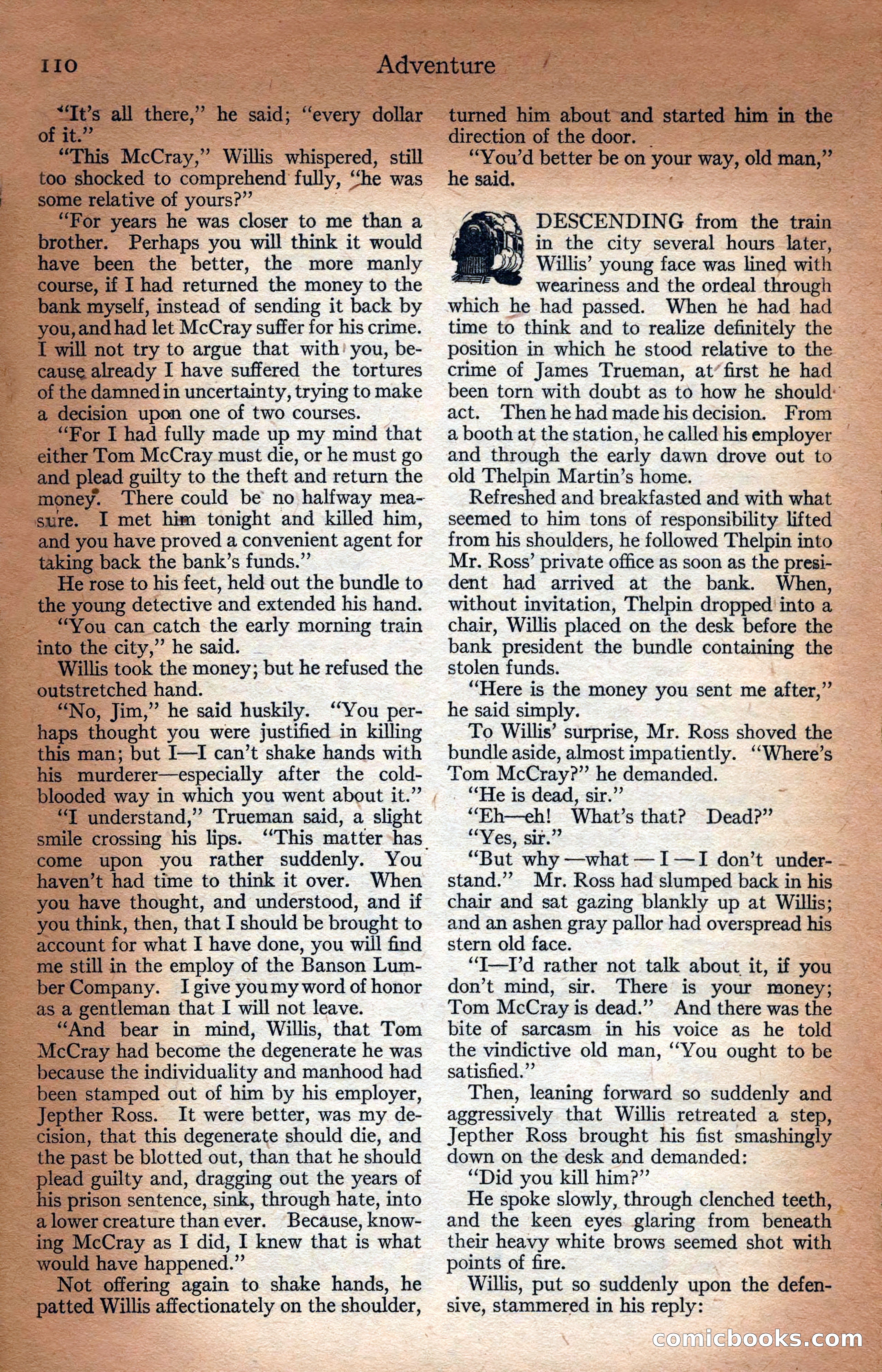
A restored page from Pulp Fiction, 1925. Page through the whole issue in the reader above.
📄 Transcribed text from this page (OCR, searchable)
Machine-transcribed from the original scan — historical spelling and the odd misread are preserved.
Ifo “It’s all there,” he said; “every dollar of it.” “This McCray,” Willis whispered, still too shocked to comprehend fully, “he was some relative of yours?”’ “For years he was closer to me than a brother. Perhaps you will think it would have been the better, the more manly course, if | had returned the money to the bank myself, instead of sending it back by you, and had let McCray suffer for his crime. 1 will not try to argue that with! you, be- cause already I have suffered the tortures of the damned in uncertainty, trying to make a decision upon one of two courses. “For I had fully made up my mind that either Tom McCray must die, or he must go and plead guilty to the theft and return the money. There could be’ no halfway mea- sure. I met him tonight and killed him, and you have proved a convenient agent for taking back the bank’s funds.” He rose to his feet, held out the bundle to the young detective and extended his hand. - “You can catch the early morning train into the city,” he said. Willis took the money; but he refused the outstretched hand. “No, Jim,” he said huskily. ‘You per- haps thought you were justified in killing this man; but I—I can’t shake hands with his murderer—especially after the cold- blooded way in which you went about it.” “T understand,” Trueman said, a slight smile crossing his lips. come upon you rather suddenly. You haven't had time to think it over. When you have thought, and understood, and if you think, then, that I should be brought to account for what I have done, you will find me still in the employ of the Banson Lum- ber Company. I give youmy word of honor as a gentleman that I will not leave. “And bear in mind, Willis, that Tom McCray had become the degenerate he was because the individuality and manhood had been stamped out of him by his employer, Jepther Ross. It were better, was my de- cision, that this degenerate should die, and the past be blotted out, than that he should plead guilty and, dragging out the years of his prison sentence, sink, through hate, into a lower creature thanever. Because, know- ing McCray as I did, I knew that is what would have happened.”’ Not offering again to shake hands, he patted Willis affectionately on the shoulder, “This matter -has_ Adventure turned him about and started him in the direction of the door. “You'd better be on your way, old man,” he said. fe}, DESCENDING from the train Wee in the city several hours later, ] DD Willis’ young face was lined with at weariness and the ordeal through which he had passed. When he had had time to think and to realize definitely the position in which he stood relative to the crime of James Trueman, at’first he had been torn with doubt as to how he should: act. ‘Then he had made his decision. From a booth at the station, he called his employer and through the early dawn drove out to old Thelpin Martin’s home. Refreshed and breakfasted and with what seemed to him tons of responsibility lifted from his shoulders, he followed Thelpin into Mr. Ross’ private office as soon as the presi- dent had arrived at the bank. When, without invitation, Thelpin dropped into a chair, Willis placed on the desk before the bank president the bundle containing the stolen funds. “Here is the money you sent me after,” he said simply. To Willis’ surprise, Mr. Ross shoved the bundle aside, almost impatiently. ‘“‘Where’s Tom McCray?” he demanded. “He is dead, sir.” “Eh—eh! What’s that? Dead?” “Yes, sir.” “But why —what — I—I don’t under- stand.” Mr. Ross had slumped back in his chair and sat gazing blankly up at Willis; and an ashen gray pallor had overspread his stern old face. “I—I’d rather not talk about it, if you don’t mind, sir. There is your money; Tom McCray is dead.” And there was the bite of sarcasm in his voice as he told the vindictive old man, ‘You ought to be satisfied.” Then, leaning forward so suddenly and aggressively that Willis retreated a step, Jepther Ross brought his fist smashingly down on the desk and demanded: “Did you kill him?” He spoke slowly, through clenched teeth, and the keen eyes glaring from beneath their heavy white brows seemed shot with points of fire. Willis, put so suddenly upon the defen- sive, stammered in his reply: Gomicboo CS (ee)