
Pulp Fiction, 1925 · page 103 of 196
Adventure Magazine Cover — page 103: what you’re looking at
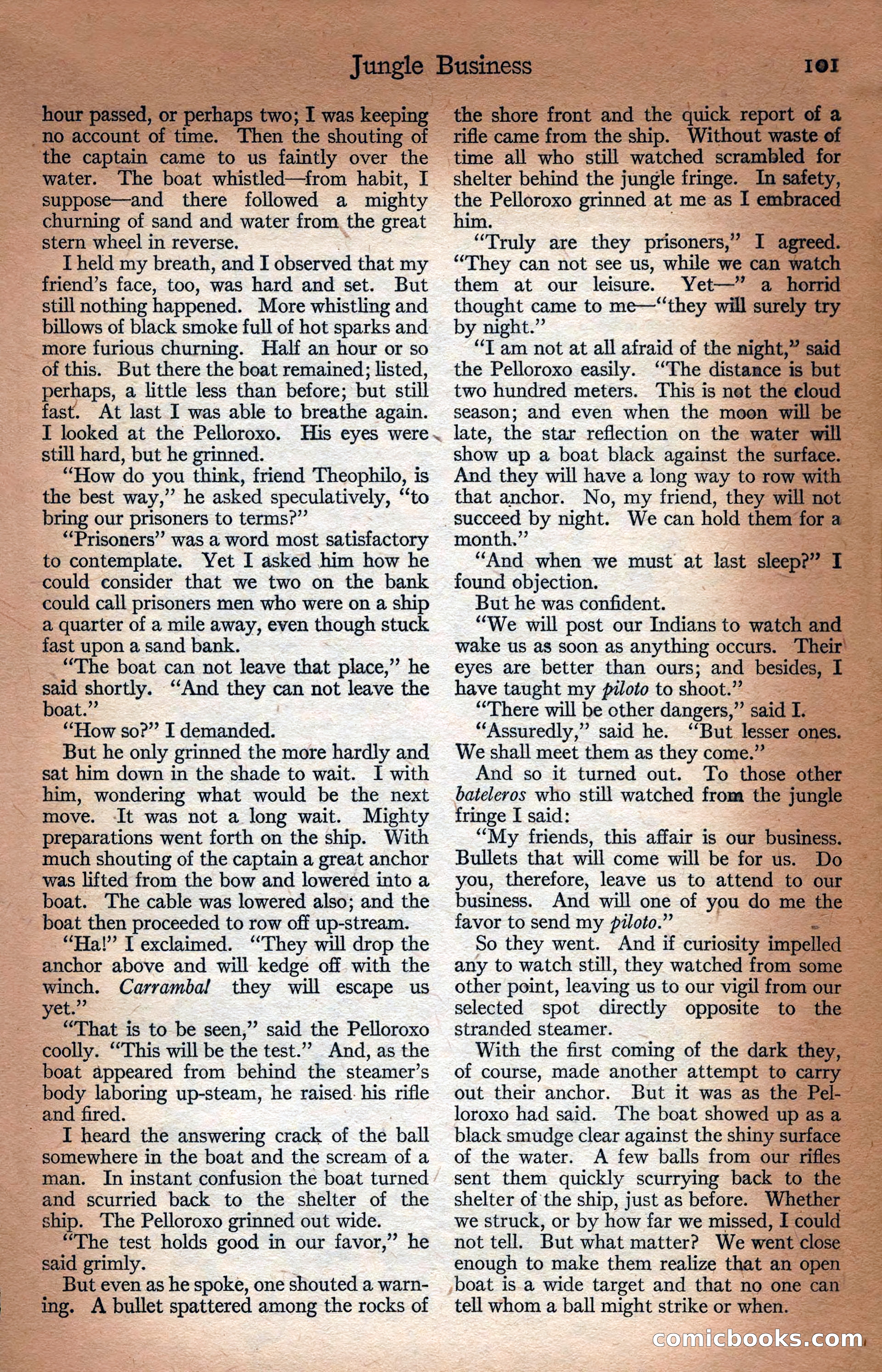
A restored page from Pulp Fiction, 1925. Page through the whole issue in the reader above.
📄 Transcribed text from this page (OCR, searchable)
Machine-transcribed from the original scan — historical spelling and the odd misread are preserved.
J ungle Business hour passed, or perhaps two; I was keeping -no account of time. Then the shouting of the captain came to us faintly over the water. The boat whistled—from habit, I suppose—and there followed a mighty churning of sand and water from the great stern wheel in reverse. I held my breath, and I observed that my friend’s face, too, was hard and set. But still nothing happened. More whistling and billows of black smoke full of hot sparks and more furious churning. Half an hour or so of this. But there the boat remained; listed, perhaps, a little less than before; but still fast. At last I was able to breathe again. I looked at the Pelloroxo. still hard, but he grinned. “How do you think, friend Theophilo, is the best way,” he asked speculatively, ‘‘to bring our prisoners to terms?” ‘Prisoners’ was a word most satisfactory to contemplate. Yet I asked him how he could consider that we two on the bank could call prisoners men who were on a ship a quarter of a mile away, even though stuck fast upon a sand bank. “The boat can not leave that place,” he — shortly. “And they can not leave the oat.” “How sop” I demanded. But he only grinned the more hardly and sat him down in the shade to wait. I with him, wondering what would be the next move. -It was not a long wait. Mighty preparations went forth on the ship. With much shouting of the captain a great anchor was lifted from the bow and lowered into a boat. The cable was lowered also; and the boat then proceeded to row off up-stream. “Ha!” I exclaimed. ‘They will drop the anchor above and will kedge off with the winch. Carrambal they will escape us yet.’ “That is to be seen,” said the Pelloroxo coolly. “This will be the test.” And, as the boat appeared from behind the steamer’s body laboring up-steam, he raised: his rifle and fired. I heard the answering crack of the ball somewhere in the boat and the scream of a man. In instant confusion the boat turned and scurried back to the shelter of the ship. The Pelloroxo grinned out wide. “The test holds good in our favor,” he said grimly. But even as he spoke, one shouted a warn- ing. A bullet spattered among the rocks of His eyes were . Iol the shore front and the quick report of a rifle came from the ship. Without waste of time all who still watched scrambled for shelter behind the jungle fringe. In safety, the Pelloroxo grinned at me as I embraced him | “Truly are they prisoners,” I agreed. “They can not see us, while we can watch them at our leisure. Yet—” a horrid thought came to me—“‘they will surely try by night.” “T am not at all afraid of the night,” said the Pelloroxo easily. “The distance is but two hundred meters. This is net the eloud season; and even when the moon will be late, the star reflection on the water will show up a boat black against the surface. © And they will have a long way to row with that anchor. No, my friend, they will not succeed by night. We can hold them for a month.”’ “And when we must at last sleep?” I found objection. But he was confident. “We will post our Indians to watch and wake us as soon as anything occurs. Their eyes are better than ours; and besides, I have taught my piloto to shoot.” ‘There will be other dangers,” said I. “Assuredly,” said he. “But lesser ones. We shall meet them as they come.” And so it turned out. To those other bateleros who still watched from the jungle fringe I said: “My friends, this affair is our business. Bullets that will come will be for us. Do you, therefore, leave us to attend to our business. And will one of you do me the favor to send my piloto.” So they went. And if curiosity impelled any to watch still, they watched from some other point, leaving us to our vigil from our selected spot directly opposite to the stranded steamer. With the first coming of the dark they, of course, made another attempt to carry out their anchor. But it was as the Pel- loroxo had said. The boat showed up as a black smudge clear against the shiny surface of the water. A few balls from our rifles sent them quickly scurrying back to the shelter of the ship, just as before. Whether we struck, or by how far we missed, I could not tell. But what matter? We went close enough to make them realize that an open boat is a wide target and that no one can tell whom a ball might strike or when. Gomicbooks (ele) mm