
Pulp Fiction, 1925 · page 98 of 212
Adventure Magazine Cover, March 20, 1925 — page 98: what you’re looking at
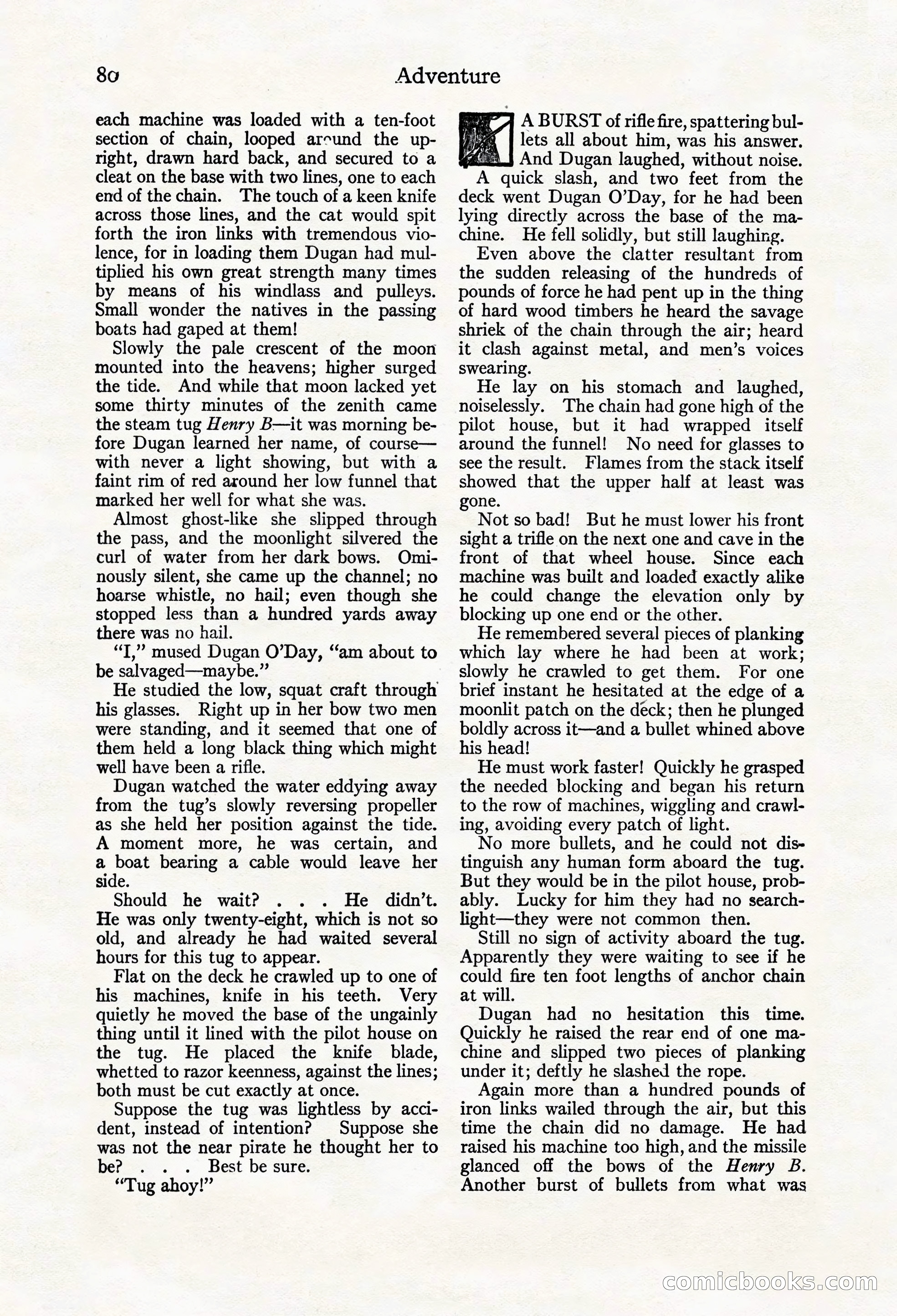
A restored page from Pulp Fiction, 1925. Page through the whole issue in the reader above.
📄 Transcribed text from this page (OCR, searchable)
Machine-transcribed from the original scan — historical spelling and the odd misread are preserved.
80 each machine was loaded with a ten-foot section of chain, looped around the up- right, drawn hard back, and secured to a cleat on the base with two lines, one to each end of the chain. The touch of a keen knife across those lines, and the cat would spit forth the iron links with tremendous vio- lence, for in loading them Dugan had mul- tiplied his own great strength many times by means of his windlass and pulleys. Small wonder the natives in the passing boats had gaped at them! Slowly the pale crescent of the moon mounted into the heavens; higher surged the tide. And while that moon lacked yet some thirty minutes of the zenith came the steam tug Henry B—it was morning be- fore Dugan learned her name, of course— with never a light showing, but with a faint rim of red around her low funnel that marked her well for what she was. Almost ghost-like she slipped through the pass, and the moonlight silvered the curl of water from her dark bows. Omi- nously silent, she came up the channel; no hoarse whistle, no hail; even though she stopped less than a hundred yards away there was no hail. “T,”’? mused Dugan O’Day, “‘am about to be salvaged—maybe.” He studied the low, squat craft through his glasses. Right up in her bow two men were standing, and it seemed that one of them held a long black thing which might well have been a rifle. Dugan watched the water eddying away from the tug’s slowly reversing propeller as she held her position against the tide. A moment more, he was certain, and a boat bearing a cable would leave her side. Should he wait? He didn’t. He was only twenty-eight, which is not so old, and already he had waited several hours for this tug to appear. Flat on the deck he crawled up to one of his machines, knife in his teeth. Very quietly he moved the base of the ungainly thing until it lined with the pilot house on the tug. He placed the knife blade, whetted to razor keenness, against the lines; both must be cut exactly at once. Suppose the tug was lightless by acci- dent, instead of intention? Suppose she was not the near pirate he thought her to bee . Best be sure. “Tug ahoy!” Adventure fea | A BURST of rifle fire, spattering bul- ys 1 ets all about him, was his answer. cj And Dugan laughed, without noise. oy rani slash, and two feet from the deck went Dugan O’Day, for he had been lying directly across the base of the ma- chine. He fell solidly, but still laughing. Even above the clatter resultant from the sudden releasing of the hundreds of pounds of force he had pent up in the thing of hard wood timbers he heard the savage shriek of the chain through the air; heard it clash against metal, and men’s voices swearing. He lay on his stomach one laughed, noiselessly. The chain had gone high of the pilot house, but it had wrapped itself around the funnel! No need for glasses to see the result. Flames from the stack itself showed that the upper half at least was gone. Not so bad! But he must lower his front sight a trifle on the next one and cave in the front of that wheel house. Since each machine was built and loaded exactly alike he could change the elevation only by blocking up one end or the other. He remembered several pieces of planking which lay where he had been at work; slowly he crawled to get them. For one brief instant he hesitated at the edge of a moonlit patch on the deck; then he plunged boldly across it—and a bullet whined above his head! He must work faster! Quickly he grasped the needed blocking and began his return to the row of machines, wiggling and crawl- ing, avoiding every patch of light. No more bullets, and he could not dis- tinguish any human form aboard the tug. But they would be in the pilot house, prob- ably. Lucky for him they had no search- light—they were not common then. Still no sign of activity aboard the tug. Apparently they were waiting to see if he could fire ten foot lengths of anchor chain at will. Dugan had no hesitation this time. Quickly he raised the rear end of one ma- chine and slipped two pieces of planking under it; deftly he slashed the rope. Again more than a hundred pounds of iron links wailed through the air, but this time the chain did no damage. He had raised his machine too high, and the missile glanced off the bows of the Henry B. Another burst of bullets from what was GOMIGIoOoO (©