
Pulp Fiction, 1925 · page 86 of 212
Adventure Magazine Cover, March 20, 1925 — page 86: what you’re looking at
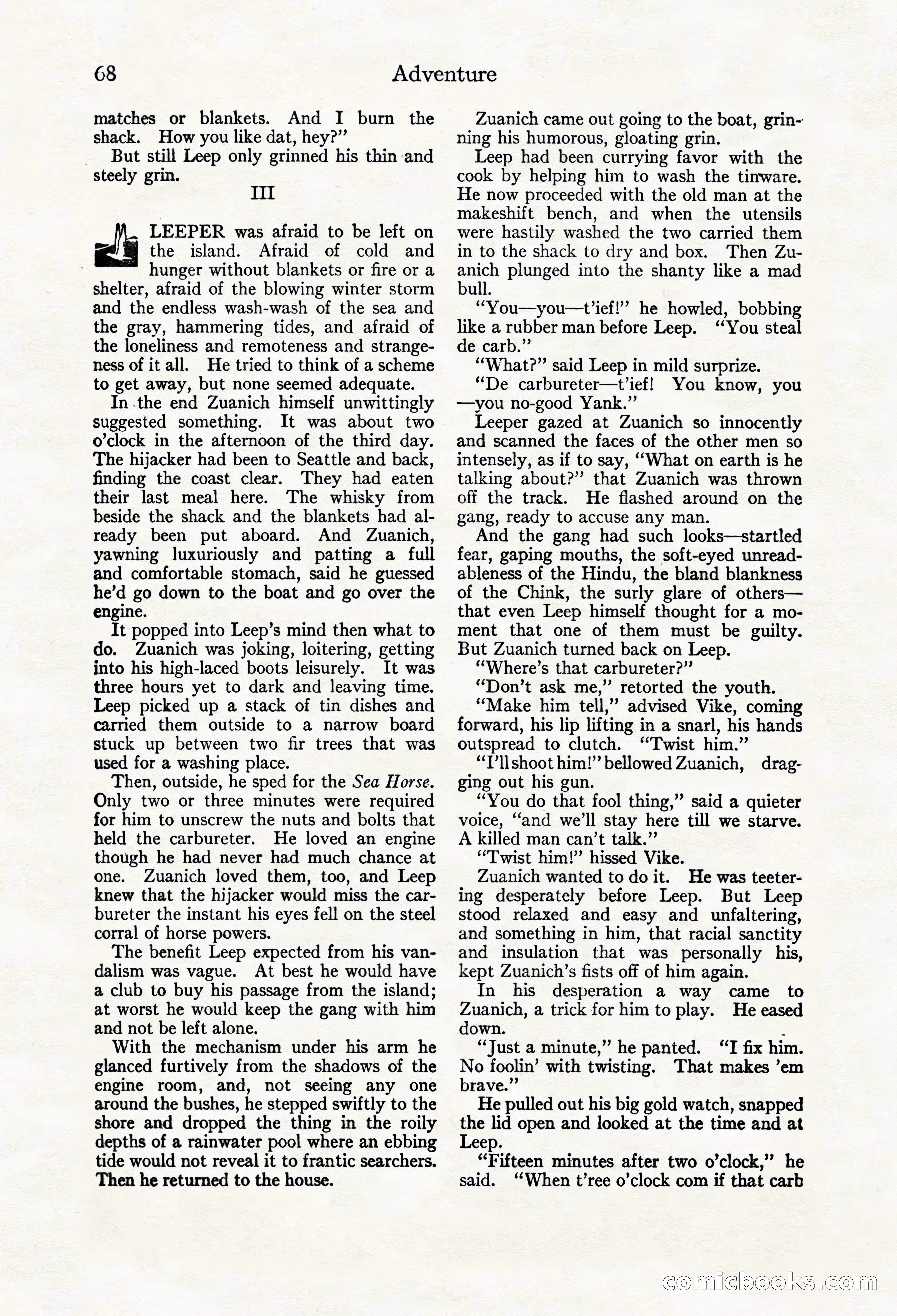
A restored page from Pulp Fiction, 1925. Page through the whole issue in the reader above.
📄 Transcribed text from this page (OCR, searchable)
Machine-transcribed from the original scan — historical spelling and the odd misread are preserved.
68 matches or blankets. And I burn the shack. How you like dat, hey?” But still Leep only grinned his thin and steely grin. ag the island. Afraid of cold and : hunger without blankets or fire or a shelter, afraid of the blowing winter storm and the endless wash-wash of the sea and the gray, hammering tides, and afraid of the loneliness and remoteness and strange- ness of it all. He tried to think of a scheme to get away, but none seemed adequate. Inthe end Zuanich himself unwittingly suggested something. It was about two o’clock in the afternoon of the third day. The hijacker had been to Seattle and back, finding the coast clear. They had eaten their last meal here. The whisky from beside the shack and the blankets had al- ready been put aboard. And Zuanich, yawning luxuriously and patting a full and comfortable stomach, said he guessed he’d go down to the boat and go over the engine. It popped into Leep’s mind then what to do. Zuanich was joking, loitering, getting into his high-laced boots leisurely. It was three hours yet to dark and leaving time. Leep picked up a stack of tin dishes and carried them outside to a narrow board stuck up between two fir trees that was used for a washing place. Then, outside, he sped for the Sea Horse. Only two or three minutes were required for him to unscrew the nuts and bolts that held the carbureter. He loved an engine though he had never had much chance at one. Zuanich loved them, too, and Leep knew that the hijacker would miss the car- bureter the instant his eyes fell on the steel corral of horse powers. The benefit Leep expected from his van- dalism was vague. At best he would have a club to buy his passage from the island; at worst he would keep the gang with him and not be left alone. With the mechanism under his arm he glanced furtively from the shadows of the engine room, and, not seeing any one around the bushes, he stepped swiftly to the shore and dropped the thing in the roily depths of a rainwater pool where an ebbing tide would not reveal it to frantic searchers. Then he returned to the house. III LEEPER was afraid to be left on Adventure Zuanich came out going to the boat, grin- ning his humorous, gloating grin. Leep had been currying favor with the cook by helping him to wash the tinware. He now proceeded with the old man at the makeshift bench, and when the utensils were hastily washed the two carried them in to the shack to dry and box. Then Zu- anich plunged into the shanty like a mad bull. ‘“You—you—t’ief!”” he howled, bobbing like a rubber man before Leep. ‘‘You steal de carb.” “What?” said Leep in mild surprize. “De carbureter—t’ief! You know, you —you no-good Yank.” Leeper gazed at Zuanich so innocently and scanned the faces of the other men so intensely, as if to say, ““What on earth is he talking about?” that Zuanich was thrown off the track. He flashed around on the gang, ready to accuse any man. And the gang had such looks—startled fear, gaping mouths, the soft-eyed unread- ableness of the Hindu, the bland blankness of the Chink, the surly glare of others— that even Leep himself thought for a mo- ment that one of them must be guilty. But Zuanich turned back on Leep. “‘Where’s that carbureter?”’ “Don’t ask me,” retorted the youth. “Make him tell,” advised Vike, coming forward, his lip lifting in a snarl, his hands outspread to clutch. “Twist him.” “T’llshoot him!” bellowed Zuanich, drag- ging out his gun. “You do that fool thing,” said a quieter voice, “and we'll stay here till we starve. A killed man can’t talk.” “Twist him!’ hissed Vike. Zuanich wanted to do it. He was teeter- ing desperately before Leep. But Leep stood relaxed and easy and unfaltering, and something in him, that racial sanctity and insulation that was personally his, kept Zuanich’s fists off of him again. In his desperation a way came to Zuanich, a trick for him to play. He eased down. : “Just a minute,” he panted. “TI fix him. No foolin’ with twisting. That makes ’em brave.” He pulled out his big gold watch, snapped the lid open and looked at the time and at Leep. “Fifteen minutes after two o’clock,” he said. “When t’ree o’clock com if that carb COnnICLOo (©