
Pulp Fiction, 1925 · page 66 of 212
Adventure Magazine Cover, March 20, 1925 — page 66: what you’re looking at
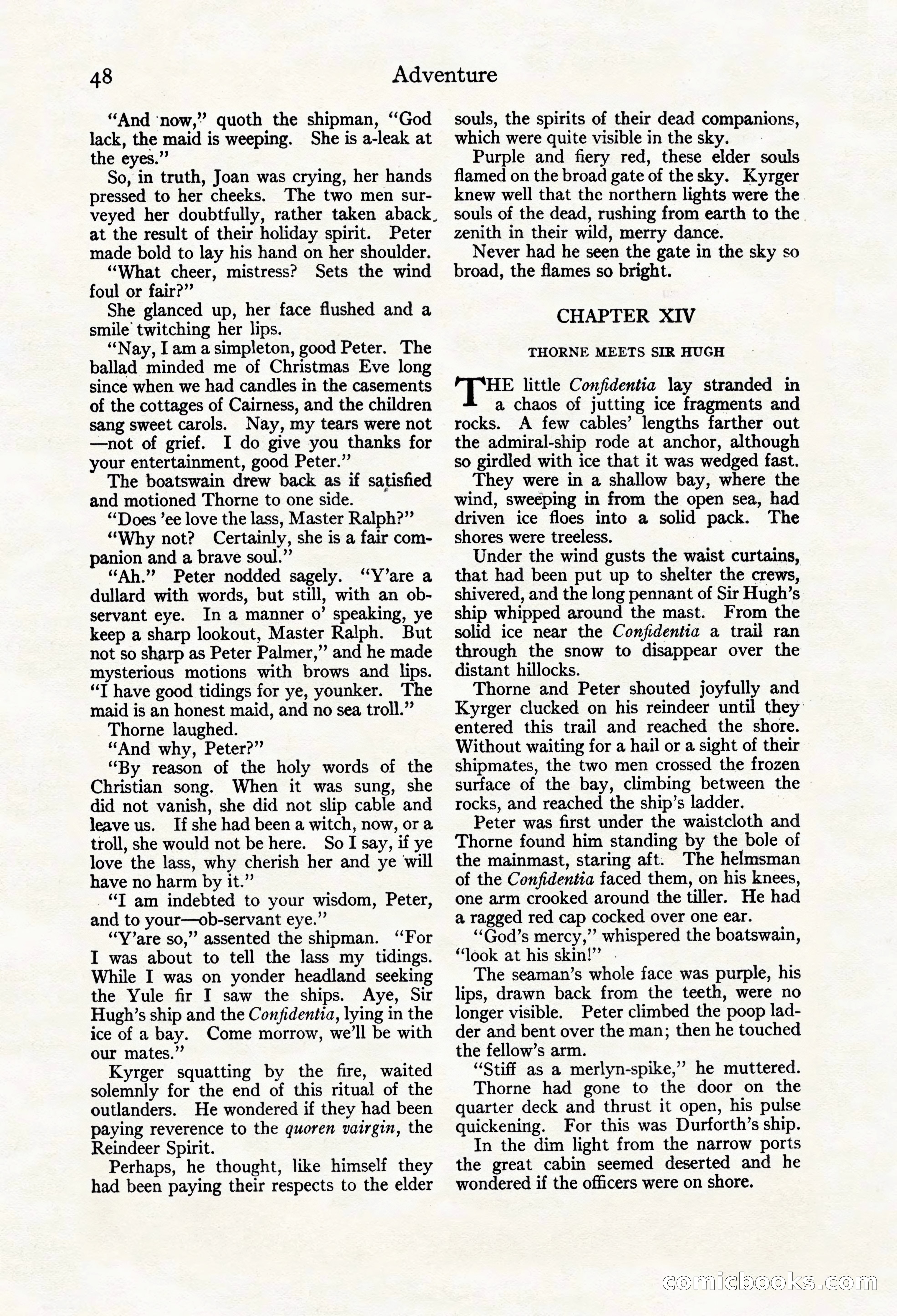
A restored page from Pulp Fiction, 1925. Page through the whole issue in the reader above.
📄 Transcribed text from this page (OCR, searchable)
Machine-transcribed from the original scan — historical spelling and the odd misread are preserved.
48 “And ‘now,” quoth the shipman, ‘God lack, the maid is weeping. She is a-leak at the eyes.” So, in truth, Joan was crying, her hands pressed to her cheeks. The two men sur- veyed her doubtfully, rather taken aback, at the result of their holiday spirit. Peter made bold to lay his hand on her shoulder. ‘“‘What cheer, mistress? Sets the wind foul or fair?” She glanced up, her face flushed and a smile twitching her lips. “Nay, [am a simpleton, good Peter. The ballad minded me of Christmas Eve long since when we had candles in the casements of the cottages of Cairness, and the children sang sweet carols. Nay, my tears were not —not of grief. I do give you thanks for your entertainment, good Peter.” The boatswain drew back as if satisfied and motioned Thorne to one side. “Toes ’ee love the lass, Master Ralph?” “Why not? Certainly, she is a fair com- panion and a brave soul.” “Ah.” Peter nodded sagely. ‘Y’are a dullard with words, but still, with an ob- servant eye. In a manner 0’ speaking, ye keep a sharp lookout, Master Ralph. But not so sharp as Peter Palmer,” and he made mysterious motions with brows and lips. “T have good tidings for ye, younker. The maid is an honest maid, and no sea troll.” Thorne laughed. “And why, Peter?” “By reason of the holy words of the Christian song. When it was sung, she did not vanish, she did not slip cable and leave us. If she had been a witch, now, ora troll, she would not be here. So I say, if ye love the lass, why cherish her and ye will have no harm by it.” _“T am indebted to your wisdom, Peter, and to your—ob-servant eye.” “V’are so,” assented the shipman. ‘For I was about to tell the lass my tidings. While I was on yonder headland seeking the Yule fir I saw the ships. Aye, Sir Hugh’s ship and the Confidentia, lying in the ice of a bay. Come morrow, we'll be with our mates.” Kyrger squatting by the fire, waited solemnly for the end of this ritual of the outlanders. He wondered if they had been paying reverence to the quoren vairgin, the Reindeer Spirit. Perhaps, he thought, like himself they had been paying their respects to the elder Adventure souls, the spirits of their dead companions, which were quite visible in the sky. Purple and fiery red, these elder souls flamed on the broad gate of thesky. Kyrger knew well that the northern lights were the. souls of the dead, rushing from earth to the | zenith in their wild, merry dance. Never had he seen the gate in the sky so broad, the flames so bright. CHAPTER XIV THORNE MEETS SIR HUGH rTHE little Conjfidentia lay stranded in a chaos of jutting ice fragments and rocks. A few cables’ lengths farther out the admiral-ship rode at anchor, although so girdled with ice that it was wedged fast. They were in a shallow bay, where the wind, sweeping in from the open sea, had driven ice floes into a solid pack. The shores were treeless. : 7 Under the wind gusts the waist curtains, that had been put up to shelter the crews, shivered, and the long pennant of Sir Hugh’s ship whipped around the mast. From the solid ice near the Confidentia a trail ran through the snow to disappear over the distant hillocks. Thorne and Peter shouted joyfully and Kyrger clucked on his reindeer until they entered this trail and reached the shore. Without waiting for a hail or a sight of their shipmates, the two men crossed the frozen surface of the bay, climbing between the rocks, and reached the ship’s ladder. Peter was first under the waistcloth and Thorne found him standing by the bole of the mainmast, staring aft. The helmsman of the Confidentia faced them, on his knees, one arm crooked around the tiller. He had a ragged red cap cocked over one ear. ‘“‘God’s mercy,” whispered the boatswain, “ook at his skin!” . The seaman’s whole face was purple, his lips, drawn back from the teeth, were no longer visible. Peter climbed the poop lad- der and bent over the man; then he touched the fellow’s arm. “Stiff as a merlyn-spike,”’ he muttered. Thorne had gone to the door on the quarter deck and thrust it open, his pulse quickening. For this was Durforth’s ship. In the dim light from the narrow ports the great cabin seemed deserted and he wondered if the officers were on shore. CORnNICLO© (C©