
Pulp Fiction, 1925 · page 209 of 212
Adventure Magazine Cover, March 20, 1925 — page 209: what you’re looking at
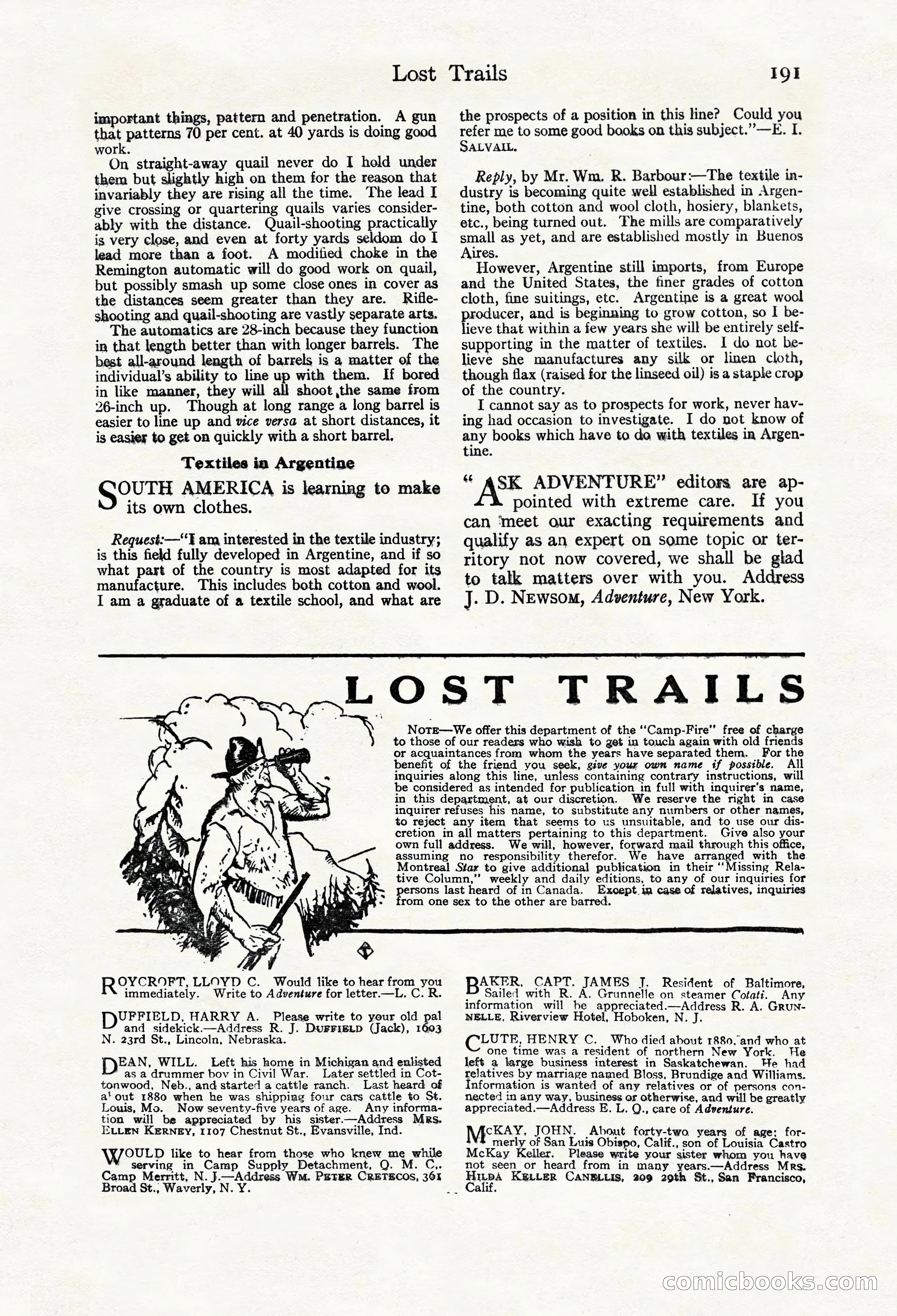
A restored page from Pulp Fiction, 1925. Page through the whole issue in the reader above.
📄 Transcribed text from this page (OCR, searchable)
Machine-transcribed from the original scan — historical spelling and the odd misread are preserved.
Lost important things, pattern and penetration. A gun that patterns 70 per cent. at 40 yards is doing good work. On straight-away quail never do I hold under them but slightly high on them for the reason that invariably they are rising all the time. The lead I give crossing or quartering quails varies consider- ably with the distance. Quail-shooting practically is very close, and even at forty yards seldom do I lead more than a foot. A modified choke in the Remington automatic will do good work on quail, but possibly smash up some close ones in cover as the distances seem greater than they are. Rifle- shooting and quail-shooting are vastly separate arts. The automatics are 28-inch because they function in that length better than with longer barrels. The best all-around length of barrels is a matter of the individual’s ability to line up with them. If bored in like manner, they will all shoot the same from 26-inch up. Though at long range a long barrel is easier to line up and vice versa at short distances, it is easier to get on quickly with a short barrel. Textiles in Argentine OUTH AMERICA is learning to make its own clothes. Request: —‘¥ am interested in the textile industry; is this field fully developed in Argentine, and if so what part of the country is most adapted for its manufacture. This includes both cotton and wool. I am a graduate of a textile school, and what are Trails 1QI the prospects of a position in this line? Could you refer me to some good books on this subject.” —E. I. SALVAIL. Reply, by Mr. Wm. R. Barbour:—The textile in- dustry is becoming quite well established in Argen- tine, both cotton and wool cloth, hosiery, blankets, etc., being turned out. The mills are comparatively small as yet, and are established mostly in Buenos Aires. However, Argentine still imports, from Europe and the United States, the finer grades of cotton cloth, fine suitings, etc. Argentine is a great wool producer, and is beginning to grow cotton, so I be- lieve that within a few years she will be entirely self- supporting in the matter of textiles. 1 do not be- lieve she manufactures any silk or linen cloth, though flax (raised for the linseed oil) is a staple crop of the country. I cannot say as to prospects for work, never hav- ing had occasion to investigate. I do not know of any books which have to do with textiles in Argen- tine. * aSK ADVENTURE” editors are ap- pointed with extreme care. If you can ‘meet our exacting requirements and qualify as an expert on some topic or ter- ritory not now covered, we shall be glad to talk matters over with you. Address J. D. NEwsom, Adventure, New York. LOST TRAILS NoTE—We offer this department of the ‘‘Camp-Fire’’ free of charge to those of our readers who wish to get in touch again with old friends or acquaintances from whom the years have separated them. For the benefit of the friend you seek, give your own name if possible. inquiries along this line, unless containing contrary instructions, will be considered as intended for publication in full with inquirer’s name, in this departm. inquirer refuses All at, at our discretion. We reserve the right in case is name, to substitute any numbers or other names, to reject any item that seems to us unsuitable, and to use our dis- cretion in all matters pertaining to this department. Give also your own full address. We will, however, forward mail through this office, assuming no responsibility therefor. We have arranged with the Montreal Star to give additional publication in their ‘Missing Rela- tive Column,” weekly and daily editions, to any of our inquiries for ROYCROFT, LLOYD C. Would like to hear from_you immediately. Write to Adventure for letter.—L. C. R. DUFFIELD, HARRY A. Please write to your old og and sidekick.—Address R. J. Dugrigtp (Jack), 1603 N. 23rd St., Lincoln, Nebraska. DEAN. WILL. Left his home in Michigan and enlisted as a drummer bov in Civil War. Later settled in Cot- tonwood, Neb., and started a cattle ranch. Last heard of at out 1880 when he was shipping four cars cattle to St. Louis, Mo. Now seventy-five years of age. Any informa- tion will be appreciated by his sister—Address Mrs. ELLEN KERNEY, 1107 Chestnut St., Evansville, Ind. WovuLtp like to hear from those who knew me while ' serving in Camp Supply Detachment, Q. M. C,. Camp Merntt, N. J}.—Address WM. Pater CRETECOS, 361 Broad St., Waverly, N. Y. persons last heard of in Canada. from one sex to the other are ba s Except.in case of relatives, inquiries AKER, CAPT. JAMES J. Resident of Baltimore, 4” Sailed with R. A. Grunnelle on steamer Cotati. Any information will be appreciated.—Address R. A. Grun- NELLE, Riverview Hotel, Hoboken, N. J LUTE, HENRY C._ Who died about 1880, and who at one time was a resident of northern New York. He left a large business interest in Saskatchewan. He had relatives by marriage named Bloss, Brundige and Williams. Information is wanted of any relatives or of persons con- nected in any way, business or otherwise, and will be greatly appreciated.—Address E. L. Q., care of Adventure. Mck4y. JOHN. About forty-two years of age: for- merly of San Luis Obispo, Calif., son of Louisia Castro McKay Keller. Please write your sister whom you have not seen or heard from in many years.—Address Mrs. ohne KELLER CANBLLIS, 209 29th St., San Francisco, alif. CORNIECLO© (©