
Pulp Fiction, 1925 · page 201 of 212
Adventure Magazine Cover, March 20, 1925 — page 201: what you’re looking at
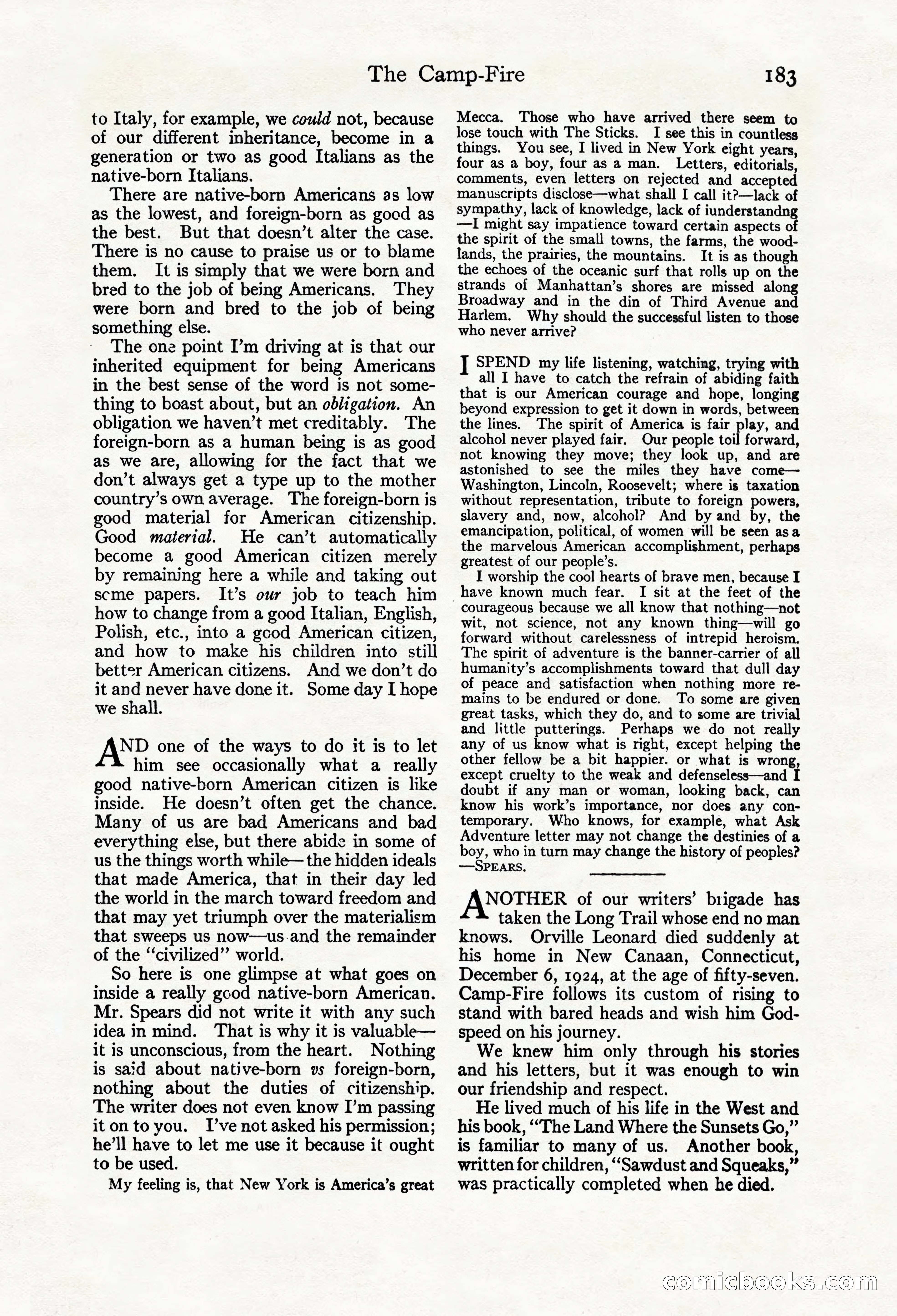
A restored page from Pulp Fiction, 1925. Page through the whole issue in the reader above.
📄 Transcribed text from this page (OCR, searchable)
Machine-transcribed from the original scan — historical spelling and the odd misread are preserved.
The Camp-Fire to Italy, for example, we could not, because of our different inheritance, become in a generation or two as good Italians as the native-born Italians. There are native-born Americans as low as the lowest, and foreign-born as gocd as the best. But that doesn’t alter the case. There is no cause to praise us or to blame them. It is simply that we were born and bred to the job of being Americans. They were born and bred to the job of being something else. The one point I’m driving at is that our inherited equipment for being Americans in the best sense of the word is not some- thing to boast about, but an obligation. An obligation we haven’t met creditably. The foreign-born as a human being is as good as we are, allowing for the fact that we don’t always get a type up to the mother country’s own average. The foreign-born is good material for American citizenship. Good material. He can’t automatically become a good American citizen merely by remaining here a while and taking out scme papers. It’s our job to teach him how to change from a good Italian, English, Polish, etc., into a gcod American citizen, and how to make his children into still better American citizens. And we don’t do ijt and never have done it. Some day I hope we shall. ND one of the ways to do it is to let him see occasionally what a really good native-born American citizen is like inside. He doesn’t often get the chance. Many of us are bad Americans and bad everything else, but there abide in some of us the things worth while— the hidden ideals that made America, that in their day led the world in the march toward freedom and that may yet triumph over the materialism that sweeps us now—us and the remainder of the ‘‘civilized”’ world. So here is one glimpse at what goes on inside a really gcod native-born American. Mr. Spears did not write it with any such idea in mind. That is why it is valuable— it is unconscious, from the heart. Nothing is said about native-born vs foreign-born, nothing about the duties of citizenship. The writer does not even know I’m passing iton to you. I’ve not asked his permission; he’ll have to let me use it because it ought to be used. My feeling is, that New York is America’s great 183 Mecca. Those who have arrived there seem to lose touch with The Sticks. I see this in countless things. You see, I lived in New York eight years, four as a boy, four as a man. Letters, editorials, comments, even letters on rejected and accepted manuscripts disclose—what shall I call it?—lack of sympathy, lack of knowledge, lack of iunderstandng —I might say impatience toward certain aspects of the spirit of the small towns, the farms, the wood- lands, the prairies, the mountains. It is as though the echoes of the oceanic surf that rolls up on the strands of Manhattan’s shores are missed along Broadway and in the din of Third Avenue and Harlem. Why should the successful listen to those who never arrive? I SPEND my life listening, watching, trying with all I have to catch the refrain of abiding faith that is our American courage and hope, longing beyond expression to get it down in words, between the lines. The spirit of America is fair play, and alcohol never played fair. Our people toil forward, not knowing they move; they look up, and are astonished to see the miles they have come— Washington, Lincoln, Roosevelt; where is taxation without representation, tribute to foreign powers, slavery and, now, alcohol? And by and by, the emancipation, political, of women will be seen asa the marvelous American accomplishment, perhaps greatest of our people’s. I worship the cool hearts of brave men, because I have known much fear. I sit at the feet of the courageous because we all know that nothing—not wit, not science, not any known thing—will go forward without carelessness of intrepid heroism. The spirit of adventure is the banner-carrier of all humanity’s accomplishments toward that dull day of peace and satisfaction when nothing more re- mains to be endured or done. To some are given great tasks, which they do, and to some are trivial and little putterings. Perhaps we do not really any of us know what is right, except helping the other fellow be a bit happier. or what is wrong except cruelty to the weak and defenseless—and i doubt if any man or woman, looking back, can know his work’s importance, nor does any con- temporary. Who knows, for example, what Ask Adventure letter may not change the destinies of a boy, who in turn may change the history of peoples? —SPEARS. ANOTHER of our writers’ brigade has taken the Long Trail whose end no man knows. Orville Leonard died suddenly at his home in New Canaan, Connecticut, December 6, 1924, at the age of fifty-seven. Camp-Fire follows its custom of rising to stand with bared heads and wish him God- speed on his journey. We knew him only through his stories and his letters, but it was enough to win our friendship and respect. He lived much of his life in the West and his book, ‘“The Land Where the Sunsets Go,” is familiar to many of us. Another book, written for children, ‘Sawdust and Squeaks,” was practically completed when he died. GoOMmiiGbdoo (©