
Pulp Fiction, 1925 · page 20 of 212
Adventure Magazine Cover, March 20, 1925 — page 20: what you’re looking at
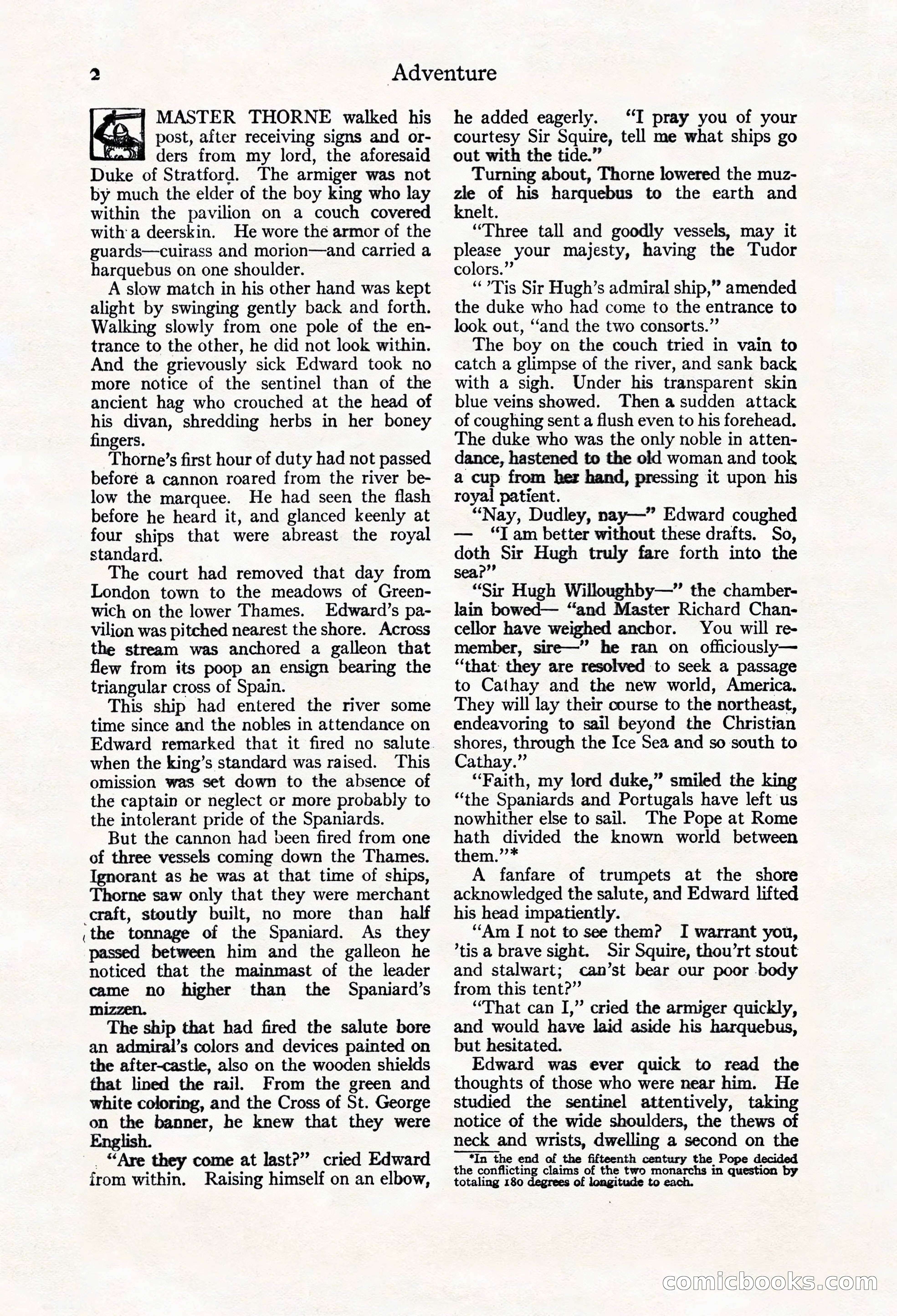
A restored page from Pulp Fiction, 1925. Page through the whole issue in the reader above.
📄 Transcribed text from this page (OCR, searchable)
Machine-transcribed from the original scan — historical spelling and the odd misread are preserved.
2 Adventure 1 MASTER THORNE walked his Site) post, after receiving signs and or- Keo ders from my lord, the aforesaid Duke of Stratford. The armiger was not by much the elder of the boy king who lay within the pavilion on a couch covered with a deerskin. He wore the armor of the guards—cuirass and morion—and carried a harquebus on one shoulder. A slow match in his other hand was kept alight by swinging gently back and forth. Walking slowly from one pole of the en- trance to the other, he did not look within. And the grievously sick Edward took no more notice of the sentinel than of the ancient hag who crouched at the head of his divan, shredding herbs in her boney fingers. Thorne’ s first hour of duty had not passed before a cannon roared from the river be- low the marquee. He had seen the flash before he heard it, and glanced keenly at four ships that were abreast the royal standard. The court had removed that day from London town to the meadows of Green- wich on the lower Thames. Edward’s pa- vilion was pitched nearest the shore. Across the stream was anchored a galleon that flew from its poop an ensign bearing the triangular cross of Spain. This ship had entered the river some time since and the nobles in attendance on Edward remarked that it fired no salute. when the king’s standard was raised. This omission was set down to the absence of the captain or neglect or more probably to the intolerant pride of the Spaniards. But the cannon had been fired from one of three vessels coming down the Thames. Ignorant as he was at that time of ships, Thorne saw only that they were merchant craft, stoutly built, no more than half _ the tonnage of the Spaniard. As they passed between him and the galleon he noticed that the mainmast of the leader came no higher than the Spaniard’s mizzen. The ship that had fired the salute bore an admiral’s colors and devices painted on the after-castle, also on the wooden shields that lined the rail. From the green and white coloring, and the Cross of St. George on the banner, he knew that they were English. “Are they come at last?” cried Edward from within. Raising himself on an elbow, he added eagerly. “I pray you of your courtesy Sir Squire, tell me what ships go out with the tide.” Turning about, Thorne lowered the muz- zle of his harquebus to the earth and knelt. “Three tall and goodly vessels, may it please your majesty, having the Tudor colors.” “?Tis Sir Hugh’s admiral ship,” amended the duke who had come to the entrance to look out, “‘and the two consorts.”’ The boy on the couch tried in vain to catch a glimpse of the river, and sank back with a sigh. Under his transparent skin blue veins showed. Then a sudden attack of coughing sent a flush even to his forehead. The duke who was the only noble in atten- dance, hastened to the old woman and took a cup from hez hand, pressing it upon his royal patient. “Nay, Dudley, nay—” Edward coughed “T am better without these drafts. So, doth Sir Hugh truly fare forth into the sea?’ “Sir Hugh Willoughby—” the chamber- lain bowed— “and Master Richard Chan- cellor have weighed anchor. You will re- member, sire—” he ran on officiously— “that they are resolved to seek a passage to Cathay and the new world, America. They will lay their course to the northeast, endeavoring to sail beyond the Christian shores, through the Ice Sea and so south to Cathay.” “Faith, my lord duke,” smiled the king “the Spaniards and Portugals have left us nowhither else to sail. The Pope at Rome hath divided the known world between them.’’* A fanfare of trumpets at the shore acknowledged the salute, and Edward lifted his head impatiently. ‘“‘Am I not to see them? I warrant you, tis a brave sight. Sir Squire, thou’rt stout and stalwart; can’st bear our poor body from this tent?” “That can I,” cried the armiger quickly, and would have laid aside his harquebus, but hesitated. Edward was ever quick to read the thoughts of those who were near him. He studied the sentinel attentively, taking notice of the wide shoulders, the thews of neck and wrists, dwelling a second on the ~ *In the end of the fifteenth century the Pope decided the conflicting claims a the two monarchs in question by totaling 180 degrees of longitude to each. COnNICLaO© (©