
Pulp Fiction, 1925 · page 187 of 212
Adventure Magazine Cover, March 20, 1925 — page 187: what you’re looking at
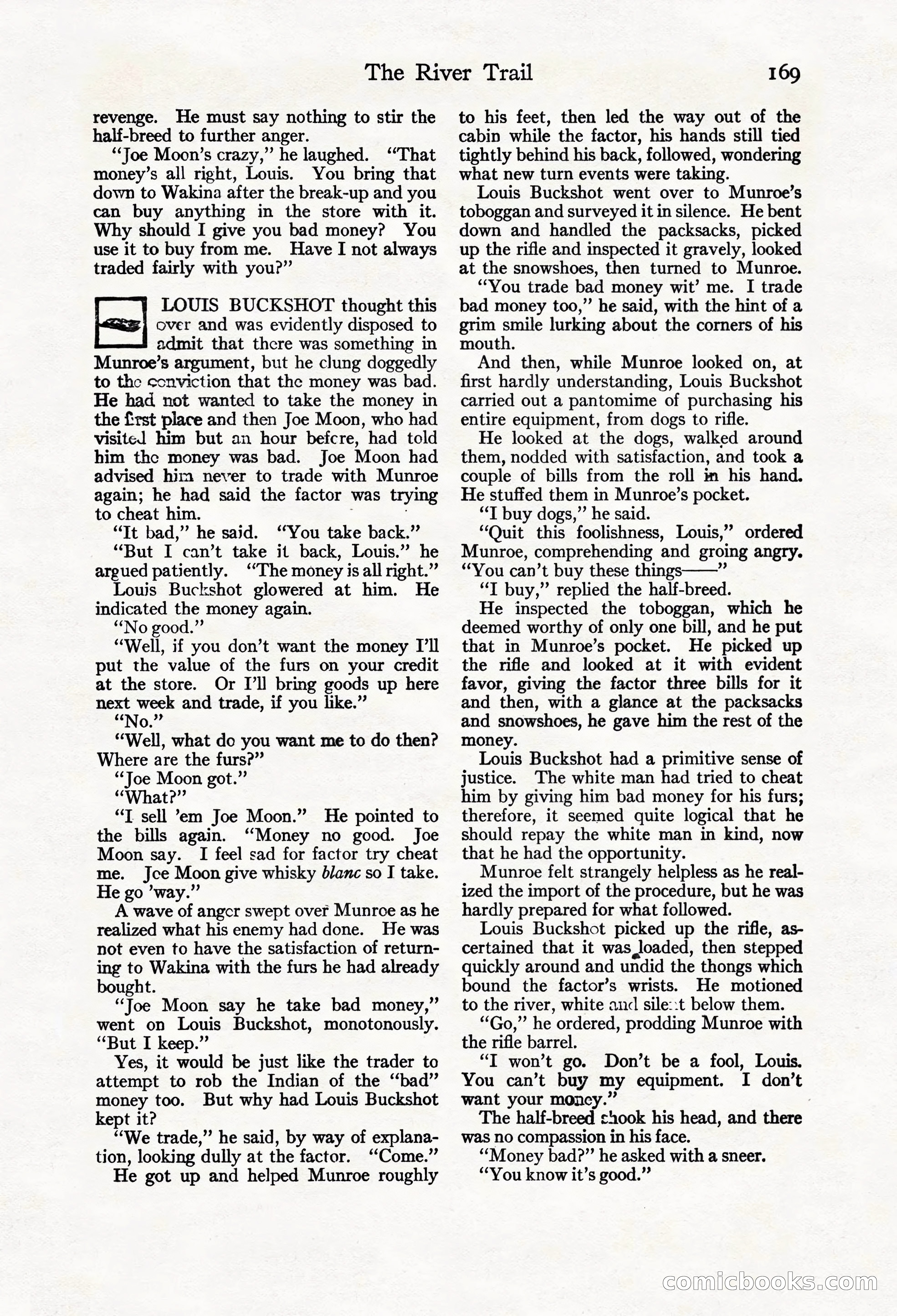
A restored page from Pulp Fiction, 1925. Page through the whole issue in the reader above.
📄 Transcribed text from this page (OCR, searchable)
Machine-transcribed from the original scan — historical spelling and the odd misread are preserved.
The River Trail revenge. He must say nothing to stir the half-breed to further anger. ‘*Joe Moon’s crazy,” he laughed. ‘That money’s all right, Louis. You bring that down to Wakina after the break-up and you can buy anything in the store with it. Why should I give you bad money? You use it to buy from me. Have I not always traded fairly with you?” LOUIS BUCKSHOT thought this over and was evidently disposed to admit that there was something in Munroe’s argument, but he clung doggedly to the conviction that the money was bad. He had not wanted to take the money in the frst place and then Joe Moon, who had visite. him but an hour befcre, had told him the money was bad. Joe Moon had advised him never to trade with Munroe again; he had said the factor was trying to cheat him. “Tt bad,” he said. ‘You take back.” “But I can’t take it back, Louis.” he argued patiently. ‘The money is all right.” Loujs Buckshot glowered at him. He indicated the money again. “No good.” “Well, if you don’t want the money I'll put the value of the furs on your credit at the store. Or I'll bring goods up here next week and trade, if you like.” “No.” “Well, what do you want me to do then? Where are the furs?” ‘Joe Moon got.” f Zea “What?” “T. sell °em Joe Moon.” He pointed to the bills again. ‘Money no good. Joe Moon say. I feel sad for factor try cheat me. Jce Moon give whisky blanc so J take. He go ’way.” A wave of angcr swept over Munroe as he realized what his enemy had done. He was not even to have the satisfaction of return- ing to Wakina with the furs he had already bought. “Joe Moon say he take bad money,” went on Louis Buckshot, monotonously. “But I keep.” Yes, it would be just like the trader to attempt to rob the Indian of the “bad” money too. But why had Louis Buckshot kept it? ‘“‘We trade,” he said, by way of explana- tion, looking dully at the factor. “Come.” He got up and helped Munroe roughly 169 to his feet, then led the way out of the cabin while the factor, his hands still tied tightly behind his back, followed, wondering what new turn events were taking. Louis Buckshot went over to Munroe’s toboggan and surveyed it in silence. He bent down and handled the packsacks, picked up the rifle and inspected it gravely, looked at the snowshoes, then turned to Munroe. “You trade bad money wit’ me. I trade bad money too,” he said, with the hint of a grim smile lurking about the corners of his mouth. And then, while Munroe looked on, at first hardly understanding, Louis Buckshot carried out a pantomime of purchasing his entire equipment, from dogs to rifle. He looked at the dogs, walked around them, nodded with satisfaction, and took a couple of bills from the roll in his hand. He stuffed them in Munroe’s pocket. “T buy dogs,” he said. “Quit this foolishness, Louis,” ordered Munroe, comprehending and groing angry. “You can’t buy these things——” “T buy,” replied the half-breed. He inspected the toboggan, which he deemed worthy of only one bill, and he put that in Munroe’s pocket. He picked up the rifle and looked at it with evident favor, giving the factor three bills for it and then, with a glance at the packsacks and snowshoes, he gave him the rest of the money. Louis Buckshot had a primitive sense of justice. The white man had tried to cheat him by giving him bad money for his furs; therefore, it seemed quite logical that he should repay the white man in kind, now that he had the opportunity. Munroe felt strangely helpless as he real- ized the import of the procedure, but he was hardly prepared for what followed. Louis Buckshot picked up the rifle, as- certained that it was loaded, then stepped quickly around and undid the thongs which bound the factor’s wrists. He motioned to the river, white and sile::t below them. “Go,” he ordered, prodding Munroe with the rifle barrel. “T won’t go. Don’t be a fool, Louis. You can’t buy my equipment. I don’t want your moncy.” The hali-breed chook his head,and there. was no compassion in his face. “Money bad?” he asked with a sneer. “You know it’s good.” GOMmiiGdoo (©