
Pulp Fiction, 1925 · page 185 of 212
Adventure Magazine Cover, March 20, 1925 — page 185: what you’re looking at
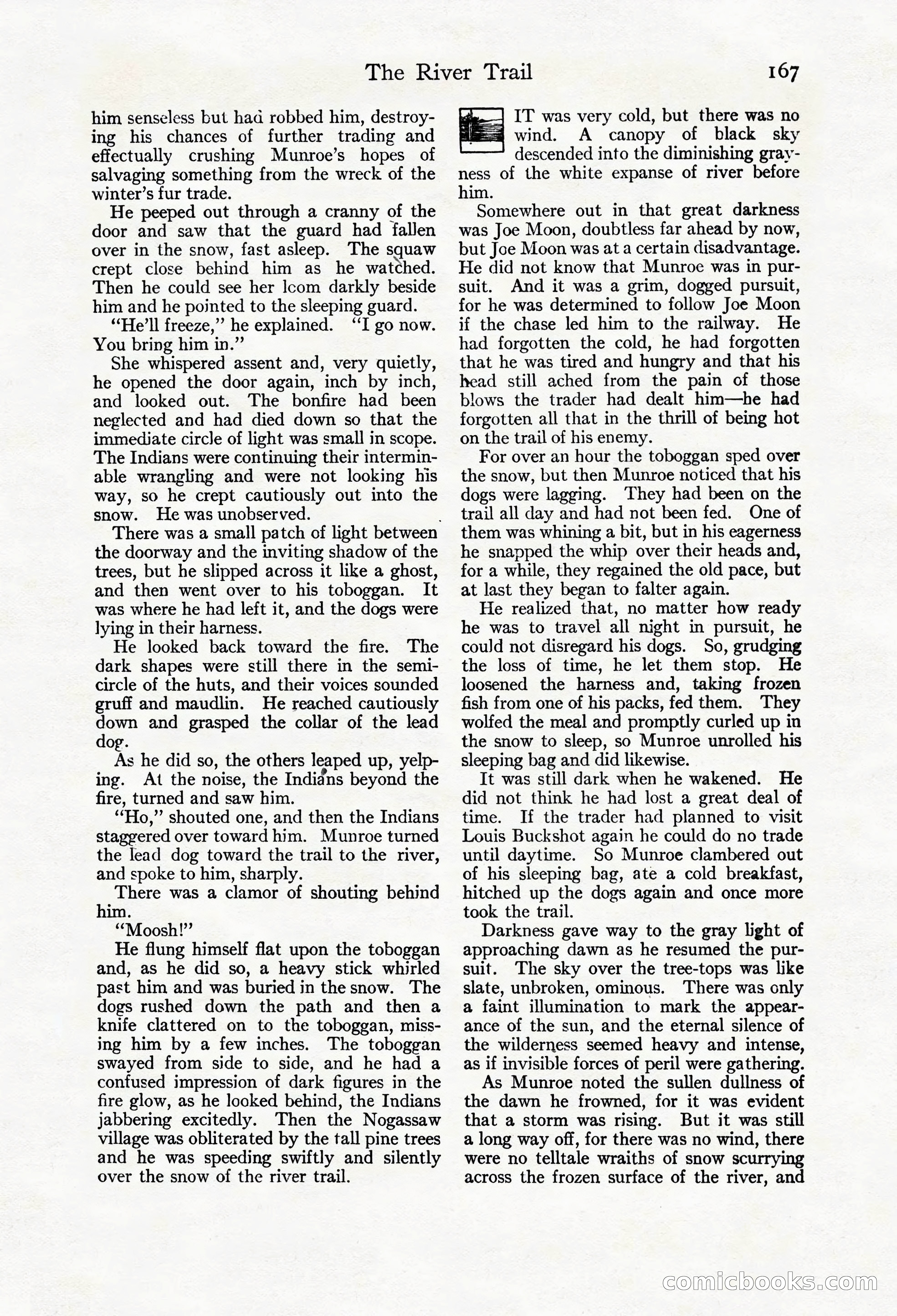
A restored page from Pulp Fiction, 1925. Page through the whole issue in the reader above.
📄 Transcribed text from this page (OCR, searchable)
Machine-transcribed from the original scan — historical spelling and the odd misread are preserved.
The River Trail him senseless but had robbed him, destroy- ing his chances of further trading and effectually crushing Munroe’s hopes of salvaging something from the wreck of the winter’s fur trade. He peeped out through a cranny of the door and saw that the guard had fallen over in the snow, fast asleep. The squaw crept close behind him as he watched. Then he could see her Icom darkly beside him and he pointed to the sleeping guard. ‘‘He’ll freeze,”’ he explained. “I go now. You bring him in.” She whispered assent and, very quietly, he opened the door again, inch by inch, and looked out. The bonfire had been neglected and had died down so that the immediate circle of light was small in scope. The Indians were continuing their intermin- able wrangling and were not looking his way, so he crept cautiously out into the snow. He was unobserved. There was a small patch of light between the doorway and the inviting shadow of the trees, but he slipped across it like a ghost, and then went over to his toboggan. It was where he had left it, and the dogs were lying in their harness. He looked back toward the fire. The dark shapes were still there in the semi- circle of the huts, and their voices sounded gruff and maudlin. He reached cautiously down and grasped the collar of the lead dog. As he did so, the others leaped up, yelp- ing. At the noise, the Indians beyond the fire, turned and saw him. “Ho,” shouted one, and then the Indians staggered over toward him. Munroe turned the lead dog toward the trail to the river, and spoke to him, sharply. There was a clamor of shouting behind him. “‘Moosh!”’ He flung himself flat upon the toboggan and, as he did so, a heavy stick whirled past him and was buried in the snow. The dogs rushed down the path and then a knife clattered on to the toboggan, miss- ing him by a few inches. The toboggan swayed from side to side, and he had a confused impression of dark figures in the fire glow, as he looked behind, the Indians jabbering excitedly. Then the Nogassaw village was obliterated by the tall pine trees and he was speeding swiftly and silently over the snow of the river trail. 167 .—| IT was very cold, but there was no S_— wind. A canopy of black sky -——] descended into the diminishing gray- ness of the white expanse of river before him. Somewhere out in that great darkness was Joe Moon, doubtless far ahead by now, but Joe Moon was at a certain disadvantage. He did not know that Munroe was in pur- suit. And it was a grim, dogged pursuit, for he was determined to follow Joe Moon if the chase led him to the railway. He had forgotten the cold, he had forgotten that he was tired and hungry and that his head still ached from the pain of those blows the trader had dealt him—he had forgotten all that in the thrill of being hot on the trail of his enemy. For over an hour the toboggan sped over the snow, but then Munroe noticed that his dogs were lagging. They had been on the trail all day and had not been fed. One of them was whining a bit, but in his eagerness he snapped the whip over their heads and, for a while, they regained the old pace, but at last they began to falter again. He realized that, no matter how ready he was to travel all night in pursuit, he could not disregard his dogs. So, grudging the loss of time, he let them stop. He loosened the harness and, taking frozen fish from one of his packs, fed them. They wolfed the meal and promptly curled up in the snow to sleep, so Munroe unrolled his sleeping bag and did likewise. It was still dark when he wakened. He did not think he had lost a great deal of time. If the trader had planned to visit Louis Buckshot again he could do no trade until daytime. So Munroe clambered out of his sleeping bag, ate a cold breakfast, hitched up the dogs again and once more took the trail. Darkness gave way to the gray light of approaching dawn as he resumed the pur- suit. The sky over the tree-tops was like slate, unbroken, ominous. There was only a faint illumination to mark the appear- ance of the sun, and the eternal silence of the wilderness seemed heavy and intense, as if invisible forces of peril were gathering. As Munroe noted the sullen dullness of the dawn he frowned, for it was evident that a storm was rising. But it was still a long way off, for there was no wind, there were no telltale wraiths of snow scurrying across the frozen surface of the river, and Gioo nn (©