
Pulp Fiction, 1925 · page 183 of 212
Adventure Magazine Cover, March 20, 1925 — page 183: what you’re looking at
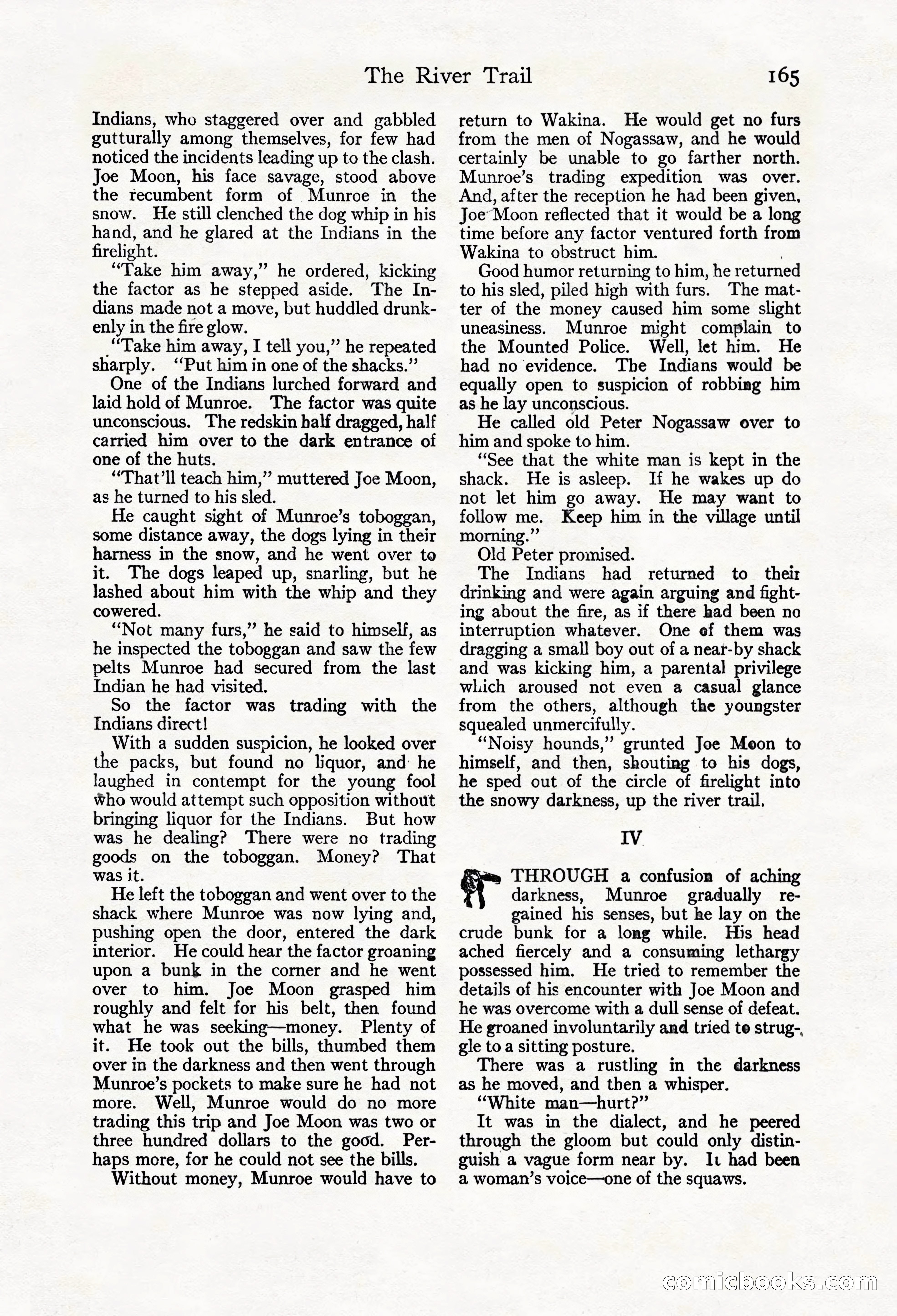
A restored page from Pulp Fiction, 1925. Page through the whole issue in the reader above.
📄 Transcribed text from this page (OCR, searchable)
Machine-transcribed from the original scan — historical spelling and the odd misread are preserved.
The River Trail Indians, who staggered over and gabbled gutturally among themselves, for few had noticed the incidents leading up to the clash. Joe Moon, his face savage, stood above the recumbent form of Munroe in the snow. He still clenched the dog whip in his hand, and he glared at the Indians in the firelight. “Take him away,” he ordered, kicking the factor as he stepped aside. The In- dians made not a move, but huddled drunk- enly in the fire glow. “Take him away, I tell you,” he repeated sharply. ‘‘Put him in one of the shacks.” One of the Indians lurched forward and laid hold of Munroe. The factor was quite unconscious. The redskin half dragged, half carried him over to the dark entrance of one of the huts. “That'll teach him,” muttered Joe Moon, as he turned to his sled. He caught sight of Munroe’s toboggan, some distance away, the dogs lying in their harness in the snow, and he went over to it. The dogs leaped up, snarling, but he lashed about him with the whip and they cowered. “Not many furs,” he said to himself, as he inspected the toboggan and saw the few pelts Munroe had secured from the last Indian he had visited. So the factor was trading with the Indians direct! With a sudden suspicion, he looked over the packs, but found no liquor, and: he laughed in contempt for the young fool Who would attempt such opposition without bringing liquor for the Indians. But how was he dealing? There were no trading goods on the toboggan. Money? That was it. He left the toboggan and went over to the shack where Munroe was now lying and, pushing open the door, entered the dark interior. He could hear the factor groaning upon a bunk in the corner and he went over to him. Joe Moon grasped him roughly and felt for his belt, then found what he was seeking—money. Plenty of it. He took out the bills, thumbed them over In the darkness and then went through Munroe’s pockets to make sure he had not more. Well, Munroe would do no more trading this trip and Joe Moon was two or three hundred dollars to the good. Per- haps more, for he could not see the bills. Without money, Munroe would have to 165 return to Wakina. He would get no furs from the men of Nogassaw, and he would certainly be unable to go farther north. Munroe’s trading expedition was over. And, after the reception he had been given, Joe’Moon reflected that it would be a long time before any factor ventured forth from Wakina to obstruct him. 7 Good humor returning to him, he returned to his sled, piled high with furs. The mat- ter of the money caused him some slight uneasiness. Munroe might complain to the Mounted Police. Well, let him. He had no evidence. The Indians would be equally open to suspicion of robbing him as he lay unconscious. He called old Peter Nogassaw over to him and spoke to him. “See that the white man is kept in the shack. He is asleep. If he wakes up do not let him go away. He may want to follow me. Keep him in the village until morning.” Old Peter promised. The Indians had returned to their drinking and were again arguing and fight- ing about the fire, as if there had been no interruption whatever. One of them was dragging a small boy out of a near-by shack and was kicking him, a parental privilege which aroused not even a casual glance from the others, although the youngster squealed unmercifully. “Noisy hounds,” grunted Joe Moon to himself, and then, shouting to his dogs, he sped out of the circle of firelight into the snowy darkness, up the river trail. IV THROUGH a confusion of aching darkness, Munroe gradually re- gained his senses, but he lay on the crude bunk for a long while. His head ached fiercely and a consuming lethargy possessed him. He tried to remember the details of his encounter with Joe Moon and he was overcome with a dull sense of defeat. He groaned involuntarily and tried te strug-, gle to a sitting posture. There was a rustling in the darkness as he moved, and then a whisper. “White man—hurt?” It was in the dialect, and he peered through the gloom but could only distin- guish a vague form near by. It had been a woman’s voice—one of the squaws. COMiICcloOO@