
Pulp Fiction, 1925 · page 181 of 212
Adventure Magazine Cover, March 20, 1925 — page 181: what you’re looking at
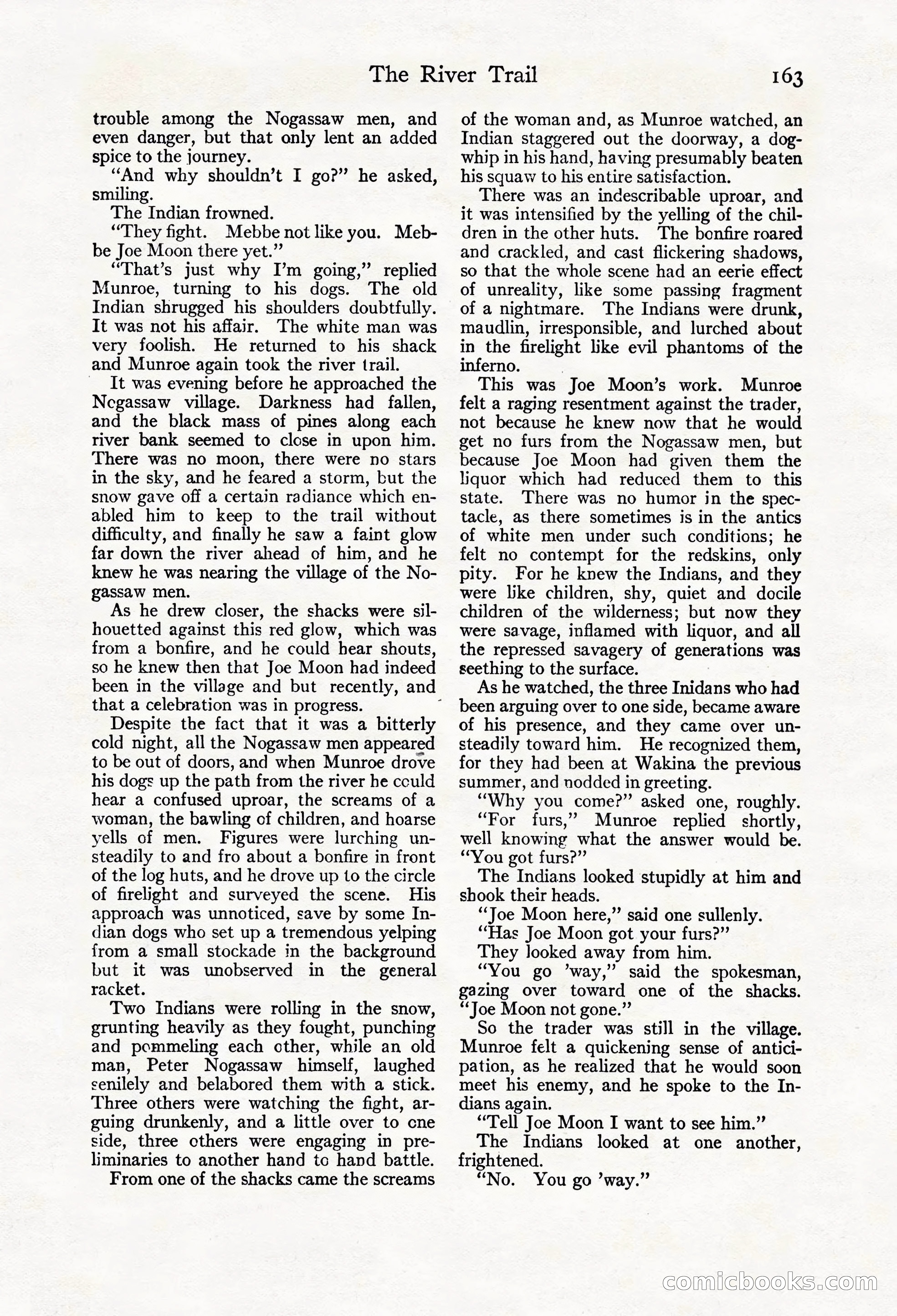
A restored page from Pulp Fiction, 1925. Page through the whole issue in the reader above.
📄 Transcribed text from this page (OCR, searchable)
Machine-transcribed from the original scan — historical spelling and the odd misread are preserved.
The River Trail trouble among the Nogassaw men, and even danger, but that only lent an added spice to the journey. “And why shouldn’t I go?” he asked, smiling. The Indian frowned. “They fight. Mebbe not like you. Meb- be Joe Moon there yet.” “That’s just why I’m going,’ replied Munroe, turning to his dogs. The old Indian shrugged his shoulders doubtfully. It was not his affair. The white man was very foolish. He returned to his shack and Munroe again took the river trail. _ It was evening before he approached the Negassaw village. Darkness had fallen, and the black mass of pines along each river bank seemed to close in upon him. There was no moon, there were no stars in the sky, and he feared a storm, but the snow gave off a certain radiance which en- abled him to keep to the trail without difficulty, and finally he saw a faint glow far down the river ahead of him, and he knew he was nearing the village of the No- gassaw men. As he drew closer, the shacks were sil- houetted against this red glow, which was from a bonfire, and he could hear shouts, so he knew then that Joe Moon had indeed been in the village and but recently, and that a celebration was in progress. Despite the fact that it was a bitterly cold night, all the Nogassaw men appeared to be out of doors, and when Munroe drove his dogs up the path from the river he cculd hear a confused uproar, the screams of a woman, the bawling of children, and hoarse yells of men. Figures were lurching un- steadily to and fro about a bonfire in front of the log huts, and he drove up to the circle of firelight and surveyed the scene. His approach was unnoticed, save by some In- dian dogs who set up a tremendous yelping from a small stockade in the background but it was unobserved in the general racket. Two Indians were rolling in the snow, grunting heavily as they fought, punching and pommeling each other, while an old man, Peter Nogassaw himself, laughed cenilely and belabored them with a stick. Three others were watching the fight, ar- guing drunkenly, and a little over to cne side, three others were engaging in pre- liminaries to another hand tc hand battle. From one of the shacks came the screams 163 of the woman and, as Munroe watched, an Indian staggered out the doorway, a dog- whip in his hand, having presumably beaten his squaw to his entire satisfaction. There was an indescribable uproar, and it was intensified by the yelling of the chil- dren in the other huts. The bonfire roared and crackled, and cast flickering shadows, so that the whole scene had an eerie effect of unreality, like some passing fragment of a nightmare. The Indians were drunk, maudlin, irresponsible, and lurched about in the firelight like evil phantoms of the inferno. : This was Joe Moon’s work. Munroe felt a raging resentment against the trader, not because he knew now that he would get no furs from the Nogassaw men, but because Joe Moon had given them the liquor which had reduced them to this state. There was no humor ijn the spec- tacle, as there sometimes is in the antics of white men under such conditions; he felt no contempt for the redskins, only pity. For he knew the Indians, and they were like children, shy, quiet and docile children of the wilderness; but now they were savage, inflamed with liquor, and all the repressed savagery of generations was seething to the surface. As he watched, the three Inidans who had been arguing over to one side, became aware of his presence, and they came over un- steadily toward him. He recognized them, for they had been at Wakina the previous summer, and nodded in greeting. “Why you come?” asked one, roughly. “For furs,’ Munroe replied shortly, well knowing what the answer would be. “You got furs?” The Indians looked stupidly at him and shook their heads. “Joe Moon here,” said one sullenly. ‘““Has Joe Moon got your furs?” They looked away from him. “You go ’way,” said the spokesman, gazing over toward one of the shacks. “Joe Moon not gone.” So the trader was still in the village. Munroe felt a quickening sense of antici- pation, as he realized that he would soon meet his enemy, and he spoke to the In- dians again. “Tell Joe Moon I want to see him.” The Indians looked at one another, frightened. “No. You go ’way.” GoOMmiGcdoo ©