
Pulp Fiction, 1925 · page 179 of 212
Adventure Magazine Cover, March 20, 1925 — page 179: what you’re looking at
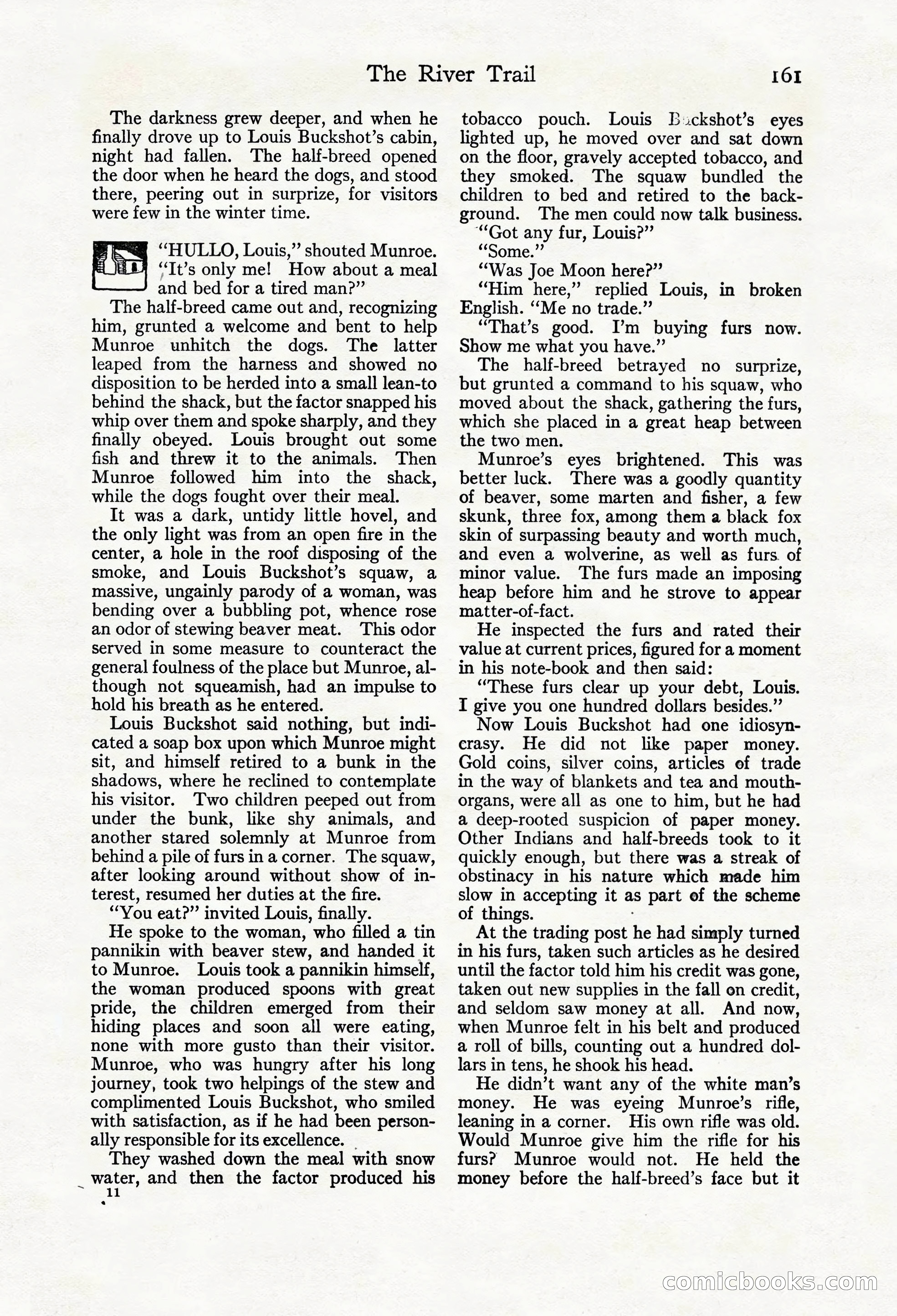
A restored page from Pulp Fiction, 1925. Page through the whole issue in the reader above.
📄 Transcribed text from this page (OCR, searchable)
Machine-transcribed from the original scan — historical spelling and the odd misread are preserved.
The River Trail The darkness grew deeper, and when he finally drove up to Louis Buckshot’s cabin, night had fallen. The half-breed opened the door when he heard the dogs, and stood there, peering out in surprize, for visitors were few in the winter time. “HULLO, Louis,” shouted Munroe. “It’s only me! How about a meal and bed for a tired man?” The half-breed came out and, recognizing him, grunted a welcome and bent to help Munroe unhitch the dogs. The latter leaped from the harness and showed no disposition to be herded into a small lean-to behind the shack, but the factor snapped his whip over them and spoke sharply, and they finally obeyed. Louis brought out some fish and threw it to the animals. Then Munroe followed him into the shack, while the dogs fought over their meal. It was a dark, untidy little hovel, and the only light was from an open fire in the center, a hole in the roof disposing of the smoke, and Louis Buckshot’s squaw, a massive, ungainly parody of a woman, was bending over a bubbling pot, whence rose an odor of stewing beaver meat. This odor served in some measure to counteract the general foulness of the place but Munroe, al- though not squeamish, had an impulse to hold his breath as he entered. Louis Buckshot said nothing, but indi- cated a soap box upon which Munroe might sit, and himself retired to a bunk in the shadows, where he reclined to contemplate his visitor. Two children peeped out from under the bunk, like shy animals, and another stared solemnly at Munroe from behind a pile of furs in a corner. The squaw, after looking around without show of in- terest, resumed her duties at the fire. “You eat?” invited Louis, finally. He spoke to the woman, who filled a tin pannikin with beaver stew, and handed it to Munroe. Louis took a pannikin himself, the woman produced spoons with great pride, the children emerged from their hiding places and soon all were eating, none with more gusto than their visitor. Munroe, who was hungry after his long journey, took two helpings of the stew and complimented Louis Buckshot, who smiled with satisfaction, as if he had been person- ally responsible for its excellence. _ They washed down the meal with snow i water, and then the factor produced his a 161 tobacco pouch. Louis Bickshot’s eyes lighted up, he moved over and sat down on the floor, gravely accepted tobacco, and they smoked. The squaw bundled the children to bed and retired to the back- ground. The men could now talk business. “Got any fur, Louis?” “Some.”’ “Was Joe Moon here?” “Him here,” replied Louis, in broken English. “Me no trade.” “That’s good. I’m buying furs now. Show me what you have.” The half-breed betrayed no _ surprize, but grunted a command to his squaw, who moved about the shack, gathering the furs, which she placed in a great heap between the two men. Munroe’s eyes brightened. This was better luck. There was a goodly quantity of beaver, some marten and fisher, a few skunk, three fox, among them a black fox skin of surpassing beauty and worth much, and even a wolverine, as well as furs. of minor value. The furs made an imposing heap before him and he strove to appear matter-of-fact. He inspected the furs and rated their value at current prices, figured for a moment in his note-book and then said: “These furs clear up your debt, Louis. I give you one hundred dollars besides.” Now Louis Buckshot had one idiosyn- crasy. He did not like paper money. Gold coins, silver coins, articles of trade in the way of blankets and tea and mouth- organs, were all as one to him, but he had a deep-rooted suspicion of paper money. Other Indians and half-breeds took to it quickly enough, but there was a streak of obstinacy in his nature which made him slow in accepting it as part of the scheme of things. ; At the trading post he had simply turned in his furs, taken such articles as he desired until the factor told him his credit was gone, taken out new supplies in the fall on credit, and seldom saw money at all. And now, when Munroe felt in his belt and produced a roll of bills, counting out a hundred dol- lars in tens, he shook his head. He didn’t want any of the white man’s money. He was eyeing Munroe’s rifle, leaning in a corner. His own rifle was old. Would Munroe give him the rifle for his furs? Munroe would not. He held the money before the half-breed’s face but it COMiIicloOoe (©