
Pulp Fiction, 1925 · page 154 of 212
Adventure Magazine Cover, March 20, 1925 — page 154: what you’re looking at
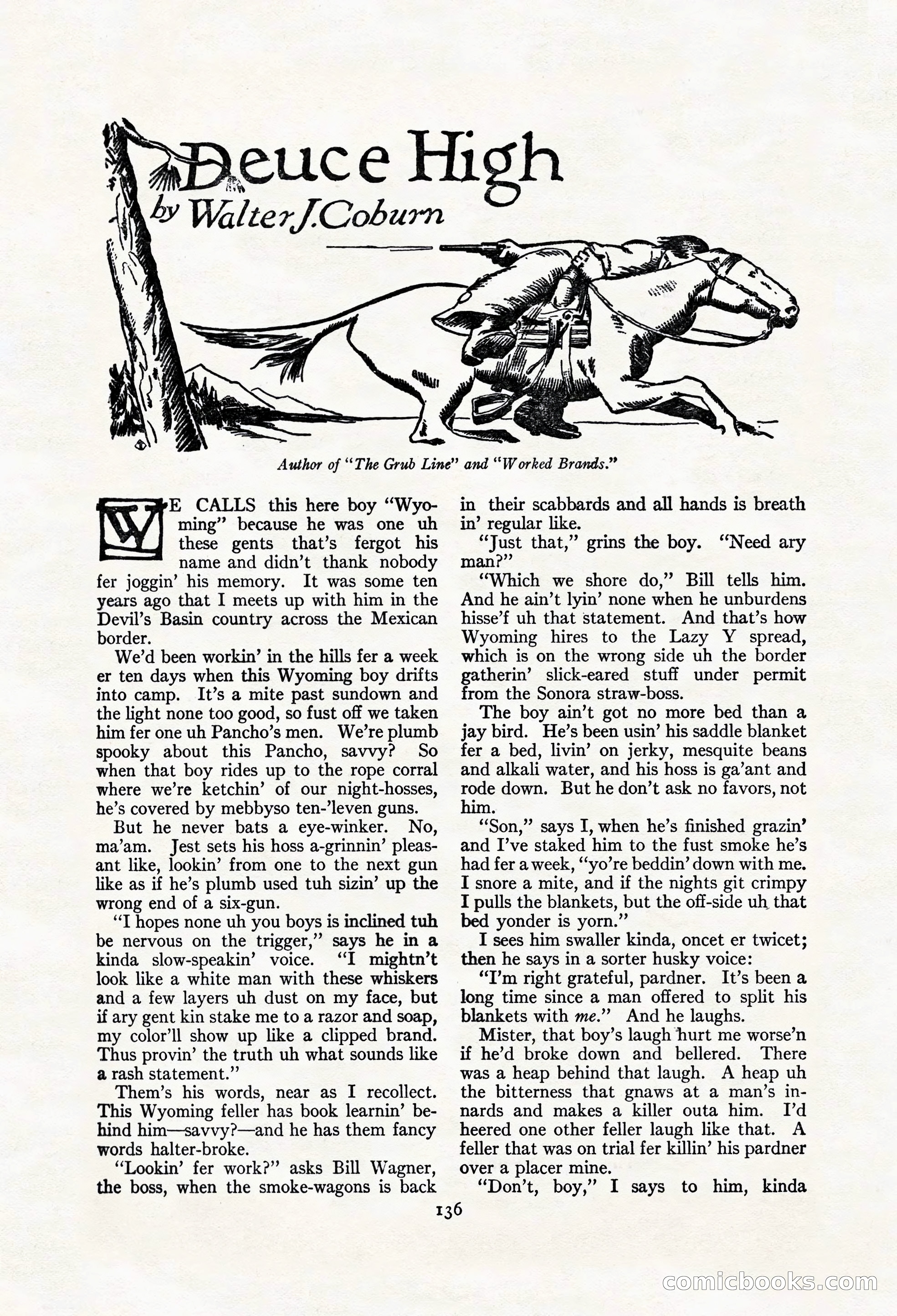
A restored page from Pulp Fiction, 1925. Page through the whole issue in the reader above.
📄 Transcribed text from this page (OCR, searchable)
Machine-transcribed from the original scan — historical spelling and the odd misread are preserved.
\e Wii rJ Coburn Peuce igh Author of ‘‘The Grub Line” and “Worked Brands.” E CALLS this here boy “Wyo- ming” because he was one uh these gents that’s fergot his name and didn’t thank nobody fer joggin’ his memory. It was some ten years ago that I meets up with him in the Devil’s Basin country across the Mexican border. We’d been workin’ in the hills fer a week er ten days when this Wyoming boy drifts into camp. It’s a mite past sundown and the light none too good, so fust off we taken him fer one uh Pancho’s men. We’re plumb spooky about this Pancho, savvy? So when that boy rides up to the rope corral where we’re ketchin’ of our night-hosses, he’s covered by mebbyso ten-’leven guns. But he never bats a eye-winker. No, ma’am. Jest sets his hoss a-grinnin’ pleas- ant like, lookin’ from one to the next gun like as if he’s plumb used tuh sizin’ up the wrong end of a six-gun. “T hopes none uh you boys is inclined tuh be nervous on the trigger,” says he in a kinda slow-speakin’ voice. ‘I mightn’t look like a white man with these whiskers and a few layers uh dust on my face, but if ary gent kin stake me to a razor and soap, my color’ll show up like a clipped brand. Thus provin’ the truth uh what sounds like a rash statement.”’ Them’s his words, near as I recollect. This Wyoming feller has book learnin’ be- hind him—savvy?—and he has them fancy words halter-broke. “Lookin’ fer work?” asks Bill Wagner, the boss, when the smoke-wagons is back in their scabbards and all hands is breath in’ regular like. “Need ary “Just that,” grins the boy. man?” ‘Which we shore do,” Bill tells him. And he ain’t lyin’ none when he unburdens hisse’f uh that statement. And that’s how Wyoming hires to the Lazy Y spread, which is on the wrong side uh the border gatherin’ slick-eared stuff under permit from the Sonora straw-boss. The boy ain’t got no more bed than a jay bird. He’s been usin’ his saddle blanket fer a bed, livin’ on jerky, mesquite beans and alkali water, and his hoss is ga’ant and rode down. But he don’t ask no favors, not him. “Son,” says I, when he’s finished grazin’ and I’ve staked him to the fust smoke he’s had fer a week, ‘“‘yo’re beddin’ down with me. I snore a mite, and if the nights git crimpy I pulls the blankets, but the off-side uh that bed yonder is yorn.”’ I sees him swaller kinda, oncet er twicet; then he says in a sorter husky voice: “I’m right grateful, pardner. It’s been a long time since a man offered to split his blankets with me.” And he laughs. Mister, that boy’s laugh hurt me worse’n if he’d broke down and bellered. There was a heap behind that laugh. A heap uh the bitterness that gnaws at a man’s in- nards and makes a killer outa him. I'd heered one other feller laugh like that. A feller that was on trial fer killin’ his pardner over a placer mine. “Don’t, boy,” I says to him, kinda 136 MICLOOO (©