
Pulp Fiction, 1925 · page 149 of 212
Adventure Magazine Cover, March 20, 1925 — page 149: what you’re looking at
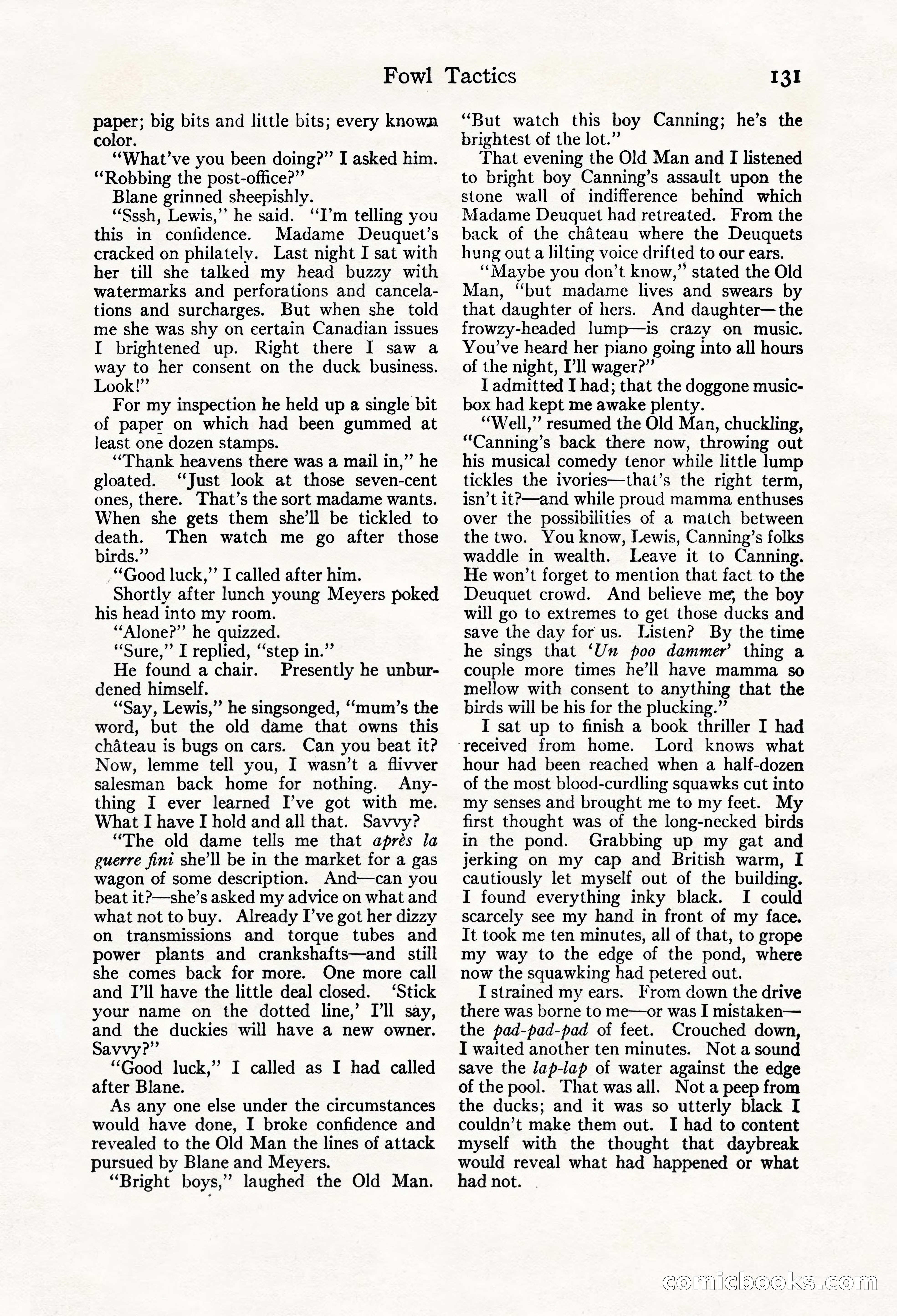
A restored page from Pulp Fiction, 1925. Page through the whole issue in the reader above.
📄 Transcribed text from this page (OCR, searchable)
Machine-transcribed from the original scan — historical spelling and the odd misread are preserved.
Fowl Tactics paper; big bits and little bits; every known color. ‘“‘What’ve you been doing?” I asked him. “Robbing the post-office?”’ Blane grinned sheepishly. “Sssh, Lewis,”’ he said. ‘I’m telling you this in confidence. Madame Deuquet’s cracked on philately. Last night I sat with her till she talked my head buzzy with watermarks and perforations and cancela- tions and surcharges. But when she told me she was shy on eertain Canadian issues I brightened up. Right there I saw a way to her consent on the duck business. Look!” For my inspection he held up a single bit of paper on which had been gummed at least one dozen stamps. ‘“‘Thank heavens there was a mail in,”’ he gloated. “Just look at those seven-cent ones, there. That’s the sort madame wants. When she gets them she’ll be tickled to death. Then watch me go after those birds.” ‘Good luck,” I called after him. Shortly after lunch young Meyers poked his head into my room. ‘“‘Alone?”’ he quizzed. “Sure,” I replied, ‘‘step in.” He found a chair. Presently he unbur- dened himself. “Say, Lewis,” he singsonged, “‘mum’s the word, but the old dame that owns this chateau is bugs on cars. Can you beat it? Now, lemme tell you, I wasn’t a flivver salesman back home for nothing. Any- thing I ever learned I’ve got with me. What I have I hold and all that. Savvy? “The old dame tells me that aprés la guerre fini she’ll be in the market for a gas wagon of some description. And—can you beat it?-—she’s asked my advice on what and what not tobuy. Already I’ve got her dizzy on transmissions and torque tubes and power plants and crankshafts—and still she comes back for more. One more call and J’ll have the little deal closed. ‘Stick your name on the dotted line,’ I'll say, and the duckies will have a new owner. Savvy?” “Good luck,’ I called as I had called after Blane. As any one else under the circumstances would have done, I broke confidence and revealed to the Old Man the lines of attack pursued by Blane and Meyers. “Bright boys,’ laughed the Old Man. 131 “But watch this boy Canning; he’s the brightest of the lot.” That evening the Old Man and I listened to bright boy Canning’s assault upon the stone wall of indifference behind which Madame Deuquet had retreated. From the back of the chateau where the Deuquets hung out a lilting voice drifted to our ears. ‘Maybe you don’t know,” stated the Old Man, “but madame lives and swears by that daughter of hers. And daughter—the frowzy-headed lump—is crazy on music. You’ve heard her piano going into all hours of the night, I’ll wager?” I admitted I had; that the doggone music- box had kept me awake plenty. ‘Well,’ resumed the Old Man, chuckling, “Canning’s back there now, throwing out his musical comedy tenor while little lump tickles the ivories—that’s the right term, isn’t it?—and while proud mamma enthuses over the possibilities of a match between the two. You know, Lewis, Canning’s folks waddle in wealth. Leave it to Canning. He won’t forget to mention that fact to the Deuquet crowd. And believe me, the boy will go to extremes to get those ducks and save the day for us. Listen? By the time he sings that ‘Un poo dammer’ thing a couple more times he’ll have mamma so mellow with consent to anything that the birds will be his for the plucking.” I sat up to finish a book thriller I had ‘received from home. Lord knows what hour had been reached when a half-dozen of the most blood-curdling squawks cut into my senses and brought me to my feet. My first thought was of the long-necked birds in the pond. Grabbing up my gat and jerking on my cap and British warm, I cautiously let myself out of the building. I found everything inky black. I could scarcely see my hand in front of my face. It took me ten minutes, all of that, to grope my way to the edge of the pond, where now the squawking had petered out. I strained my ears. From down the drive there was borne to me—or was I mistaken— the pad-pad-pad of feet. Crouched down, I waited another ten minutes. Not a sound save the lap-lap of water against the edge of the pool. That was all. Nota peep from the ducks; and it was so utterly black I couldn’t make them out. I had to content myself with the thought that daybreak would reveal what had happened or what had not. COMmiiclooe