
Pulp Fiction, 1925 · page 141 of 212
Adventure Magazine Cover, March 20, 1925 — page 141: what you’re looking at
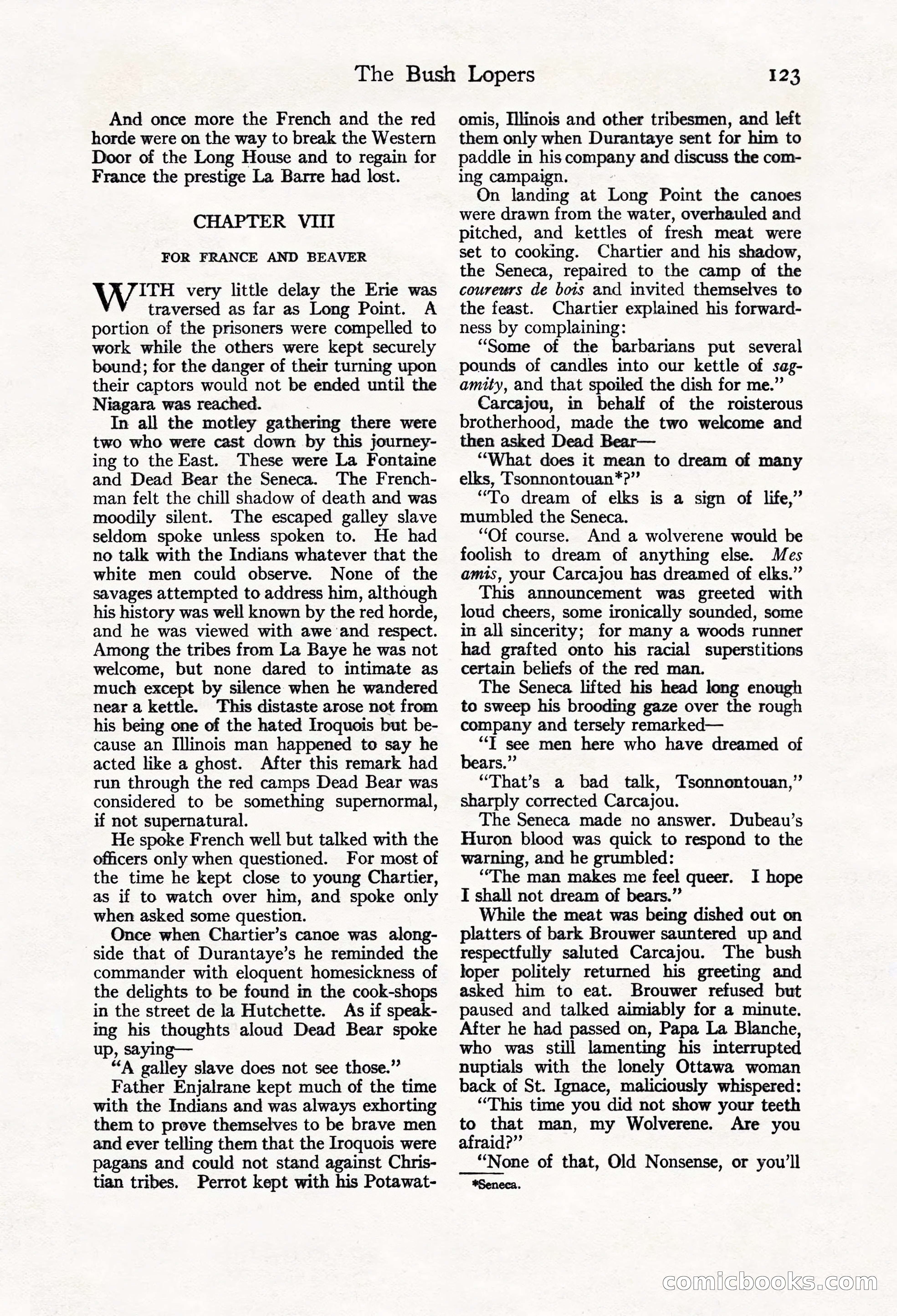
A restored page from Pulp Fiction, 1925. Page through the whole issue in the reader above.
📄 Transcribed text from this page (OCR, searchable)
Machine-transcribed from the original scan — historical spelling and the odd misread are preserved.
The Bush Lopers And once more the French and the red horde were on the way to break the Western Door of the Long House and to regain for France the prestige La Barre had lost. CHAPTER VIII FOR FRANCE AND BEAVER ITH very little delay the Erie was traversed as far as Long Point. A portion of the prisoners were compelled to work while the others were kept securely bound; for the danger of their turning upon their captors would not be ended until the Niagara was reached. In all the motley gathering there were two who were cast down by this journey- ing to the East. These were La Fontaine and Dead Bear the Seneca. The French- man felt the chill shadow of death and was moodily silent. The escaped galley slave seldom spoke unless spoken to. He had no talk with the Indians whatever that the white men could observe. None of the savages attempted to address him, although his history was well known by the red horde, and he was viewed with awe ‘and respect. Among the tribes from La Baye he was not welcome, but none dared to intimate as much except by silence when he wandered near a kettle. ‘This distaste arose not from his being one of the hated Iroquois but be- cause an Illinois man happened to say he acted like a ghost. After this remark had run through the red camps Dead Bear was considered to be something supernormal, if not supernatural. He spoke French well but talked with the officers only when questioned. For most of the time he kept close to young Chartier, as if to watch over him, and spoke only when asked some question. Once when Chartier’s canoe was along- side that of Durantaye’s he reminded the commander with eloquent homesickness of the delights to be found in the cook-shops in the street de la Hutchette. As if speak- ing his thoughts aloud Dead Bear spoke up, saying— “A galley slave does not see those.” Father Enjalrane kept much of the time with the Indians and was always exhorting them to prove themselves to be brave men and ever telling them that the Iroquois were pagans and could not stand against Chris- tian tribes. Perrot kept with his Potawat- 123 omis, Ilinois and other tribesmen, and left them only when Durantaye sent for him to paddle in his company and discuss the com- ing campaign. On landing at Long Point the canoes were drawn from the water, overhauled and pitched, and kettles of fresh meat were set to cooking. Chartier and his shadow, the Seneca, repaired to the camp of the coureurs de bois and invited themselves to the feast. Chartier explained his forward- ness by complaining: “Some of the barbarians put several pounds of candles into our kettle of sag- amity, and that spoiled the dish for me.” Carcajou, in behalf of the roisterous brotherhood, made the two welcome and then asked Dead Bear— ‘“‘What does it mean to dream of many elks, Tsonnontouan*?”’ “To dream of elks is a sign of life,” mumbled the Seneca. “Of course. And a wolverene would be foolish to dream of anything else. Mes amis, your Carcajou has dreamed of elks.” This announcement was greeted with loud cheers, some ironically sounded, some in all sincerity; for many a woods runner had grafted onto his racial superstitions certain beliefs of the red man. The Seneca lifted his head long enough to sweep his brooding gaze over the rough company and tersely remarked— “‘T see men here who have dreamed of bears.” “That’s a bad talk, Tsonnontouan,” sharply corrected Carcajou. The Seneca made no answer. Dubeau’s Huron blood was quick to respond to the warning, and he grumbled: ‘‘The man makes me feel queer. I hope I shall not dream of bears.” While the meat was being dished out on platters of bark Brouwer sauntered up and respectfully saluted Carcajou. The bush loper politely returned his greeting and asked him to eat. Brouwer refused but paused and talked aimiably for a minute. After he had passed on, Papa La Blanche, who was still lamenting his interrupted nuptials with the lonely Ottawa woman back of St. Ignace, maliciously whispered: “This time you did not show your teeth to that man, my Wolverene. Are you afraid?” “None of that, Old Nonsense, or you'll *Seneca. GoOmiGcdoo (©