
Pulp Fiction, 1925 · page 130 of 212
Adventure Magazine Cover, March 20, 1925 — page 130: what you’re looking at
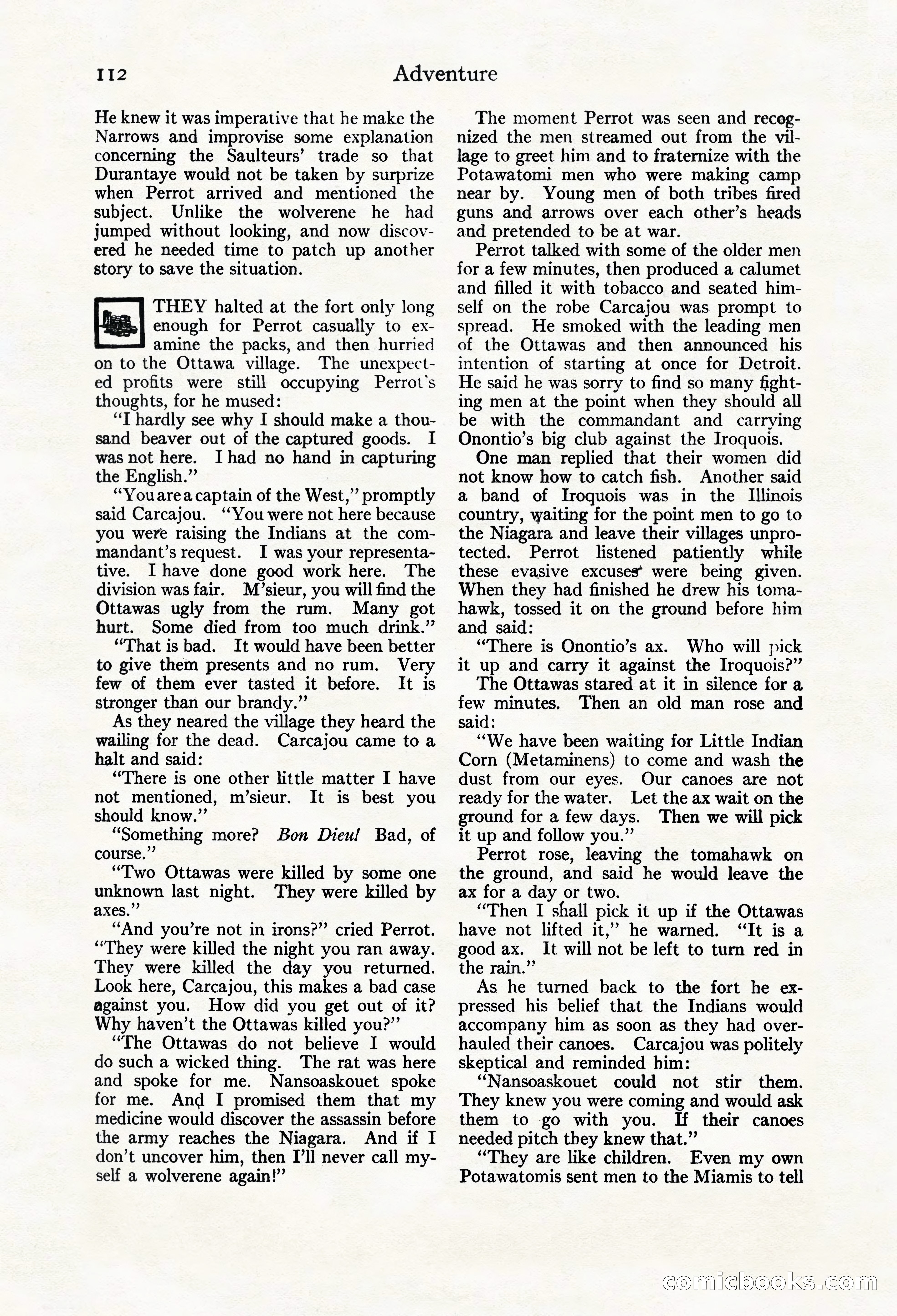
A restored page from Pulp Fiction, 1925. Page through the whole issue in the reader above.
📄 Transcribed text from this page (OCR, searchable)
Machine-transcribed from the original scan — historical spelling and the odd misread are preserved.
112 He knew it was imperative that he make the Narrows and improvise some explanation concerning the Saulteurs’ trade so that Durantaye would not be taken by surprize when Perrot arrived and mentioned the subject. Unlike the wolverene he had jumped without looking, and now discov- ered he needed time to patch up another story to save the situation. THEY halted at the fort only long enough for Perrot casually to ex- amine the packs, and then hurried on to the Ottawa village. The unexpect- ed profits were still occupying Perrot’s thoughts, for he mused: “IT hardly see why I should make a thou- sand beaver out of the captured goods. I was not here. I had no hand in capturing the English.” . “VYouareacaptain of the West,” promptly said Carcajou. ‘You were not here because you were raising the Indians at the com- mandant’s request. I was your representa- tive. I have done good work here. The division was fair. M’sieur, you will find the Ottawas ugly from the rum. Many got hurt. Some died from too much drink.” “‘That is bad. It would have been better to give them presents and no rum. Very few of them ever tasted it before. It is stronger than our brandy.” As they neared the village they heard the wailing for the dead. Carcajou came to a halt and said: “There is one other little matter I have not mentioned, m’sieur. It is best you should know.” “Something more? course.” “Two Ottawas were killed by some one unknown last night. They were killed by axes.” ‘And you’re not in irons?” cried Perrot. ‘They were killed the night you ran away. They were killed the day you returned. Look here, Carcajou, this makes a bad case against you. How did you get out of it? Why haven’t the Ottawas killed you?” “The Ottawas do not believe I would do such a wicked thing. The rat was here and spoke for me. Nansoaskouet spoke for me. And I promised them that my medicine would discover the assassin before the army reaches the Niagara. And if I don’t uncover him, then I’]] never call my- self a wolverene again!’ Bon Dieu! Bad, of Adventure The moment Perrot was seen and recog- nized the men streamed out from the vil- lage to greet him and to fraternize with the Potawatomi men who were making camp near by. Young men of both tribes fired guns and arrows over each other’s heads and pretended to be at war. Perrot talked with some of the older men for a few minutes, then produced a calumet and filled it with tobacco and seated him- self on the robe Carcajou was prompt to spread. He smoked with the leading men of the Ottawas and then announced his intention of starting at once for Detroit. He said he was sorry to find so many fight- ing men at the point when they should all be with the commandant and carrving Onontio’s big club against the Iroquois. One man replied that their women did not know how to catch fish. Another said a band of Iroquois was in the Illinois country, waiting for the point men to go to the Niagara and leave their villages unpro- tected. Perrot listened patiently while these evasive excuses’ were being given. When they had finished he drew his toma- hawk, tossed it on the ground before him and said: ‘“‘There is Onontio’s ax. Who will pick it up and carry it against the Iroquois?” The Ottawas stared at it in silence for a few minutes. Then an old man rose and said: ‘“‘We have been waiting for Little Indian Corn (Metaminens) to come and wash the dust from our eyes. Our canoes are not ready for the water. Let the ax wait on the ground for a few days. Then we will pick it up and follow you.” Perrot rose, leaving the tomahawk on the ground, and said he would leave the ax for a day or two. “Then I shall pick it up if the Ottawas have not lifted it,” he warned. “It is a good ax. It will not be left to tur red in the rain.”’ As he turned back to the fort he ex- pressed his belief that the Indians would accompany him as soon as they had over- hauled their canoes. Carcajou was politely skeptical and reminded him: ‘“‘Nansoaskouet could not stir them. They knew you were coming and would ask them to go with you. If their canoes needed pitch they knew that.” “They are like children. Even my own Potawatomis sent men to the Miamis to tell COMiICcloOO@ ©