
Pulp Fiction, 1925 · page 127 of 212
Adventure Magazine Cover, March 20, 1925 — page 127: what you’re looking at
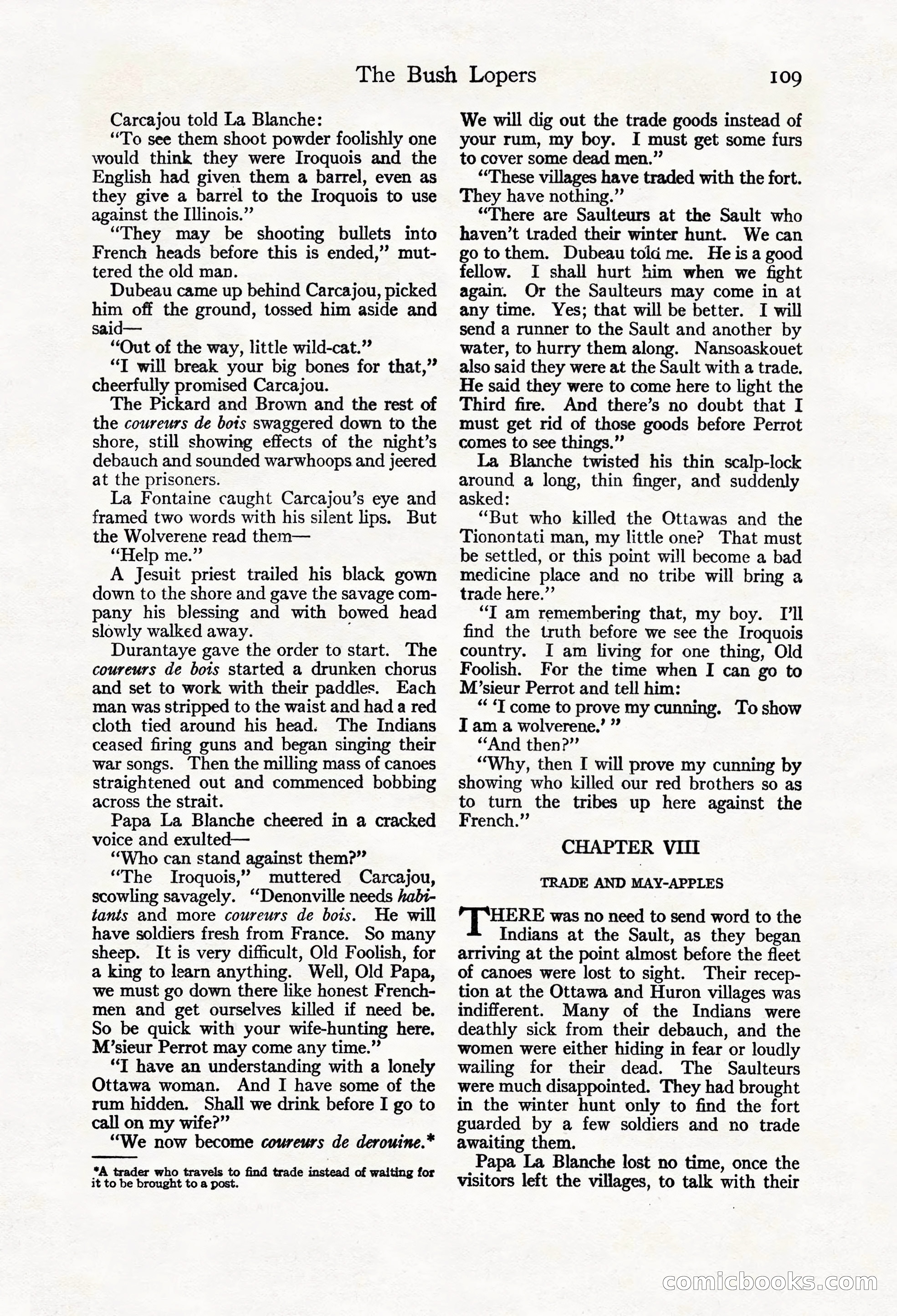
A restored page from Pulp Fiction, 1925. Page through the whole issue in the reader above.
📄 Transcribed text from this page (OCR, searchable)
Machine-transcribed from the original scan — historical spelling and the odd misread are preserved.
The Bush Lopers Carcajou told La Blanche: ‘“‘To see them shoot powder foolishly one would think they were Iroquois and the English had given them a barrel, even as they give a barrel to the Iroquois to use against the Illinois.” “They may be shooting bullets into French heads before this is ended,” mut- tered the old man. Dubeau came up behind Carcajou, picked him off the ground, tossed him aside and said— “Out of the way, little wild-cat.” “T will break your big bones for that,” cheerfully promised Carcajou. The Pickard and Brown and the rest of the coureurs de bots swaggered down to the shore, still showing effects of the night’s debauch and sounded warwhoops and jeered at the prisoners. La Fontaine caught Carcajou’s eye and framed two words with his silent lips. But the Wolverene read them— “‘Help me.” A Jesuit priest trailed his black gown down to the shore and gave the savage com- pany his blessing and with bowed head slowly walked away. Durantaye gave the order to start. The coureurs de bois started a drunken chorus and set to work with their paddles. Each man was stripped to the waist and had a red cloth tied around his head. The Indians ceased firing guns and began singing their war songs. Then the milling mass of canoes straightened out and commenced bobbing across the strait. Papa La Blanche cheered in a cracked voice and exulted— “Who can stand against them?” “The Iroquois,” muttered Carcajou, scowling savagely. ‘‘Denonville needs habi- tants and more coureurs de bois. He will have soldiers fresh from France. So man sheep. It is very difficult, Old Foolish, for a king to learn anything. Well, Old Papa, we must go down there like honest French- men and get ourselves killed if need be. So be quick with your wife-hunting here. M’sieur Perrot may come any time.” “T have an understanding with a lonely Ottawa woman. And I have some of the rum hidden. Shall we drink before I go to call on my wife?” “We now become coureurs de derouine.* “A trader who travels to find trade instead of waiting for it to be brought to a post. 109 We will dig out the trade goods instead of your rum, my boy. I must get some furs to cover some dead men.” “These villages have traded with the fort. They have nothing.” “There are Saulteurs at the Sault who haven’t traded their winter hunt. We can go tothem. Dubeau told me. He is a good fellow. I shall hurt him when we fight again. Or the Saulteurs may come in at any time. Yes; that will be better. I will send a runner to the Sault and another by water, to hurry them along. Nansoaskouet also said they were at the Sault with a trade. He said they were to come here to light the Third fire. And there’s no doubt that I must get rid of those goods before Perrot comes to see things.” La Blanche twisted his thin scalp-lock around a long, thin finger, and suddenly asked: “But who killed the Ottawas and the Tionontati man, my little one? That must be settled, or this point will become a bad medicine place and no tribe will bring a trade here.”’ “T am remembering that, my boy. IT’ll find the truth before we see the Iroquois country. I am living for one thing, Old Foolish. For the time when I can go to M’sieur Perrot and tell him: “ ‘T come to prove my cunning. To show I am a wolverene.’ ”’ ‘And then?” “Why, then I will prove my cunning by showing who killed our red brothers so as to turn the tribes up here against the French.” CHAPTER VIII TRADE AND MAY-APPLES HERE was no need to send word to the Indians at the Sault, as they began arriving at the point almost before the fleet of canoes were lost to sight. Their recep- tion at the Ottawa and Huron villages was indifferent. Many of the Indians were deathly sick from their debauch, and the women were either hiding in fear or loudly wailing for their dead. The Saulteurs were much disappointed. They had brought in the winter hunt only to find the fort guarded by a few soldiers and no trade awaiting them. Papa La Blanche lost no time, once the visitors left the villages, to talk with their CORnNIECLO© (©