
Pulp Fiction, 1925 · page 113 of 212
Adventure Magazine Cover, March 20, 1925 — page 113: what you’re looking at
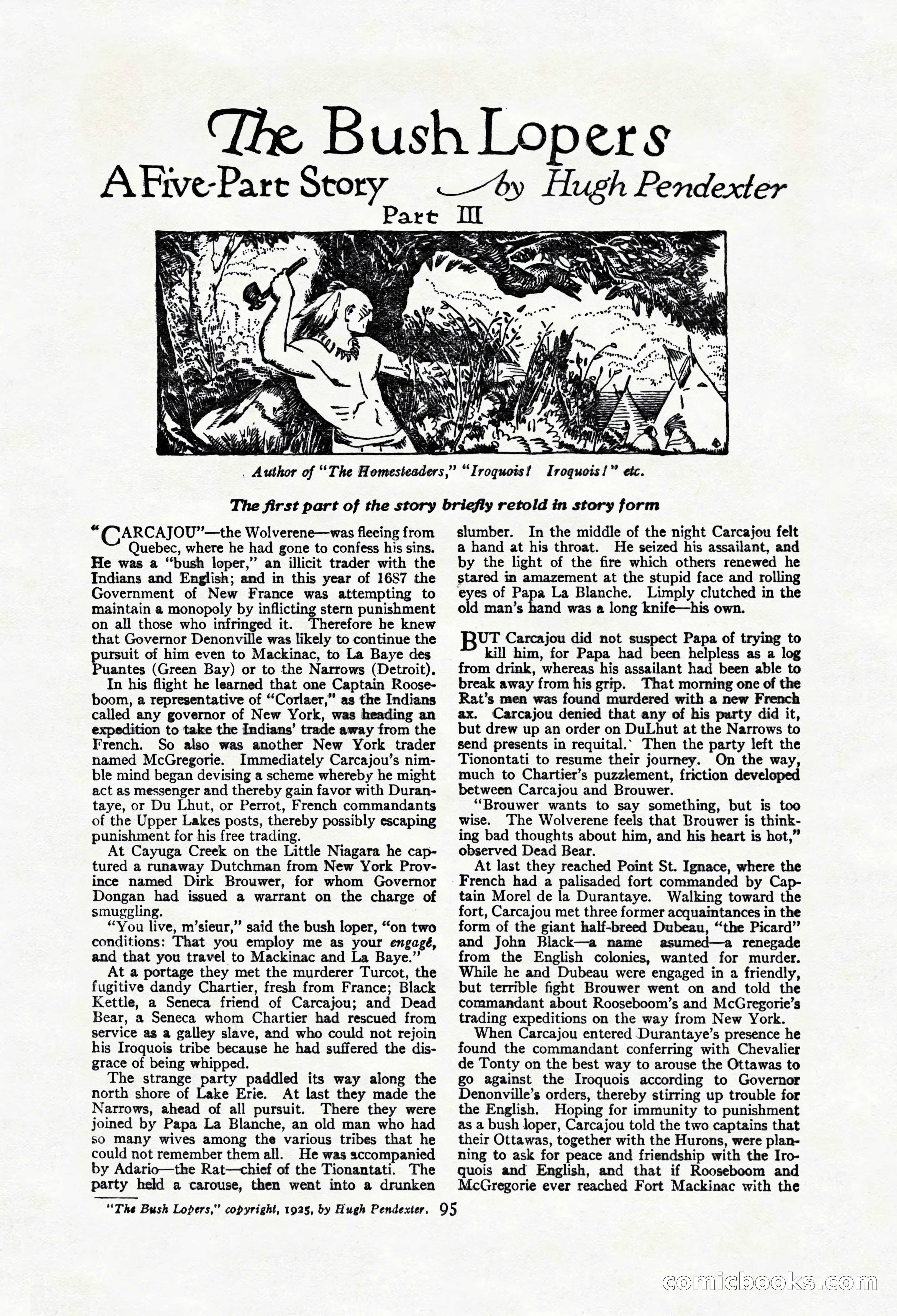
A restored page from Pulp Fiction, 1925. Page through the whole issue in the reader above.
📄 Transcribed text from this page (OCR, searchable)
Machine-transcribed from the original scan — historical spelling and the odd misread are preserved.
The Bush Lopers A Five-Pare Story by Hush Pendexter Part Ii . Author of “The Homesteaders,” “Iroquois! Iroquois!” etc. The first part of the story briefly retold in story form = CARCAJOU”—the Wolverene—was fleeing from Quebec, where he had gone to confess his sins. He was a “bush loper,” an illicit trader with the Indians and English; and in this year of 1687 the Government of New France was attempting to maintain a monopoly by inflicting stern punishment on all those who infringed it. Therefore he knew that Governor Denonville was likely to continue the pursuit of him even to Mackinac, to La Baye des Puantes (Green Bay) or to the Narrows (Detroit). In his flight he learned that one Captain Roose- boom, a representative of “Corlaer,” as the Indians called any governor of New York, was heading an expedition to take the Indians’ trade away from the French. So also was another New York trader named McGregorie. Immediately Carcajou’s nim- ble mind began devising a scheme whereby he might act as messenger and thereby gain favor with Duran- taye, or Du Lhut, or Perrot, French commandants of the Upper Lakes posts, thereby possibly escaping punishment for his free trading. At Cayuga Creek on the Little Niagara he cap- tured a runaway Dutchman from New York Prov- ince named Dirk Brouwer, for whom Governor Dongan had issued a warrant on the charge of smuggling. “You live, m’sieur,”’ said the bush loper, “on two conditions: That you employ me as your engagé, and that you travel to Mackinac and La Baye.” At a portage they met the murderer Turcot, the fugitive dandy Chartier, fresh from France; Black Kettle, a Seneca friend of Carcajou; and Dead Bear, a Seneca whom Chartier had rescued from service as a galley slave, and who could not rejoin his Iroquois tribe because he had suffered the dis- grace of being whipped. The strange party paddled its way along the north shore of Lake Erie. At last they made the Narrows, ahead of all pursuit. There they were joined by Papa La Blanche, an old man who had so many wives among the various tribes that he could not remember them all. He was accompanied by Adario—the Rat—chief of the Tionantati. The party held a carouse, then went into a drunken “The Bush Lopers,"’ copyright, 1925, by Hugh Pendexter, 95 slumber. In the middle of the night Carcajou felt a hand at his throat. He seized his assailant, and by the light of the fire which others renewed he stared in amazement at the stupid face and rolling eyes of Papa La Blanche. Limply clutched in the old man’s hand was a long knife—his own. But Carcajou did not suspect Papa of trying to kill him, for Papa had been helpless as a log from drink, whereas his assailant had been able to break away from his grip. That morning one of the Rat’s men was found murd with a new French ax. Carcajou denied that any of his purty did it, but drew up an order on DuLhut at the Narrows to send presents in requital.. Then the party left the Tionontati to resume their journey. On the way, much to Chartier’s puzzlement, friction developed between Carcajou and Brouwer. “Brouwer wants to say something, but is too wise. The Wolverene feels that Brouwer is think- ing bad thoughts about him, and his heart is hot,” observed Dead Bear. At last they reached Point St. Ignace, where the French had a palisaded fort commanded by Cap- tain Morel de la Durantaye. Walking toward the fort, Carcajou met three former acquaintances in the form of the giant half-breed Dubeau, “the Picard’”’ and John Black—a name asumed—a renegade from the English colonies, wanted for murder. While he and Dubeau were engaged in a friendly, but terrible fight Brouwer went on and told the commandant about Rooseboom’s and McGregorie’s trading expeditions on the way from New York. When Carcajou entered Durantaye’s presence he found the commandant conferring with Chevalier de Tonty on the best way to arouse the Ottawas to go against the Iroquois according to Governor Denonville’s orders, thereby stirring up trouble for the English. Hoping for immunity to punishment as a bush loper, Carcajou told the two captains that their Ottawas, together with the Hurons, were plan- ning to ask for peace and friendship with the Iro- quois and English, and that if Rooseboom and McGregorie ever reached Fort Mackinac with the OO CO